
10 Aug 2026 · Design & Build
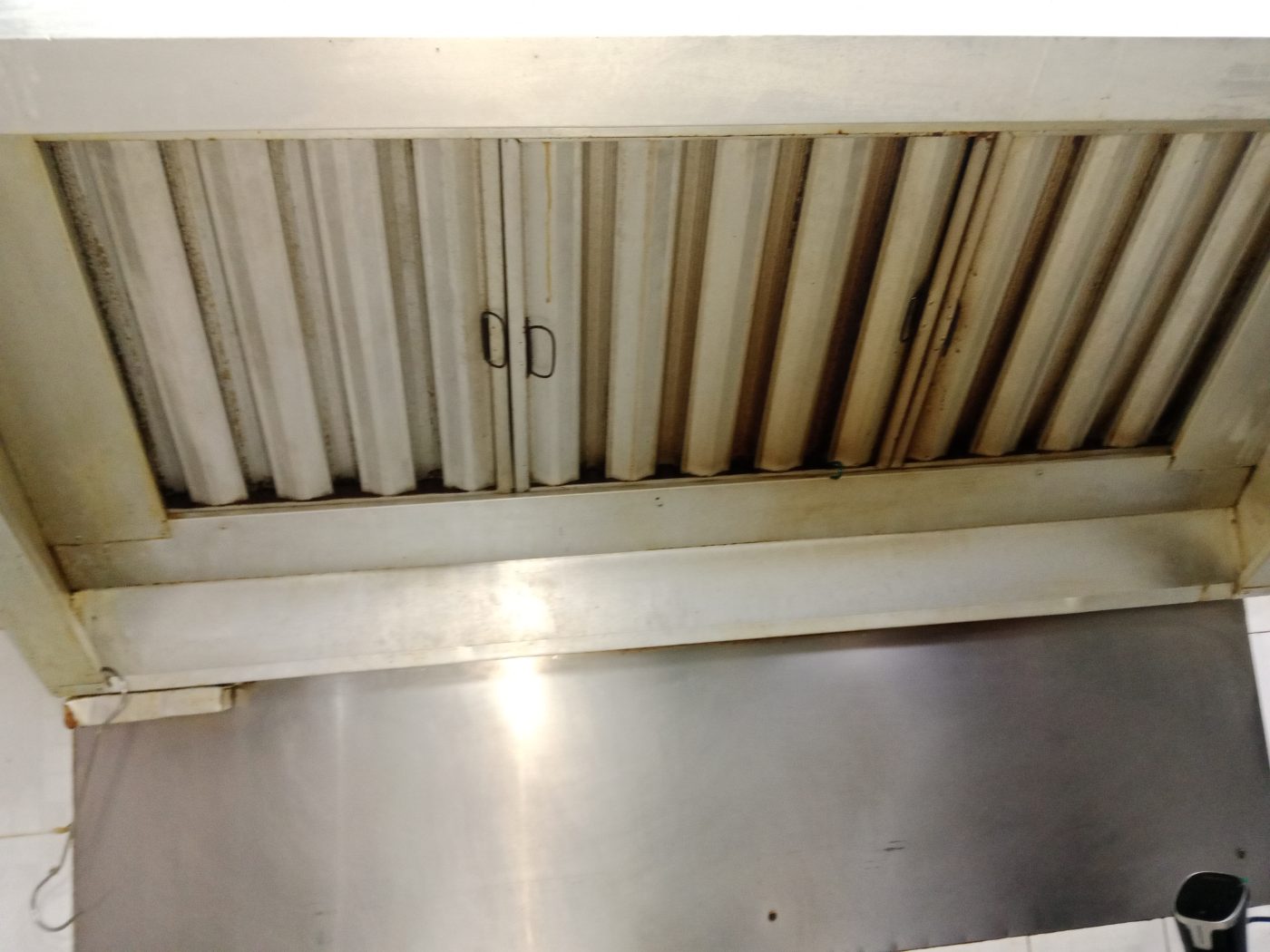
Before signing for an existing F&B unit, check six things about the kitchen exhaust: whether the hood was sized for your cooking line rather than the previous operator's, the grease depth behind the filters, where the duct discharges and whether it has access panels, where the make-up air enters, the cleaning and approval records, and whether the fire suppression coverage still matches the equipment layout you plan.
Taking over an existing F&B unit is attractive for one obvious reason: the kitchen is already there. The hood is up, the duct is run, the fan is on the roof, and the previous operator was trading. What is easy to miss is that you are also taking over whatever condition that system is in, and whatever the authorities think of it. We are called into these units regularly — usually a few weeks after the lease was signed, when the new operator has discovered the system does not do what they assumed.
This is what to look at before you sign, in the order we would look at it.
This is the first question and the one that decides the most money. A ventilation system is designed around the cooking line beneath it — the equipment, its intensity, and the grease it throws off. A hood sized for a bakery or a sandwich counter is not a hood for a wok range, no matter how new it looks.
So go with your own equipment schedule in hand and compare it to what was there. If the previous operator ran a cafe and you are opening a zi char, assume the system needs redesigning rather than reusing. If your line is lighter than theirs, you are usually fine, and you may even be over-provisioned.
The equipment is what matters, not the floor area. We set out how cooking type drives the whole design in designing a compliant commercial kitchen ventilation system.
You do not need to be a specialist to learn a great deal in sixty seconds. Lift out a baffle filter and look at the plenum behind it, then look up into the duct collar if you can see it.
What you are looking for:
A dirty hood is cleanable. What it really tells you is how likely the ductwork behind it is to be heavily loaded — and duct cleaning, not hood cleaning, is the part that costs.
The duct is where the risk lives, and it is the part nobody inspects before signing.
Every cubic metre you exhaust has to come back in. If nobody can tell you where the make-up air enters, the answer is usually "around the doors" — which means the kitchen sits in negative pressure, the hood loses capture efficiency, and the kitchen is hot and smoky even with the fan running.
This is the single most commonly skimped part of an existing system, and it is also the one most often blamed on the fan. Replacing a fan on a system with no make-up air makes noise, not airflow.
Ask the outgoing operator, the agent and the landlord for:
Missing paperwork is not automatically a deal-breaker. It is a price negotiation — and it tells you to survey rather than assume.
Fire suppression is designed around specific appliances in specific positions. Move a fryer, add a wok burner or change the line and the coverage may no longer match. If you are changing the cooking line at all, the suppression arrangement has to be looked at with it, not after the kitchen is built. Our scope on that is on the fire suppression systems page.
A survey before signing costs a fraction of what discovering the problem afterwards costs, and it changes your negotiating position while you still have one. We look at the hood against your intended cooking line, open the duct at the access points, check the discharge and the make-up air arrangement, and tell you plainly which of three situations you are in:
We will tell you when it is the first one. Design and installation work is quoted after that survey — there is no price list, because there is no standard kitchen. Full scope is on kitchen exhaust design and build, and if the answer is a deep clean, that is on kitchen exhaust cleaning.
Tell us where the unit is, what you intend to cook, and when you need to open. We will arrange a survey and give you a straight answer on what you are inheriting — and if something goes wrong once you are trading, our 24/7 standby team is available.
WhatsApp BC Air 8989 2833 for a pre-lease survey →
Related reading: signs a hood is overdue a deep clean · what NEA expects · what SCDF looks for · neighbour odour complaints and how they are fixed · servicing a kitchen that never closes
Related: if the unit is in a shopping centre, the constraints come from the landlord rather than the cooking line — see kitchen exhaust in a mall F&B unit: shared risers and landlord rules.
At the other end of the lease, what reinstatement asks of a kitchen exhaust system covers strip-out versus hand-over and how the original condition record decides the bill.
Also worth reading: the ventilation timeline for a new F&B outlet — the order a fit-out should run in so the extract does not delay the opening.
And if the unit is a conservation shophouse, the route itself is the first question rather than the last - where the ductwork can actually go.
If you are building rather than inheriting, the equivalent question is one of responsibility: who owns the kitchen exhaust scope in an F&B fit-out.
Related: Cloud kitchens and shared kitchen facilities — what to establish before taking a bay someone else used.
We design, clean, repair and maintain commercial kitchen exhaust systems across Singapore — on 24/7 standby.