
24/7 Standby · Always At Your Service 💬 WhatsApp +65 8989 2833

Kitchen Exhaust Reinstatement at End of Lease in Singapore: What Landlords Ask For

23 Aug 2026 · Operations & Cost
Kitchen Exhaust Reinstatement at End of Lease in Singapore: What Landlords Ask For
A kitchen exhaust reinstatement clause can require one of three things: stripping out the hood, ductwork and fan and making good to a defined base condition; handing the system over in working order and cleaned to a stated standard; or removing your equipment while leaving fixed ductwork and the riser connection in place. Which one applies decides the cost, and operators frequently assume the second when the lease requires the first. The boundary between tenant and landlord equipment is settled by the condition record made at the original handover, so photographs and a written schedule from the day you took the unit are what shorten the dispute.

Most F&B operators think carefully about the kitchen exhaust when they take a unit over. Very few think about it when they leave, and that is the end where the surprise bill lives.

Reinstatement is the clause that says what condition you hand the unit back in. For a kitchen, it is rarely as simple as removing your equipment and sweeping up — and the cost of getting it wrong is taken straight out of a deposit you were counting on.

Read the clause before you read the quote

Reinstatement clauses in Singapore F&B leases vary a great deal, and they are the starting point for everything else. What you are looking for is which of three things it asks you to do:

  • Strip out and make good — remove the hood, ductwork, fan and services you installed, and return the space to bare shell or to a defined base condition.
  • Hand over in working order — leave the system in place, functioning, and usually cleaned to a stated standard.
  • Something in between, most often: remove your equipment but leave the fixed ductwork and the riser connection alone.

These are very different jobs with very different costs, and operators regularly assume the second when the lease says the first. Read it early — ideally at the point you start looking for your next unit, not in the last month.

The question that decides the bill: what did you actually install?

This is where end-of-lease disputes usually start. If the previous tenant left a hood and you extended it, or replaced the fan, or added a section of duct to reach a new appliance, the boundary between "yours" and "the landlord's" is genuinely unclear unless somebody wrote it down.

The document that settles it is the condition record made when you took the unit over. If you have photographs and a written handover schedule from that day, this conversation is short. If you do not, you are negotiating from memory against a landlord with an agent and a quote.

If you are currently taking over a unit rather than leaving one, this is the argument for doing the survey properly now — our note on checking the existing kitchen exhaust when you take over an F&B unit covers what to record and why.

Grease is the part nobody budgets for

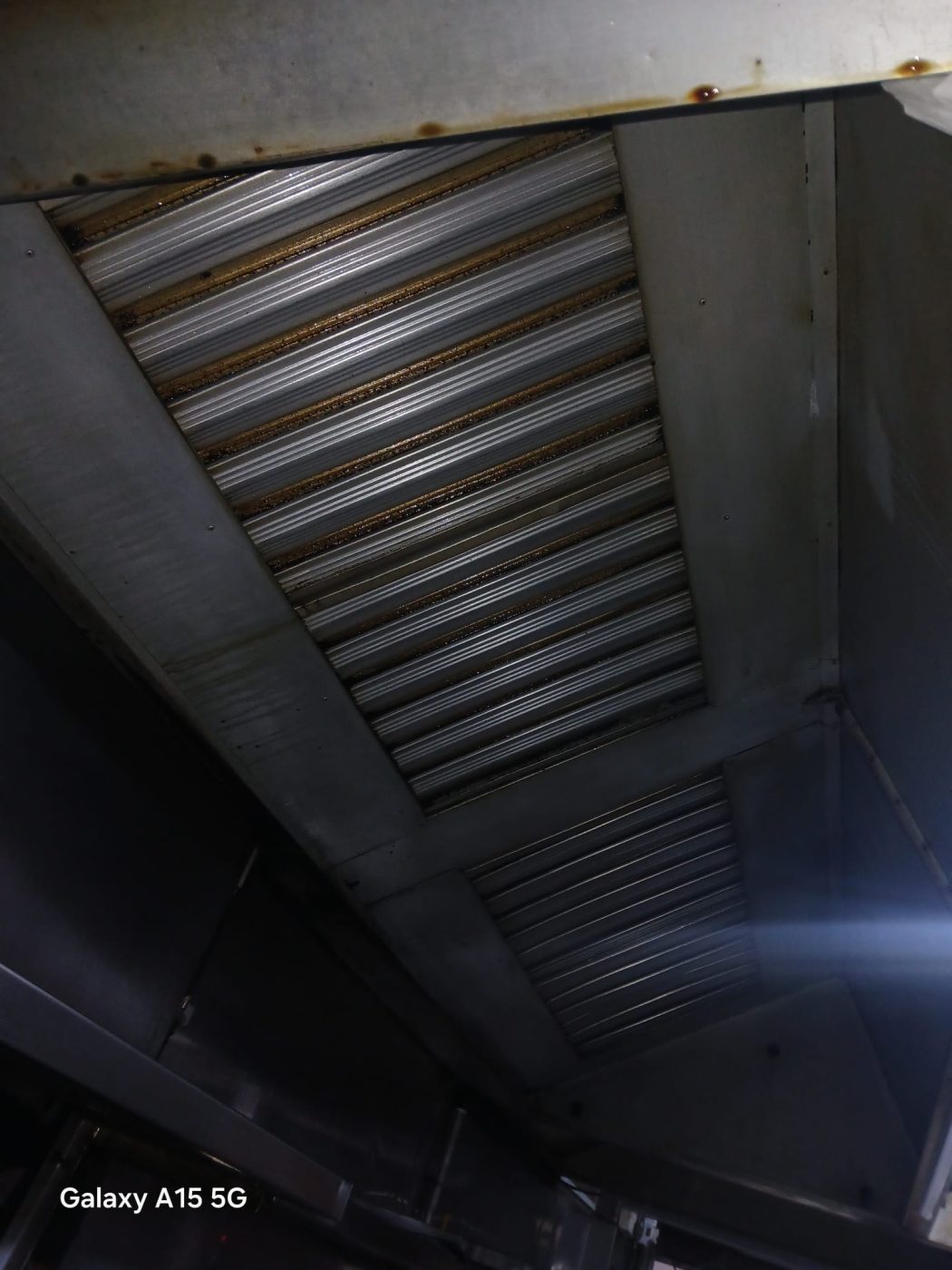
A kitchen extract system that has been running for a lease term holds grease in places you cannot see from the kitchen: the horizontal duct runs, the riser, the fan housing and the discharge point.

Two things follow from that at reinstatement.

First, if the lease asks you to hand over in working order, "clean" will usually mean cleaned through the full run rather than wiped down at the canopy. A hood that looks acceptable from below can sit under ductwork that is heavily loaded. Our note on what a kitchen exhaust cleaning service should include sets out the difference between the two.

Second, if you are stripping out, grease-laden ductwork is not ordinary demolition. It has to come down in a way that does not spread grease through a live building, and it has to be disposed of appropriately. Removing it is a controlled job, not a skip and two men on a Sunday.

The operators who are least surprised at the end are the ones who kept to a sensible cleaning interval throughout, which is one more argument for planned maintenance over reactive callouts.

Shared risers change the rules

If your unit sits in a mall or a mixed development, your ductwork almost certainly ties into a shared riser serving other tenants. That has three consequences at handover:

  • You usually cannot work on the riser itself. Your removal stops at your connection to it, and the landlord will care a great deal about how that connection is capped and made good.
  • Access is controlled. Riser work and anything on the roof at the discharge end generally needs a permit from building management, and often has to happen outside trading hours for the whole centre rather than just yours.
  • Other tenants keep trading. Your strip-out cannot take the shared system down, which constrains both the method and the hours.

Our note on shared risers and landlord rules in mall F&B units goes through how those relationships normally work.

"Make good" is a bigger phrase than it looks

Where the lease requires a strip-out, the removal is often the smaller half of the job. Making good is what the landlord actually inspects, and it covers things that are easy to leave off a quote:

  • The duct penetration. Wherever your ductwork passed through a wall, a slab or a compartment line, there is now a hole. It has to be closed properly, and where it crossed a fire compartment the reinstatement of that barrier is not a cosmetic patch. Our note on fire-rated ductwork and where it is required explains why those crossings were treated specially in the first place.
  • Ceilings and finishes. Ductwork above a ceiling means ceiling access panels, hangers and supports fixed into the slab. Removing the duct leaves all of that behind.
  • Power and controls. The fan supply, isolators, any variable speed drive and the interlocks between extract, make-up air and suppression all need isolating and terminating safely rather than simply being left dead in a cupboard.
  • The discharge point. At roof or facade level there is a cowl, a plinth or a louvre that came with your system. Whether it stays or goes should be in the agreed scope, because it is visible and it is the first thing anyone inspecting from outside will notice.

None of this is exotic work. It is simply work that exists, and the reason end-of-lease budgets get beaten is that people price the removal and forget the four items above.

Fire suppression comes out too

If a kitchen hood fire suppression system was installed for your cooking line, it is part of this conversation. Whether it is removed or handed over, its status needs to be clear, documented and agreed — not left ambiguous on the day the keys change hands.

Where the system stays for an incoming tenant, remember that suppression coverage is arranged around the appliances that were under the canopy when it was commissioned. It protects the kitchen you built, not the kitchen the next operator will build. That is worth saying to the landlord in writing, because a system described as "handed over working" can become the next tenant's problem, and occasionally comes back to yours.

What to do, and when

  1. Six months out: read the reinstatement clause and find your original handover record. Establish what is yours.
  2. Four months out: get the scope agreed with the landlord or their agent in writing, before you price it. A quote against an unagreed scope is a number you will have to revisit.
  3. Three months out: price the work against that agreed scope, and check what building management requires for permits and working hours.
  4. On completion: photograph everything and get the handover signed off. The same discipline that would have helped you at the start helps the next time you take a unit.

If you want to know where you stand

Send us the reinstatement clause and tell us what you installed versus what was already there. We will tell you which of the three jobs above you are actually facing, and whether the honest answer is a clean and hand over rather than a strip-out. If it is the cheaper one, that is what we will say.

Message us on WhatsApp about an end-of-lease kitchen exhaust, or see our kitchen exhaust design and build and kitchen exhaust cleaning work.

Questions

Common questions

What does kitchen exhaust reinstatement mean at the end of a lease?
It means returning the unit in the condition the lease requires. For a kitchen that is usually one of three things: stripping out the hood, ductwork and fan and making good to a defined base condition; handing the system over in working order and cleaned to a stated standard; or removing your own equipment while leaving fixed ductwork and the riser connection in place. Read which one your lease actually says before pricing anything.
How do I prove which ductwork is mine and which was already there?
With the condition record made when you took the unit over — photographs and a written handover schedule from that day. Without it you are negotiating from memory against a landlord with an agent and a quote. If you are taking over a unit now, this is the reason to document the existing system properly at the start.
Why is removing kitchen ductwork more expensive than normal demolition?
Because a system that has run for a lease term holds grease in the horizontal runs, the riser, the fan housing and the discharge point. It has to come down without spreading grease through a live building and be disposed of appropriately, which makes it a controlled removal rather than a strip-out with a skip.
Can I work on the shared riser when I leave a mall unit?
Usually not. In a mall or mixed development your removal generally stops at your connection to the shared riser, and the landlord will be particular about how that connection is capped and made good. Riser and roof discharge work normally needs a permit from building management and often has to happen outside trading hours for the whole centre.
What happens to the kitchen fire suppression system at handover?
Its status has to be clear, documented and agreed rather than left ambiguous. If it stays for an incoming tenant, note in writing that suppression coverage is arranged around the appliances present when it was commissioned, so it protects the kitchen you built rather than the one the next operator will build.
When should I start planning end-of-lease kitchen exhaust works?
About six months out: read the clause and find your handover record. Four months out, get the scope agreed with the landlord in writing before pricing it, because a quote against an unagreed scope will have to be revisited. Three months out, price it and check permit and working-hour requirements with building management.

Need This Sorted in Your Kitchen?

We design, clean, repair and maintain commercial kitchen exhaust systems across Singapore — on 24/7 standby.

Chat on WhatsApp