
05 Aug 2026 · Cleaning & Compliance
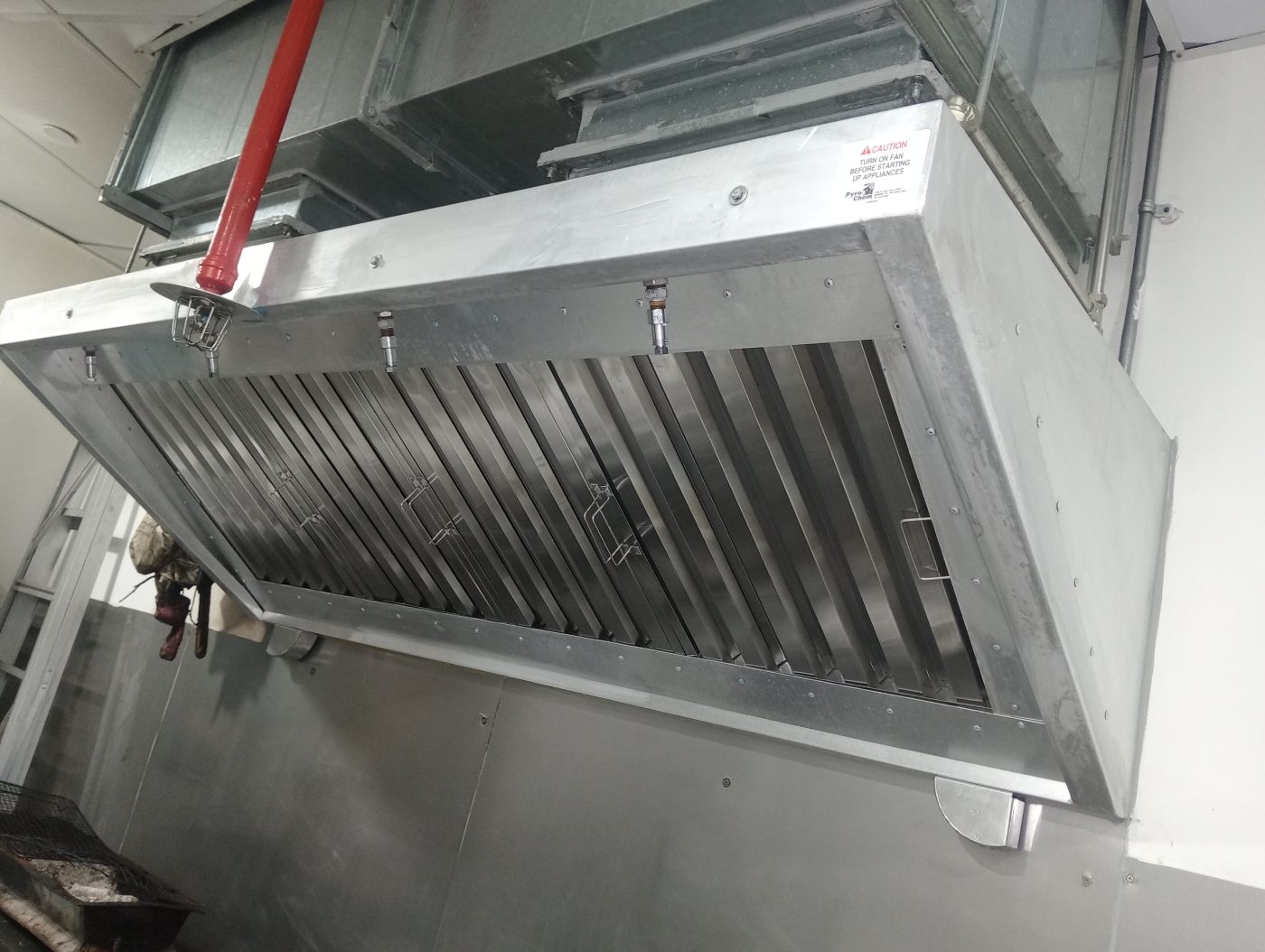
A commercial kitchen exhaust hood is overdue for a deep clean when you notice visible grease drips, persistent cooking odours, smoke lingering at cook height, noisy or strained fans, or a film on nearby surfaces. Left unaddressed, grease build-up becomes a serious fire and compliance risk under NEA and SCDF requirements.
Every time your kitchen cooks, grease-laden vapour rises off the woks, grills and fryers and gets drawn up into the exhaust hood. The filters catch a portion of it, but some grease always migrates further — coating the plenum chamber, the fan blades, the ductwork, and the internal surfaces of the canopy itself. In a busy commercial kitchen, this accumulation can reach dangerous levels within weeks, not months. The heavier the cooking load — particularly wok hei cooking with high-heat open flame — the faster it builds.
We fabricate and maintain systems across restaurants, hotel kitchens, food courts and central kitchens, and the pattern is consistent: the higher the grease load, the shorter the safe interval between cleans. A light café and a high-volume zi char kitchen are simply not on the same cleaning schedule.
This is the most obvious one. If you can see grease dripping from the underside of the canopy, pooling in the grease tray, or running down the hood face, the internal surfaces are saturated. At this stage, you're not just looking at a hygiene issue — you're looking at a fire risk. Liquid grease near a heat source is a serious hazard, and SCDF requirements exist precisely because of this.
A properly functioning exhaust system captures smoke and vapour at the source. When you notice smoke lingering at head height, drifting into the dining area, or making the kitchen uncomfortable to work in, the system isn't capturing effectively. This usually means either the filters are blocked solid, the fan is struggling, or both. We've walked into kitchens where the cooks had simply gotten used to the smoke — they'd stopped noticing it was abnormal.
Odours seeping into dining rooms, corridors or neighbouring tenants are a strong signal. When the exhaust pathway is clogged with grease, it loses extraction efficiency and odour-laden air finds other routes out. We handle odour control with our own germicidal UV systems and carbon banks, but no odour control system performs well sitting downstream of a grease-blocked duct.
Run a finger along the top of a nearby shelf, the range hood trim, or the ceiling tiles closest to the canopy. A tacky, oily film that comes back quickly after wiping is a sign that your hood is no longer capturing grease effectively and is redistributing it into the kitchen environment instead. This also creates secondary slip and hygiene risks on floors and surfaces.
We stock and service MV fans and motors in-house, so we know exactly what a struggling fan sounds like. When grease coats the fan blades, it adds uneven weight and disrupts airflow. The motor compensates by working harder, which generates more noise, heat and vibration. Left long enough, this leads to bearing failure or motor burnout — which is always a more expensive fix than a timely clean. If your fan pitch has changed or there's a new rattle or hum, take it seriously.
When exhaust capacity drops, heat has nowhere to go. Cooks notice it first — the kitchen feels hotter than usual, the air feels stale, and working conditions deteriorate. Heat stress is a real occupational health concern in commercial kitchens, and a blocked exhaust system directly contributes to it. If your team is complaining about the heat more than before, your hood may be the culprit.
This one sounds obvious, but we mean it genuinely. If you're not certain when the last professional deep clean was done — not just a filter rinse, but a full plenum and duct clean — the answer is almost certainly "too long ago." NEA requires exhaust systems serving commercial kitchens to be kept clean and in good working order. We always confirm the exact requirement with the relevant authority before quoting, but the intent is clear: regular, documented cleaning is not optional.
We see this confusion often. Many kitchens clean their grease filters weekly or fortnightly — which is good practice — but assume that covers the entire system. It doesn't. The filters are just the first line of defence. Grease still migrates into the plenum chamber behind the filters, along the duct runs, and onto the fan assembly. A proper deep clean means opening up the plenum, accessing the ductwork, degreasing the fan blades and housing, and cleaning the full internal surface of the canopy. We use our own BC Air chemical degreaser series for this — formulated specifically for commercial kitchen grease, not repurposed household products.
The risks compound quickly. Grease in a duct is fuel. A duct fire travels fast and is extremely difficult to extinguish once it takes hold — conventional kitchen suppression systems are not designed to fight a fire inside ductwork. Beyond fire risk, a visibly neglected exhaust system is a liability during NEA or SCDF inspections, and documented non-compliance can result in penalties or licence issues. We've been called in for emergency cleans before an inspection more times than we'd like to count. It's always more disruptive and more costly than scheduled maintenance would have been.
There's no single answer that fits every kitchen. A high-volume wok kitchen operating 16 hours a day has a fundamentally different grease load from a hotel banquet kitchen used intermittently. As a working guide, we assess cleaning frequency based on cooking method, operating hours, and the type of food being prepared. Some kitchens need us quarterly; others need us monthly. We'll tell you honestly what your system requires after an inspection — not what fits a convenient schedule.
Often it's both — grease build-up accelerates wear on fans, motors and bearings, so a deep clean sometimes reveals underlying mechanical issues. When we carry out a clean, we inspect the full system at the same time. If we find a fan bearing on its way out or a motor drawing too much current, we'll tell you before it becomes an emergency. We carry our own stock of motors, MV fans and parts, so we're not waiting on a supplier to fix what we find.
You can wipe down the external surfaces and pull the grease filters for a rinse — and you should, regularly. But the plenum chamber, the ductwork and the fan assembly require proper access, the right degreasers, and the know-how to reassemble everything safely and correctly. Doing it improperly can push grease deeper into the duct or damage components. For anything beyond surface-level maintenance, a professional clean is the right call — and the documented record is important for compliance purposes too.
We clean the full system — canopy, plenum chamber, ductwork and fan assembly — not just the visible hood face. We also inspect the discharge point at roof or external wall level, where grease can accumulate and cause issues with neighbouring properties or building management. Everything is done in-house by our own team; we don't sub-contract any part of the work.
It depends on the system size and how long it's been since the last clean. A straightforward single-hood system in a small restaurant might take two to three hours. A large hotel kitchen with multiple canopies and extended ductwork runs takes considerably longer. We'll give you a realistic time estimate before we start so you can plan your kitchen's downtime accordingly.
Yes, always. We provide a service record after every clean that documents what was done, the condition of the system, and any findings or recommendations. This is important for your own records and for demonstrating compliance if NEA or your building management requests evidence of maintenance. We always advise keeping these records on file.
If any of the signs above sound like your kitchen, don't wait for a problem to force the issue. Reach out to us for a site assessment and quotation — we'll give you a straight answer on the condition of your system and what it needs. Our 24/7 standby team is available whenever your kitchen needs us, including outside operating hours so your service doesn't disrupt your business.
]]>Related: Taking over an F&B unit — the six checks to make on an existing kitchen exhaust before you sign the lease.
Also worth reading: baffle vs mesh hood filters — what each type does, and how the wrong one ends up in the frame.
Most of these signs are spotted first by the people working under the hood. The daily routine that keeps them from appearing covers the five things a kitchen team should pass on rather than work around.
We design, clean, repair and maintain commercial kitchen exhaust systems across Singapore — on 24/7 standby.