
20 Jul 2026 · Design & Build
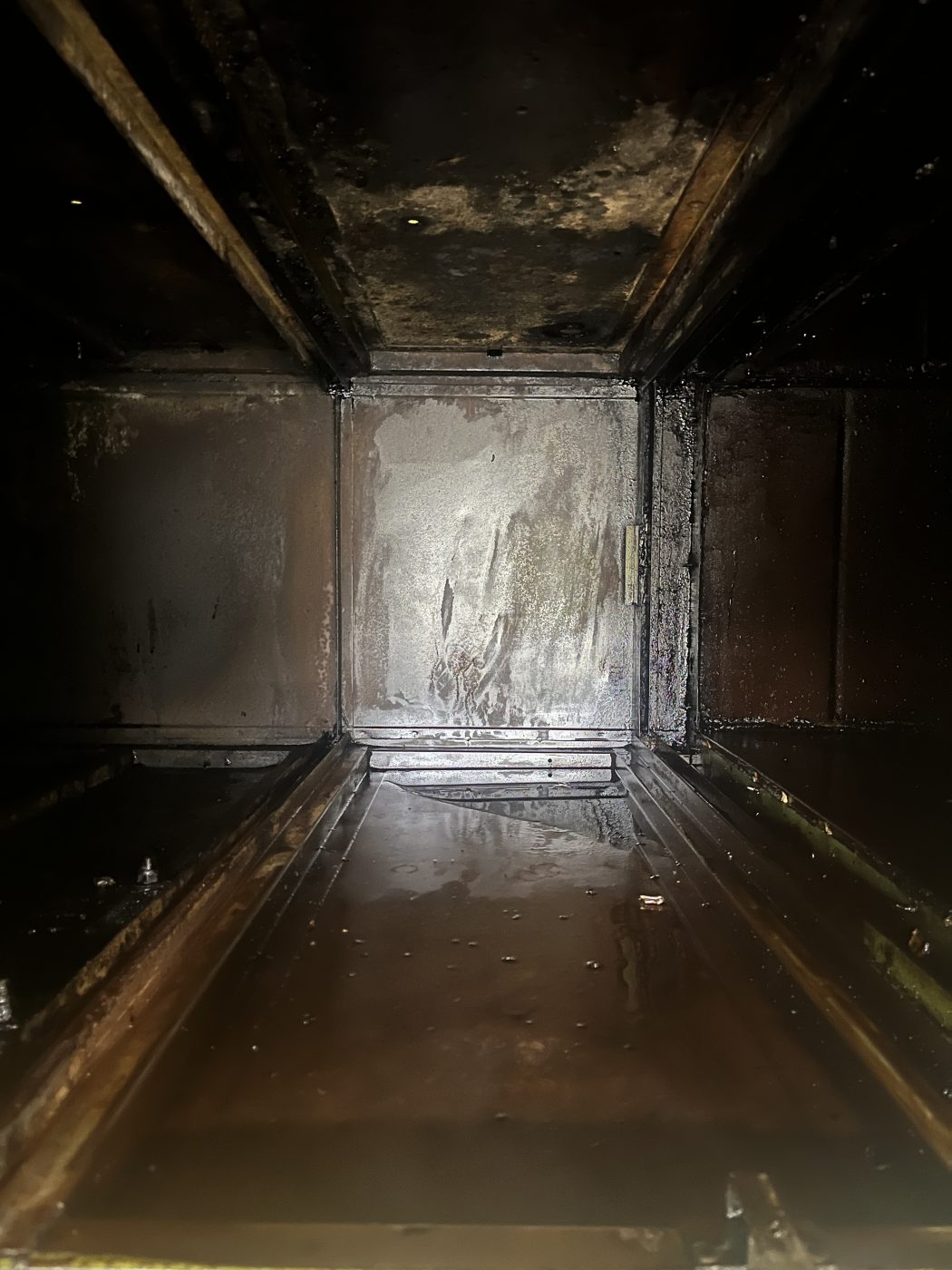
Neighbour odour complaints from a commercial kitchen are almost always caused by undersized ducting, low discharge points, or missing odour-control equipment. We fix them by recalculating airflow, raising the discharge stack, and adding carbon filtration or germicidal UV systems — permanently, not just on paper.
When a neighbour files an odour complaint against your kitchen, the clock starts ticking fast — NEA can be at your door within days. In our experience, almost every complaint we've been called to investigate traces back to the same root causes: a discharge point that's too low, an undersized or poorly routed duct, or odour-control equipment that was either never installed or quietly stopped working. The good news is that every one of those problems is an engineering problem — and engineering problems have engineering solutions.
Cooking produces a continuous stream of greasy, humid, odour-laden air. Your exhaust system's entire job is to capture that air at the canopy, move it through ducting, treat it if necessary, and discharge it at a point and height where it disperses harmlessly. When any link in that chain fails, the smell ends up somewhere it shouldn't — at a neighbour's window, in the corridor of a mixed-use development, or drifting into an adjacent unit's air-intake.
The three failure modes we see most often are:
NEA's requirements for exhaust discharge cover both the mechanical performance of the system and the odour impact at the boundary of the premises. We always confirm the exact current requirements with the authority before quoting — specifications do get updated — but in general, the discharge point must be positioned so that the exhaust plume does not cause a nuisance to neighbouring properties, and the system must be maintained in proper working order at all times.
In mixed-use buildings — shophouses with residential units above, or commercial podiums next to hotels — SCDF and BCA also have a say in how ducts are routed and where they can terminate. Getting all three authorities aligned before you start cutting holes is something we handle as part of every design engagement.
What that means practically: if you've received a complaint letter, the first thing we do is a site audit. We measure actual airflow against the design intent, inspect the canopy capture zone, check discharge height and direction, and test any odour-control equipment in place. Only after that do we tell you exactly what needs to change.
This is the single most effective fix when the problem is plume impingement on a neighbouring building. We extend the vertical stack — sometimes running it internally up a riser, sometimes externally — to get the discharge above the obstruction. We also make sure the terminal is fitted with a properly designed rain cap or discharge cowl that directs airflow upward, not sideways.
On one kitchen we were called to, the installed fan was oversized for the duct run, creating turbulence and back-pressure that was actually pushing fume-laden air back through gaps in the canopy seals. We rebalanced the system using a variable speed drive — one of the components we stock and install ourselves — which let us dial in the correct operating point for that specific duct geometry. The complaints stopped within a week of commissioning.
Make-up air is equally important. We design supply and exhaust flows together, not independently. A well-balanced kitchen keeps the cooking zone slightly negative relative to the dining area, while ensuring the canopy itself has the replacement air it needs to maintain capture velocity across the full cooking suite.
Activated carbon banks are highly effective at adsorbing the volatile organic compounds responsible for cooking odours. We fabricate and stock our own carbon banks, which means we control the media quality and can size the bank correctly for your grease load and air volume. A carbon bank that is too thin for the airflow passing through it is essentially decorative — we size for real dwell time, not just to tick a box.
Carbon media does saturate, and when it does, odour control drops off sharply. We include media replacement schedules in our maintenance contracts so you're never caught out.
UV-C systems work differently from carbon — they break down grease aerosols and odour compounds photochemically rather than adsorbing them. They are particularly useful in high-volume kitchens where carbon alone would require very frequent media changes, and in situations where grease build-up in the duct is also a fire-risk concern. We supply and install germicidal UV systems as standalone units or in combination with carbon banks, depending on what the airflow analysis tells us.
Like carbon, UV lamps have a service life. Lamp intensity degrades over time even when the lamp still appears to be lit. We log lamp hours and replace on schedule — not when the smell returns.
Sometimes the odour source isn't the exhaust plume at all — it's a grease-saturated duct lining that off-gasses between service intervals, or leaking duct joints that allow fume to escape into ceiling voids. Our cleaning teams use our own BC Air chemical series, formulated for heavy commercial grease, and after every clean we inspect and seal joints before sign-off. A clean duct is a significantly less smelly duct, even before you add any treatment equipment.
Yes — and this is where we'd rather spend the conversation. When we design a kitchen exhaust system from scratch, we model the discharge plume relative to neighbouring buildings, size the odour-control train for the intended menu and cooking volume, and specify maintenance access points so that filters and UV banks can actually be serviced properly once the kitchen is running. Retrofitting odour control into a poorly designed system always costs more and delivers a less elegant result than building it in correctly the first time.
If you're fitting out a new kitchen in a location with residential neighbours, or in a mixed-use development with tight constraints, talk to us before the M&E drawings are finalised. Changing a discharge point on paper costs nothing. Changing it after the false ceiling is up costs significantly more.
Don't ignore the timeline in the letter. Call us immediately for a site audit. We'll assess your system, document its current condition, and give you a clear picture of what needs to change before any follow-up inspection. Acting quickly and demonstrating that remediation is already underway is always better than waiting.
It depends on the root cause. Carbon filtration is very effective at reducing odour compounds, but if your discharge point is aimed directly at a neighbour's window three metres away, no filter will compensate for that. We assess the full system before recommending treatment equipment — sometimes the fix is repositioning the stack, sometimes it's adding carbon, and often it's both.
It varies with cooking volume, menu type, and the size of the carbon bank relative to your airflow. Heavy frying operations saturate media faster than light cooking. As a rough guide, many high-volume kitchens need media changes every three to six months, but we calculate the correct interval for each installation and include it in the maintenance schedule rather than guessing.
Yes — most of our odour-control work is retrofit. We audit what's there, identify the weakest points, and prioritise changes by impact. Sometimes a single fix like raising the discharge stack resolves most of the problem. Other times a combination of duct sealing, carbon filtration and airflow rebalancing is needed. We'll tell you honestly what the options are and what each one will and won't achieve.
We support you through the technical side — providing system specifications, airflow calculations and maintenance records that you or your QP can submit to the relevant authority. For submissions that require a registered QP or PE to sign off, we work alongside your appointed professional. We always confirm what documentation each authority requires before we start work, so nothing falls through the cracks.
If you're dealing with an odour complaint — or you simply want to make sure your exhaust system is designed so that you never receive one — get in touch with us for a site assessment and quotation. Our team is available 24/7, so even if the complaint landed on a Friday evening, we can be on-site when you need us.
Related: Choosing a commercial kitchen exhaust hood in Singapore — sizing to the cooking line, filters, duct sizing and make-up air.
Related: Taking over an F&B unit — the six checks to make on an existing kitchen exhaust before you sign the lease.
Also worth reading: when a commercial kitchen actually needs an electrostatic precipitator — and why an ESP is not an odour fix.
Related reading: noise and vibration complaints from kitchen exhaust · kitchen exhaust in a conservation shophouse, where the discharge point is nearly always the constraint
Also worth reading: If the complaint stopped and then returned, the carbon bank may be spent. See carbon banks in a kitchen exhaust.
We design, clean, repair and maintain commercial kitchen exhaust systems across Singapore — on 24/7 standby.