
27 Sep 2026 · Repair & Equipment
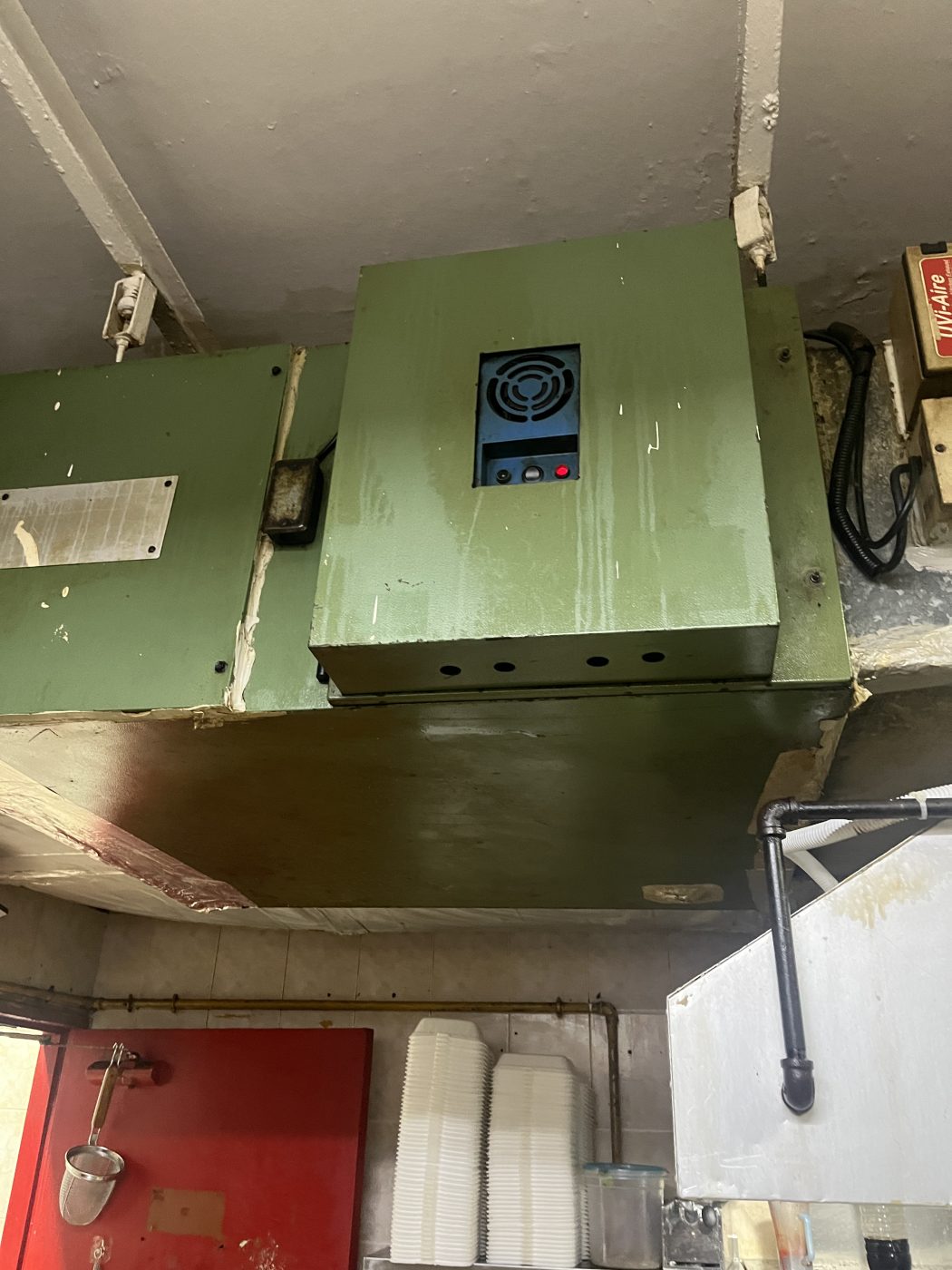
Used kitchen exhaust equipment - a hood, duct sections or a fan - can be reused safely, but only after it is checked against your own cooking line and current NEA, SCDF and BCA requirements, not against how clean it looks. A hood sized for a cafe will not serve a wok range regardless of condition, a duct section loses any fire rating it once had the moment it is cut or re-welded without re-certification, and a used fan's bearing and motor wear cannot be judged by eye - it has to be run and checked. Buy the equipment schedule first and match hardware to it, not the other way round.
Pictured above: a hood and control box from one of our jobs, repainted more than once over its working life — exactly the kind of surface that makes a unit look fine in a listing photo. What is underneath the paint is the part that actually decides whether it is worth buying.
A closing restaurant lists its old exhaust hood. An equipment reseller has ex-display fans at a fraction of catalogue price. A renovation contractor offers to keep the previous tenant's ductwork "since it's already there." All three conversations happen constantly in Singapore F&B, and all three can be a legitimate way to cut a fit-out budget — commercial kitchen exhaust equipment is not cheap, and a hood that already exists is money you do not have to spend on fabrication.
What decides whether it actually saves you money is not how clean the unit looks in a photo. It is whether it was built for the cooking line you are about to run, and whether it still satisfies the requirements that apply the day you switch it on — not the day it was first installed.
Not all used equipment carries the same risk.
Duct sections are the most forgiving, provided the material and gauge are right for the job and the section is free of rust-through, splits or old patch repairs that were never properly sealed. A straight run of sound stainless duct can outlast several kitchens. The catch is that a duct's fire rating, where it has one, belongs to the assembly as originally installed and certified — cut it, re-weld it or relocate it and that rating does not travel with the metal automatically. See fire-rated ductwork for what a rated run actually requires.
Hoods are more particular, because a hood is not a generic box — it is sized to cover a specific cooking line with an overhang past the ends, matched to specific filters, and built with a grease channel and access that suit however it is cleaned. Reusing one from a completely different kitchen means judging it against your own equipment, not against its condition. We go through how that sizing actually works in choosing a commercial kitchen exhaust hood.
Fans and motors carry the most hidden risk of the three, because wear on a motor winding or a fan bearing is not visible from outside the casing. A fan that looks freshly painted can be near the end of its bearing life, and one that looks rough can still have plenty of running hours left. Condition has to be established by running it and checking it, not by looking at it.
It is the same problem an operator faces when taking over an existing F&B unit and inheriting whatever hood is already bolted to the ceiling — covered in taking over an F&B unit: what to check about the existing kitchen exhaust. Buying loose used equipment for a fresh fit-out is the same trap approached from the other direction: the previous owner's hood, duct and fan were sized for their cooking line, not yours.
A hood built for a bakery or a drinks counter will not capture a wok range's plume no matter how solid the steel is. A fan sized for a light coffee-shop exhaust will be under-duty the moment it is asked to move air for a char-grill or a deep-fry line. Physical fit — will it bolt up, does the duct collar line up — tells you nothing about whether it will actually perform on your kitchen. That answer comes from your own equipment schedule: every appliance, its type, and its position, compared against what the used hood and fan were actually designed to handle. We ask for exactly that schedule before quoting any new system, for the same reason.
It is easy to assume that equipment which was compliant once stays compliant wherever it goes next. It does not work that way. NEA, SCDF and BCA requirements attach to the installed system as it exists in your kitchen on the day it is inspected, not to the equipment's manufacturing history.
A few places this catches people out with used equipment specifically:
None of this requires special equipment on your part - it requires asking the right questions and not skipping the ones that are inconvenient to ask a seller who wants the sale to close.
When we are asked to look at a piece of used equipment before a purchase, the answer usually falls into one of three outcomes: it genuinely suits your cooking line and needs cleaning plus some maintenance before installation; the bones are sound but the filters, some ductwork sections or the fan need replacing to match your line; or it was built for a different kitchen entirely and adapting it will cost more than fabricating new. We would rather tell you the third one before you pay a deposit than after it is delivered to site.
Used equipment is not a shortcut around design - it is a set of components that still has to go through the same design process as new steel: matched to your cooking line, checked against current requirements, and installed with the ductwork, fan and make-up air sized to work together. Where it genuinely fits, it can fairly cut a fit-out budget. Where it does not, finding that out on paper - or on a phone call before the equipment is moved - is far cheaper than finding it out after it is welded into place.
Send us photos, any documentation you have, and your cooking equipment schedule before you commit to buying, and we will tell you plainly which of the three outcomes you are looking at. Full scope for fitting it in is on kitchen exhaust design and build, and if a fan or motor needs assessment or replacement, that is on kitchen exhaust repair & replacement.
WhatsApp BC Air on 8989 2833 with photos and your cooking line before you commit, and we will tell you what is realistic.
Related reading: taking over an F&B unit - checking the existing kitchen exhaust · choosing a commercial kitchen exhaust hood · reading a kitchen ventilation quotation · how a grease fire travels up kitchen ductwork
We design, clean, repair and maintain commercial kitchen exhaust systems across Singapore — on 24/7 standby.