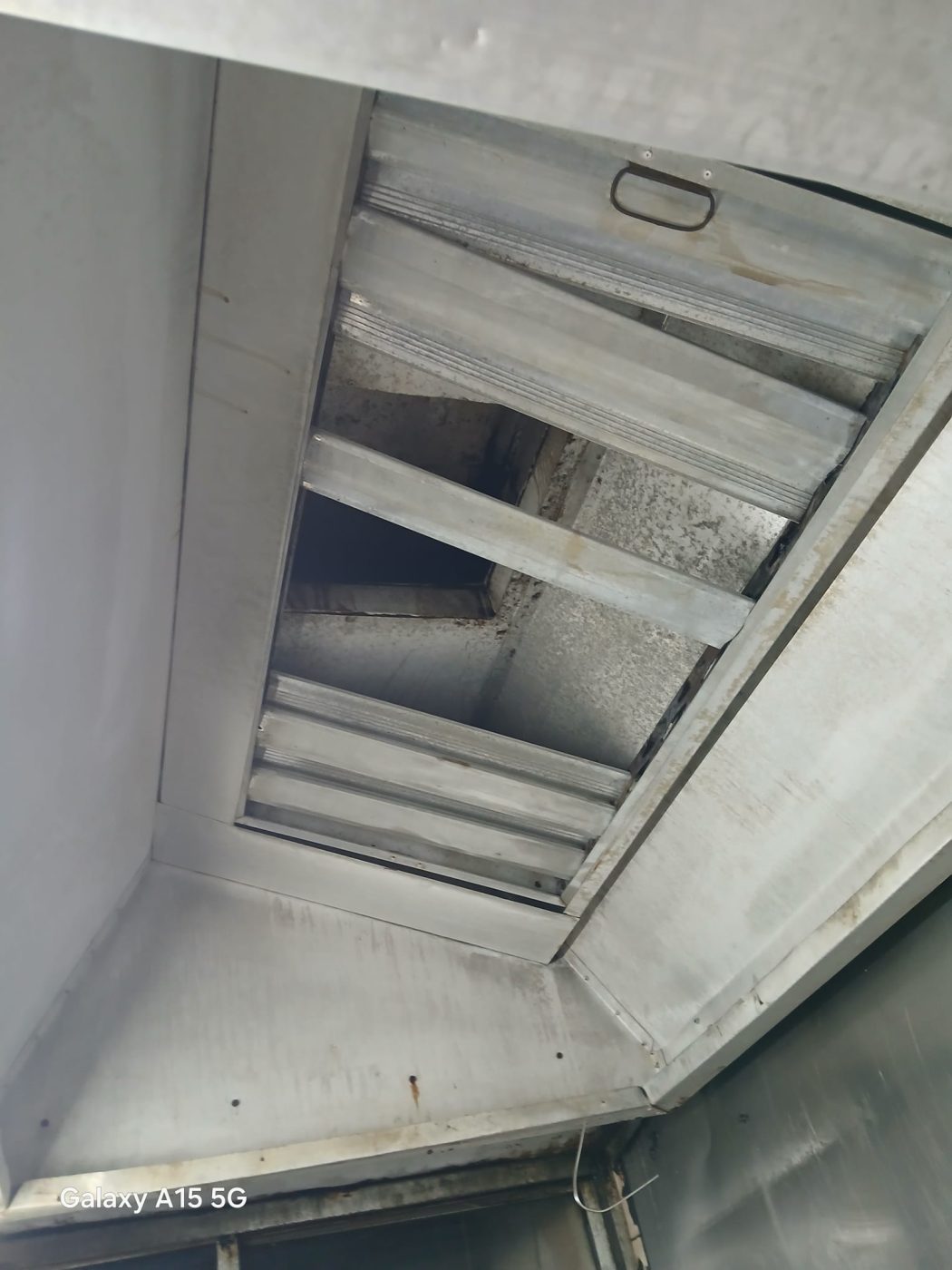
Pictured above: looking up into a hood on one of BC Air’s projects in Serangoon, past the filter bank to the opening behind it. This is a photo from our own work, reused here because it is the view a survey starts with.
You send a message asking how much a kitchen exhaust will cost, or how much to fix the one you have, and what comes back is not a number. It is a handful of questions and an offer to come and look. That can feel like a stalling tactic. It is not, and this post sets out why, what to send so the first visit is useful, what the visit is for, and what you should hold in your hand afterwards before you compare anything.
We do not publish a price for kitchen exhaust work and we do not give a figure over the phone, because the figure depends on things that cannot be seen from a message. Everything below is about getting those things onto the table quickly.
Why a price needs a survey first
A commercial kitchen exhaust is not a product with a size. It is a hood, a duct run, a fan, a discharge point and a supply of replacement air, all of it fitted to one particular cooking line in one particular building. What moves the figure is different for each kind of job.
- A new system, or a rebuild. It depends on the cooking line, the duct route and the discharge point. Two kitchens with the same floor area can need very different systems because one has a wok range and the other has a sandwich counter. Our design and build work is quoted against that scope, not off a price list.
- A repair or a replacement part. It depends on what is actually wrong, and the first visit is often how that gets found. A smell, a noise or a trip tells you where to look, not what you will find. See repair and replacement.
- A clean. It depends on how much of the system there is, how much of it can be reached and how loaded it is. We have set out what decides a cleaning quote in what decides the price of a commercial kitchen exhaust clean, so it is not repeated here.
- Airflow modelling or balancing. It depends on the cooking line, the number of hoods, the duct run and the make-up air. See CFD modelling and air balancing.
In every case the answer is the same: the number follows what is found, so the finding comes first. A quote given before it would be a guess dressed up as a figure, and the gap between the guess and the real job would turn up later as a variation.
What to send before anyone visits
You do not need to be technical to do this and you do not need a specialist on site. A good message and a few photographs let us arrive knowing what we are looking at. Send what you can; a missing item is not a reason to delay.
- Where the unit is and what kind of building it is. A mall unit, a shophouse, an industrial unit and a hawker or coffee shop stall each bring different constraints on routes, risers and working hours. The address matters less than the type of building.
- What you cook, on what, and for how many hours a day. List the appliances: wok range, fryer, griddle, oven, steamer, charcoal. Say whether they are gas or electric. The cooking line, not the room, sets what the exhaust has to do.
- What you are trying to solve. New system, a clean, a repair, a smoky kitchen, a neighbour complaint, a second opinion on a quotation you already have. One line is enough.
- A photograph of the hood from the front, wide enough to show the whole canopy and the cooking line beneath it.
- A photograph of the filter bank. Show whether the filters are all the same type and whether any are missing.
- A photograph looking into the hood with one filter out. Do this with the fan off and the appliances cold, and take the filter from the middle of the line. The space behind the filters is the first thing that tells us how loaded the system is.
- The fan and its nameplate, if you can reach them safely. If the fan is on a roof or in a plant room you cannot easily get to, do not climb for it. Say where it is and who holds the key.
- Where the duct comes out. A photograph of the discharge point from the ground or from a window is enough. Say what is near it: a neighbour’s window, an air intake, a walkway.
- Any access panels you know about, and any ceiling you have noticed has no way in above the hood.
- Paperwork, if there is any. The last cleaning report, any drawings of the system, anything from the landlord or management office about risers, roof access or working hours.
Three safety points. Do not climb to a roof or into a ceiling void for a photograph. Do not open or dismantle anything beyond lifting out a filter, and only with the fan isolated and the line cold. And if there is smoke or flame, that is not a survey question: stop cooking, follow your fire plan and call 995.
What the survey is for
A survey is not a sales call with a tape measure. It is where the scope of the job is established, and the scope is what the quotation then describes. When we look at a kitchen we are asking the same set of questions whatever the job was called when you messaged:
- Does the hood suit the cooking line beneath it? A canopy that was right for the previous tenant’s menu may not be right for yours. We explain how hoods are sized in sizing a commercial kitchen exhaust hood.
- What are the filters and the space behind them doing? Filter type, gaps, and how far grease has travelled past them.
- Where does the duct go, and can it be reached? The route, the access points, and whether a long horizontal run or a closed ceiling has made part of it impossible to clean.
- What is the fan, and what is it working against?
- Where does the air leave, and where does the replacement air come from? A system that is missing the second half is the usual reason a kitchen stays smoky when the fan is running.
That is also why a survey tends to sort a job into one of a few outcomes rather than one: the system suits the kitchen and needs a clean and some maintenance; the bones are sound but the hood, filtration, fan or make-up air needs work; or the system was built for a different kitchen and reusing it will cost more than doing it properly. We set that out for a unit you are taking over in what to check in an existing kitchen exhaust before you sign. Sometimes the honest answer is the smallest one.
What slows a survey down, and what to sort out early
The visit itself is rarely the slow part. What holds a job up is access and permission, and most of it can be started before anyone arrives.
- Roof, plant room and riser access. If the fan or the duct is somewhere you need a key, a permit or the landlord’s staff to reach, ask for that early. In a managed building it is often the first thing that decides when a survey can happen.
- The landlord’s own rules. Risers, routes, roof penetrations and working hours are set by the building, not by us. If your lease or the management office has a fit-out guide, send it. In a mall unit this can matter as much as the kitchen itself; see kitchen exhaust in a mall F&B unit.
- An equipment list that is not final. If the menu or the equipment is still changing, say so. A survey on a kitchen that is about to add a wok range answers a different question from one on the kitchen as it is today.
- A kitchen that cannot stop. If you cannot close for a visit, tell us which hours are quietest. The look at the hood and filters does not need the kitchen empty, but a look inside the duct usually needs the system off.
What you should have afterwards
The product of a survey is a scope, and the quotation should read as a description of that scope with a price at the end of it. Before you compare it with anything else, check that it states the hood, the filters, the fan, the duct and how it is reached, the discharge point, the make-up air, what is excluded and what you receive at handover. If you have more than one quotation, put them on the same footing first; the method is in comparing kitchen ventilation quotations. If the work is a fit-out, settle who owns which part of the exhaust before the quotations arrive, as set out in who owns the kitchen exhaust scope in an F&B fit-out.
When not to wait for a survey
If the exhaust fan has stopped, or the kitchen cannot be run safely, the first call is not a survey, it is a repair. We run a 24/7 standby line for exactly that, and the same photographs help there too. Start with kitchen exhaust fan not working: causes and fixes, then send us what you find. A survey for a planned job can wait for the right day; a dead fan during service cannot.
The short version
We do not quote a kitchen exhaust from a message because the figure depends on the cooking line, the duct route, the discharge point and what is found in the system, and none of those can be seen from a text. To make the first visit useful, send the building type, the appliance list and hours, what you are trying to solve, and photographs of the hood, the filter bank, the space behind a filter, the fan nameplate if you can reach it safely, and the discharge point. Sort out roof and riser access with the landlord early. Afterwards you should hold a written scope, not just a total. For the full picture of how these systems are put together, see our commercial kitchen ventilation system page.
Ready to arrange one? WhatsApp BC Air on 8989 2833 with the location, what you cook and a few photographs, and we will tell you what we need to see. See also our design and build and maintenance services.
Related reading: comparing kitchen ventilation quotations · taking over an F&B unit · who owns the exhaust scope
Questions
Common questions
Why will BC Air not give a price for kitchen exhaust work over WhatsApp?
The figure depends on the cooking line, the duct route, the discharge point and, for repairs and cleans, on what is found in the system. None of that can be seen from a message, so we survey the kitchen and quote from what is there rather than from a guess.
What should I send before a kitchen exhaust site survey?
The type of building, the appliances you cook on and the hours you run, what you are trying to solve, and photographs of the hood from the front, the filter bank, the space behind one filter, the fan nameplate if you can reach it safely, and the discharge point. Any cleaning report, drawings or landlord paperwork helps too.
Is it safe to take a filter out and photograph behind it?
Only with the exhaust fan isolated and the cooking line cold, and only one filter from the middle of the line. Do not open or dismantle anything else, and do not climb onto a roof or into a ceiling void for a photograph.
What does a kitchen exhaust survey look at?
Whether the hood suits the cooking line, the filters and the space behind them, the duct route and whether it can be reached, the fan, the discharge point and where the replacement air comes from. The outcome is a scope that the quotation then describes.
What if my exhaust fan has stopped working?
That is a repair, not a planned survey. BC Air runs a 24/7 standby line for breakdowns. If there is smoke or flame, stop cooking, follow your fire plan and call 995.