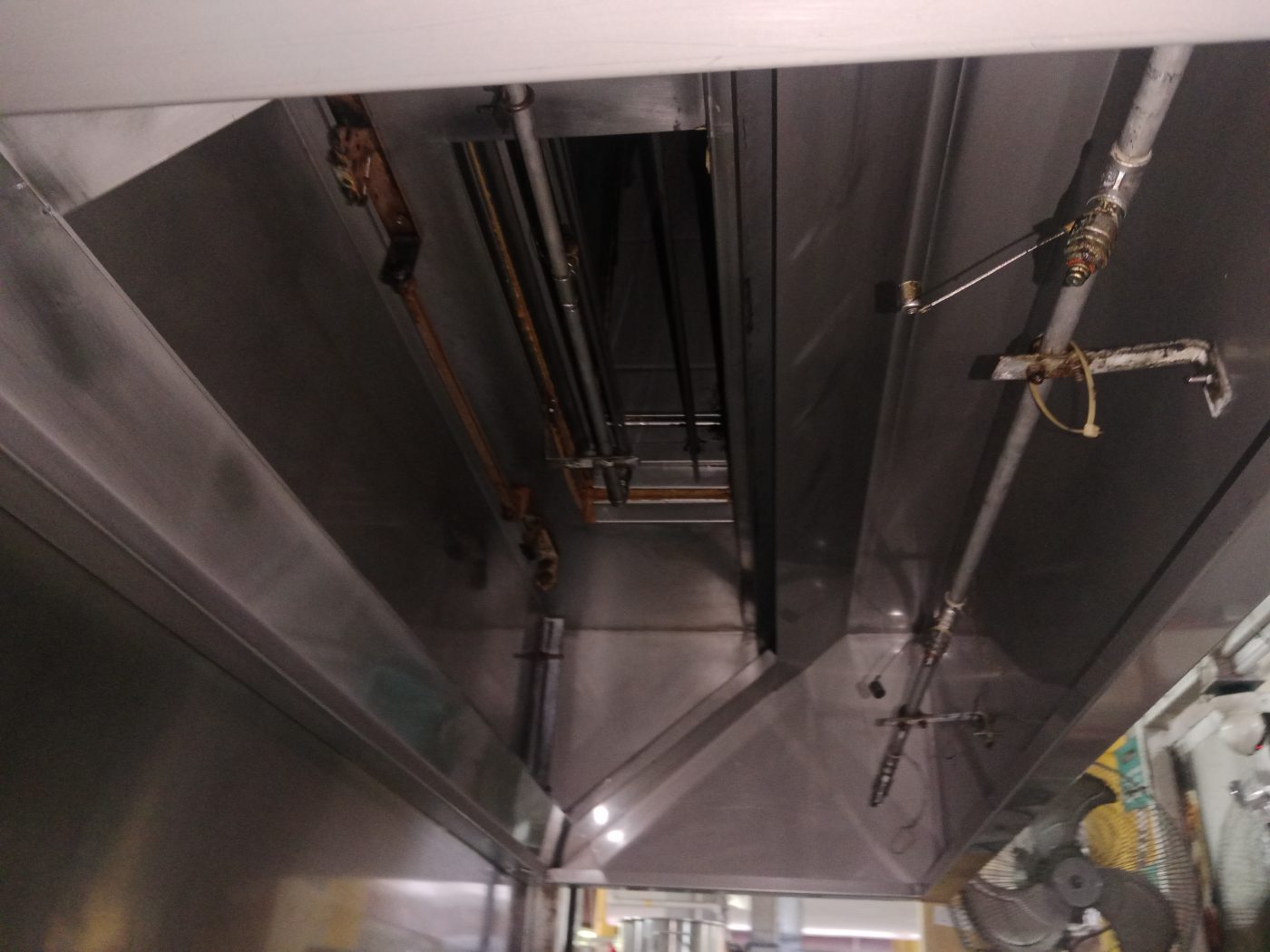
Pictured above: inside a hood on one of our projects (Timbre, Yishun) — the wet-chemical suppression pipework and nozzles, with the detector line and its release cable running along the canopy. Almost none of what makes this system safe is visible from the kitchen floor.
Every commercial kitchen has a set of connections nobody thinks about until the day they matter: the exhaust fan, the gas supply, the appliances and the fire suppression system are wired and plumbed to each other so that when one of them does something, the others respond. Those connections are the interlocks.
They are invisible in normal service. The fan runs, the gas burns, the extraction works. Then something happens — the suppression system discharges, the fan fails, a contractor works on the panel — and suddenly the interlocks are the only thing standing between a manageable incident and a bad one. Or, just as often, they are the reason a kitchen cannot cook and nobody on site knows why.
This is what those connections actually do, what goes wrong with them, and what a kitchen team should know without opening anything.
What the suppression system is connected to
A wet-chemical suppression system over a cooking line is not a standalone box. It is designed to do several things in the same moment:
- Discharge wet chemical through nozzles positioned over specific appliances and into the hood plenum and duct.
- Shut off the fuel. This is the part people forget. A suppression system that puts out a fire while gas keeps flowing to the burners has not finished the job. The link is usually a mechanical gas valve held open by the same release mechanism, so when the system trips the valve closes and stays closed.
- Cut power to the cooking appliances where they are electric, through a shunt trip or contactor.
- Do something specific with the fan. Whether your exhaust fan is designed to keep running after a discharge, or to stop, and what the make-up air is set to do, is a design decision made when the system was installed. Both arrangements exist in Singapore kitchens. Nobody on site should be guessing which one yours is. It is on the system's documentation, and a competent service engineer can tell you at the next visit.
It is triggered two ways: automatically, by detectors in the hood that release at cooking-fire temperatures, and manually, by a pull station that should be on the way out of the kitchen — not deep inside it, not behind a rack of trays.
The everyday interlock: fan and gas
Separately from fire, many kitchens have a control arrangement where the gas supply is interlocked with the exhaust fan, so that gas cannot be turned on unless extraction is running.
The logic is sound: burning gas without extraction fills a kitchen with combustion products and heat, and in a sealed unit it is genuinely dangerous. But this interlock is also the single most common reason we get an urgent call that turns out not to be a fire system problem at all: the gas will not come on. Nine times out of ten the fan has tripped, or a starter has failed, or somebody left the control switched to manual, and the interlock has done exactly what it was designed to do.
That is worth telling your kitchen team in one sentence: if the gas will not light, look at whether the exhaust fan is actually running before you look at anything else.
What goes wrong
In the kitchens we attend, the failures repeat:
- Nobody knows where the manual reset is. After a discharge, or after a gas valve trips, somebody has to reset it. If no one on the evening shift knows where that valve is or who is allowed to touch it, the kitchen is closed until someone comes out.
- The interlock gets bypassed. The fan fails on a Friday night, the gas will not come on, and someone finds a way around it so service can continue. That kitchen is now cooking with no extraction and no interlock — and the bypass is almost never removed afterwards.
- The cooking line moved and the nozzles did not. Nozzles are positioned for specific appliances in specific places. Swap a fryer for a griddle, add a wok range, or shift the line half a metre, and the protection no longer sits over what it was designed to protect. We wrote about this in adding equipment to an existing hood, and it applies to suppression as much as to airflow.
- Grease over the detectors and the release line. The detection sits in the dirtiest part of the kitchen. Heavy grease build-up on a detector, a cable or a pulley is not a theoretical problem — it affects how the system releases. It is one of the quiet reasons cleaning frequency matters, on top of how a grease fire travels up ductwork.
- The pull station is blocked. Trolleys, stock, a new shelf. The one control a cook can use in a hurry is behind something.
- Nothing is documented. A kitchen changes hands, the new operator inherits a system with no certificate, no drawing and no service history, and nobody can say what it is set to do. That is one of the first things to look for when taking over an F&B unit.
After a discharge: what actually happens next
If the system goes off, the kitchen does not simply wipe down and carry on. The wet chemical has to be cleaned off every surface it reached, including inside the hood and the plenum, because it is corrosive to bare metal if left. The cylinders have to be recharged, the detectors and links replaced, the gas valve reset, and the whole system re-certified before cooking restarts. Depending on where the fire was, the duct may need cleaning before the first service as well.
We have set out the full sequence in what to do when a suppression system goes off. The point for today is that the interlocks are what make that stop happen safely — and a system that had been bypassed would not have stopped anything.
The five-minute walk, for a manager
None of this needs a technician. Walk the kitchen with the head chef and answer five questions:
- Where is the manual pull station, and is it clear? Stand at the cooking line and look at the way out. Anyone should be able to reach it without moving anything.
- Where is the gas shut-off, and who resets it? Name the person on each shift who knows.
- Does the team know the fan–gas rule? If the gas will not light, check the fan first.
- Has the cooking line changed since the system was installed? New fryer, new wok range, equipment moved. If yes, the nozzle layout needs reviewing.
- Where is the paperwork? The suppression certificate, the last service report, and any drawing. If nobody can produce them, that is this week's job.
What a proper service visit should cover
When the suppression system and the exhaust are serviced, ask for these to be confirmed in the report rather than assumed:
- The gas valve was exercised and confirmed to close and reset.
- The fan-to-gas interlock was tested, not just looked at.
- Detectors, links and the release cable were inspected and cleaned, and replaced where required.
- Nozzle positions were checked against the appliances actually on the line today.
- The manual pull station operates and is unobstructed.
- Any bypass found on site was recorded and removed.
A report that says "system checked, OK" tells you nothing. A report that lists those six items tells you the interlocks were genuinely tested, which is the difference that shows up on the one night it matters. That is the same principle as the readings and documents we say to ask for at a new exhaust handover.
The short version
- The suppression system is connected to the fuel, the appliances and the fan. Putting out the fire is only part of what it does.
- Whether your fan keeps running after a discharge is a design decision. Find out which yours is instead of guessing.
- If the gas will not light, check whether the exhaust fan is running before anything else.
- Bypassing an interlock to get through a service is the worst of the common failures, and the bypass usually stays.
- Move the cooking line and the nozzle layout has to be reviewed.
- Grease on detectors and release cables is a safety issue, not just a cleanliness one.
- After a discharge: clean off the wet chemical, recharge, replace detectors, reset the gas valve, re-certify, then cook.
- Ask for six specific confirmations in the service report, not "system OK".
Not sure what your kitchen is set to do, or when the interlocks were last actually tested? WhatsApp BC Air on 8989 2833 with your location and cooking type and we will arrange a look. Fire suppression is on the fire suppression page, scheduled servicing on the maintenance page, and mechanical work on the repair page. Scope and pricing follow an inspection.
Related reading: when the suppression system goes off · why hood fire suppression matters · when the exhaust fan stops working
Questions
Common questions
What does a kitchen fire suppression system shut off when it discharges?
It discharges wet chemical over the appliances and into the hood plenum and duct, closes the gas supply through a mechanical valve held open by the release mechanism, and cuts power to electric cooking appliances through a shunt trip or contactor. What the exhaust fan and make-up air do at that moment depends on how your system was designed, and should be recorded in its documentation.
Why will the gas not turn on in my commercial kitchen?
In many kitchens the gas supply is interlocked with the exhaust fan so gas cannot flow unless extraction is running. If the gas will not light, check first whether the exhaust fan is actually running: a tripped fan, a failed starter or a control left in manual is a far more common cause than a fault in the fire system. It can also be a gas valve that has tripped and needs a manual reset by a competent person.
Is it ever acceptable to bypass the fan and gas interlock?
No. Cooking with gas and no extraction puts combustion products and heat into the kitchen, and a bypass fitted to get through one busy service is almost never removed afterwards. If the fan has failed, the correct answer is to stop gas cooking and get the fan repaired. Any bypass found on site should be recorded and removed at the next service visit.
What has to happen before cooking restarts after a suppression discharge?
The wet chemical has to be cleaned off every surface it reached, including inside the hood and plenum, because it is corrosive to bare metal if left. The cylinders are recharged, detectors and links replaced, the gas valve reset and the system re-certified. Depending on where the fire was, the duct may need cleaning before the first service as well.
What should a suppression and exhaust service report actually say?
That the gas valve was exercised and confirmed to close and reset; that the fan-to-gas interlock was tested rather than inspected; that detectors, links and the release cable were checked, cleaned and replaced where required; that nozzle positions were verified against the appliances on the line today; that the manual pull station operates and is unobstructed; and that any bypass found was recorded and removed. "System checked, OK" tells you nothing.