
02 Nov 2026 · Fire Safety
Between suppression service visits, a supervisor can look but not touch: keep the manual pull station clear, check every nozzle still has its cap, confirm each appliance is still under a nozzle, note grease on nozzles and links, and write down the gauge reading with the date. The agent, detection, fusible links and cylinder are for a specialist.
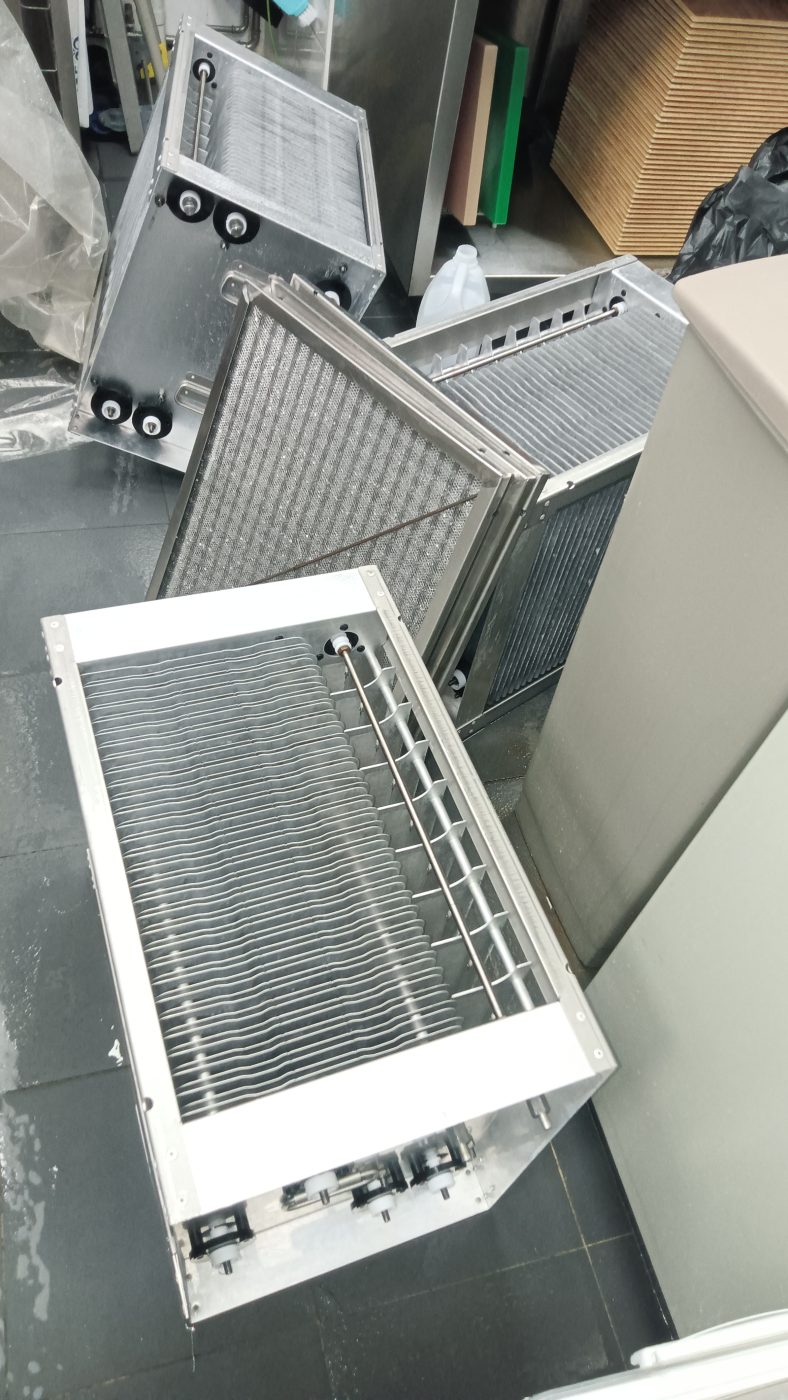
Pictured above: electrostatic filter cells lifted out of a hood during a clean on one of our projects (Sushi Go, VivoCity). It is not a suppression job. It is reused here because a hood opened up for cleaning is the one moment the nozzles and links above the cooking line are in easy reach, and that is the moment most kitchens never use.
A kitchen hood suppression system is serviced on a schedule by a technician. Between those visits it sits above the cooking line for months, in the greasiest air in the building, and nobody on the kitchen team is asked to look at it. Then a menu changes, a fryer gets moved, a crate gets stacked in the wrong corner, and by the time the technician returns, the system on the wall no longer matches the kitchen underneath it.
This post is for the supervisor or owner who wants a short, safe routine for the gaps between visits. It is not a replacement for the service, and it does not ask anyone to touch the agent, the detection or the cylinder. It is about looking: five minutes, no tools, nothing opened, and a note of what you saw. It does not give a price, because servicing is quoted after an inspection of the actual system.
You cannot service a suppression system yourself, but you can notice when something has changed around it. Look at the manual pull station, the nozzle caps, the cooking line against the nozzles, the grease on and around the nozzles and links, the gauge, and the signage. Write down what you saw and the date. Anything that looks different from last time goes to whoever services the system, not to the next shift.
A suppression system fails quietly. Nozzles clog with grease. Fusible links foul. Cylinder pressure drifts. Detection drifts out of position. None of that is visible from the floor on the day it matters, which is why the service visit exists. But a lot of what goes wrong between visits is not inside the system at all. It is the kitchen changing around it.
The grease is the link to everything else in the hood. The same build-up we remove during an exhaust clean also fouls the nozzles and coats the fusible links, and a link that is greased over can fail to release at the temperature it was rated for. A system is not a box on the wall that stays clean on its own. It lives in the dirtiest part of the kitchen.
Do it with the line cold and the fan off, at the end of the night or before the prep shift. Stand where you can see the hood and the line together.
Add the date of the last exhaust clean to the note. Our published guidance is a clean every one to three months for most commercial kitchens, monthly for heavy wok, grill and deep-frying kitchens and quarterly for lighter ones. The longer the hood goes between cleans, the more grease reaches the nozzles and links.
Some basic checks, such as making sure the nozzle caps are in place and the filters are clean, are within reach of a trained kitchen supervisor. That is the list above. Anything involving the agent, the detection circuit, the fusible links or the cylinder belongs to a specialist.
Every service visit is documented, so you have a dated record of upkeep to show SCDF, your landlord, your insurer or an auditor. Your walk-round note is the other half: it shows what the kitchen did in the months between visits. Keep both in the same folder as your exhaust cleaning records. A documented service history, kept alongside your cleaning records, covers the full fire-safety picture SCDF expects of a commercial kitchen.
A simple note is enough: date, who looked, pull station clear (yes or no), caps present (yes or no), any appliance moved since the last visit, grease visible on nozzles or links (yes or no), gauge reading, a photo. Five lines on one page, kept by the kitchen supervisor.
If the system has discharged, that is a different procedure. What to do when a restaurant fire suppression system goes off is set out in a separate post.
What a service visit should leave you with is covered in a separate post, along with the questions worth putting to any servicer.
Grease is the enemy of both systems. Servicing the suppression and cleaning the exhaust on one coordinated visit means one team sees the whole cooking line: the nozzles and links get looked at while the hood is open, and neither job gets skipped. We service suppression systems whoever installed them. If you have inherited a system with an unknown service history, we inspect it, tell you honestly what condition it is in, and set up a schedule from there.
The full list of what a visit covers is on our fire suppression maintenance page, and the system itself, how it works and what it protects, is on fire suppression systems.
If your walk-round finds something, or you are not sure what you are looking at, WhatsApp BC Air on 8989 2833 with a photo of the pull station and the nozzles over the line, what you cook, the date of the last service and the date of the last clean. We are on 24/7 standby. We give no price in a post: every kitchen is different, and the quotation follows an inspection of the actual system.
Related reading: what a suppression service visit should leave you with · when the suppression system has gone off · adding cooking equipment to an existing hood · hood, fan, gas and suppression interlocks
We design, clean, repair and maintain commercial kitchen exhaust systems across Singapore — on 24/7 standby.