
19 Oct 2026 · Maintenance
Leave the kitchen exhaust fan running after the last order until the line has cooled and nothing under the hood is steaming or smoking. Hot oil and hot surfaces keep giving off vapour after cooking stops, and with the fan off that vapour goes into the kitchen and ceiling void instead of out through the filters and duct. There is no single number of minutes: it depends on what was cooked and how big the line is. Where the gas is interlocked to the exhaust, stopping the fan stops the appliances but does not cool them.
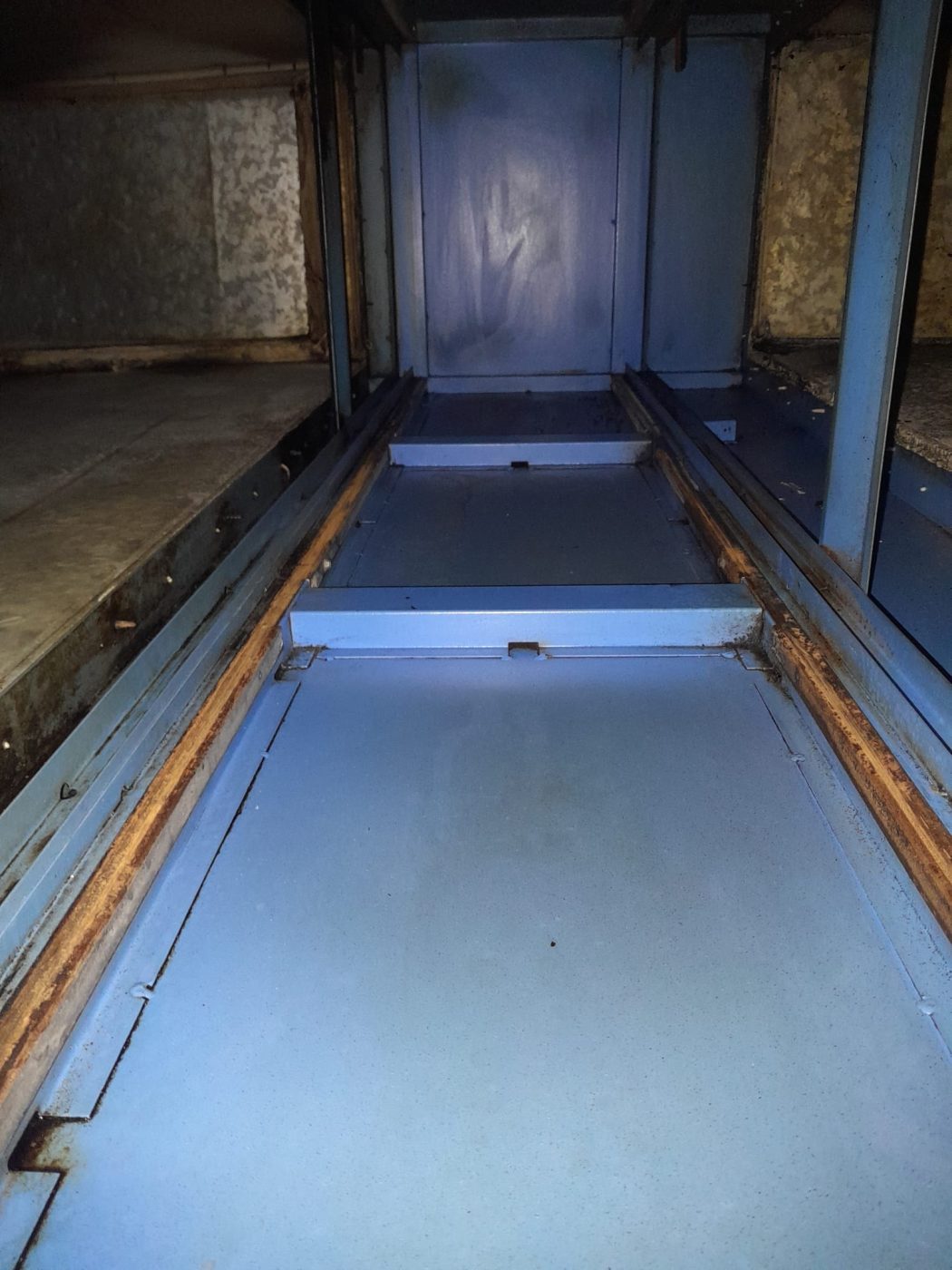
Pictured above: the inside of an exhaust section on one of our projects (Sushi Go, VivoCity), photographed with a torch. It is here to show what the system is made of on the inside: the metal that hot, wet, greasy air passes across every time the fan runs.
The last order goes out. The cooks wipe down, someone reaches for the fan switch, and the hood goes quiet. It feels like the right moment, because nothing is being cooked.
It is usually the wrong one. A kitchen that has just stopped cooking is not a cold kitchen, and the exhaust is still doing a job. This post is about that gap: what is still happening under the hood after the last order, when the fan can come off, what a timer or a variable speed drive can and cannot safely do, and how to make sure it is somebody’s job rather than whoever happens to be nearest the switch.
Hot surfaces and hot oil carry on producing vapour well after the last plate leaves the pass. A fryer that has just been turned down is still a vat of hot oil. A wok range, a griddle, a grill and the oven behind them are all still hot, and all still giving off heat, steam and a little grease into the air above them.
With the fan running, that goes where it was designed to go: into the hood, through the filters and out through the duct. With the fan switched off at that moment, the same vapour has nowhere to go. It drifts into the kitchen and into the ceiling void, and it settles on whatever is cool enough to catch it. Charcoal and wood make this more pronounced: a charcoal bed or a wood oven keeps burning, and keeps putting heat and smoke into the hood, long after the last order, which we covered in solid-fuel kitchens and their exhaust.
The practical rule is the one we give kitchen teams for the daily routine: the fan goes on before cooking starts and stays on after the line shuts down. Cool-down is the part that gets skipped. It is covered, with the rest of what a kitchen team does each day, in what your kitchen team does daily decides what the deep clean costs.
We cannot give you a number of minutes from here, and we would be wary of anyone who does without seeing the kitchen. What decides it is what was cooked, how much oil is still hot, how big the line is and whether anything on it is solid-fuel. A light line will be ready sooner than a heavy wok and fryer line. The honest test is a physical one: the fan can come off when the line has cooled and the hot surfaces under the hood have stopped giving off vapour, not when the shift ends.
If you want a working figure for your own kitchen, set it from what you can see. Stand at the line a little after the last order. Is anything still steaming, smoking or shimmering? Is the oil still hot? Can you feel heat rising into the hood? When the honest answer to all three is no, that is your cool-down. Write it on the shift sheet so it is not a guess made by tired people at midnight.
In many kitchens the gas supply is interlocked with the exhaust fan, so that gas cannot be on unless extraction is running. We explained the logic, and the most common way it goes wrong, in hood, fan, gas and suppression interlocks.
Two consequences matter here.
It also works the other way. If the gas will not light next morning, look at whether the exhaust fan is actually running before you look at anything else. A fan that tripped, or a control left on manual, is the usual reason.
Some kitchens put the fan on a time clock so that nobody has to remember. That is a sensible idea, and it fails in predictable ways.
If you use a timer, give it a run-on after the scheduled stop rather than an exact finish, and tell every shift that it exists. The exact interval is something to settle for your kitchen, not copy from another.
Where the fan is fitted with a variable speed drive (VSD), there is a third option between full speed and off. We have described VSD control by a timer schedule, a cooking sensor, a temperature probe or a manual speed selector, with a minimum speed set so that airflow never drops below what the hood needs to work safely while cooking.
That minimum applies while the kitchen is cooking. A lower after-service speed is a different setting with a different purpose, and it should be set and recorded by whoever commissions the drive, not by a cook pressing buttons on the panel. If your kitchen has a VSD and the fan is being switched fully off straight after the last order, ask whether the drive can be scheduled to step down instead. Also check what it does after a power cut: a drive that has reset can leave the fan turning far slower than the line needs, which we noted in reopening a kitchen after a long closure.
The fan is not the only thing wired to the switch. Before changing when it stops, find out:
The simplest fix is not technical. Put the fan on the closing checklist, name the role that owns it, and add a line for the cool-down check: is anything still hot, steaming or smoking under the hood, yes or no, then the time the fan was switched off. A one-minute log of this kind also gives you a dated answer when a landlord, an inspector or an insurer asks how the system is looked after.
If you are not sure how your fan is wired, whether it is on a timer, whether it is on a drive, or what stops when it stops, that is worth finding out at the next service visit. Ask for the answer to be written in the report rather than given by word of mouth.
Not sure how long your fan should run after service, or what it is wired to? WhatsApp BC Air on 8989 2833 with your location and what you cook, and we will tell you what we would check. Routine upkeep is on the maintenance page, cleaning on the exhaust cleaning page, and repairs to fans, motors and control panels on the repair page. Scope and pricing follow an inspection.
Related reading: what your kitchen team does daily · hood, fan, gas and suppression interlocks · preparing for a night clean
We design, clean, repair and maintain commercial kitchen exhaust systems across Singapore — on 24/7 standby.