12 Oct 2026 · Maintenance
Gas flames that lean, lift or go out when a kitchen exhaust runs are usually reacting to the air, not the stove. A kitchen short of replacement air pulls draughts through doors and gaps, and a draught across the cooking line bends flames sideways. Open a door while the exhaust runs and watch: if flames settle, the kitchen is short of air; if they lean harder, something is blowing across the line. One burner misbehaving with the exhaust off is a gas-side fault for a licensed installer. A bigger fan usually makes it worse. Quote-only.
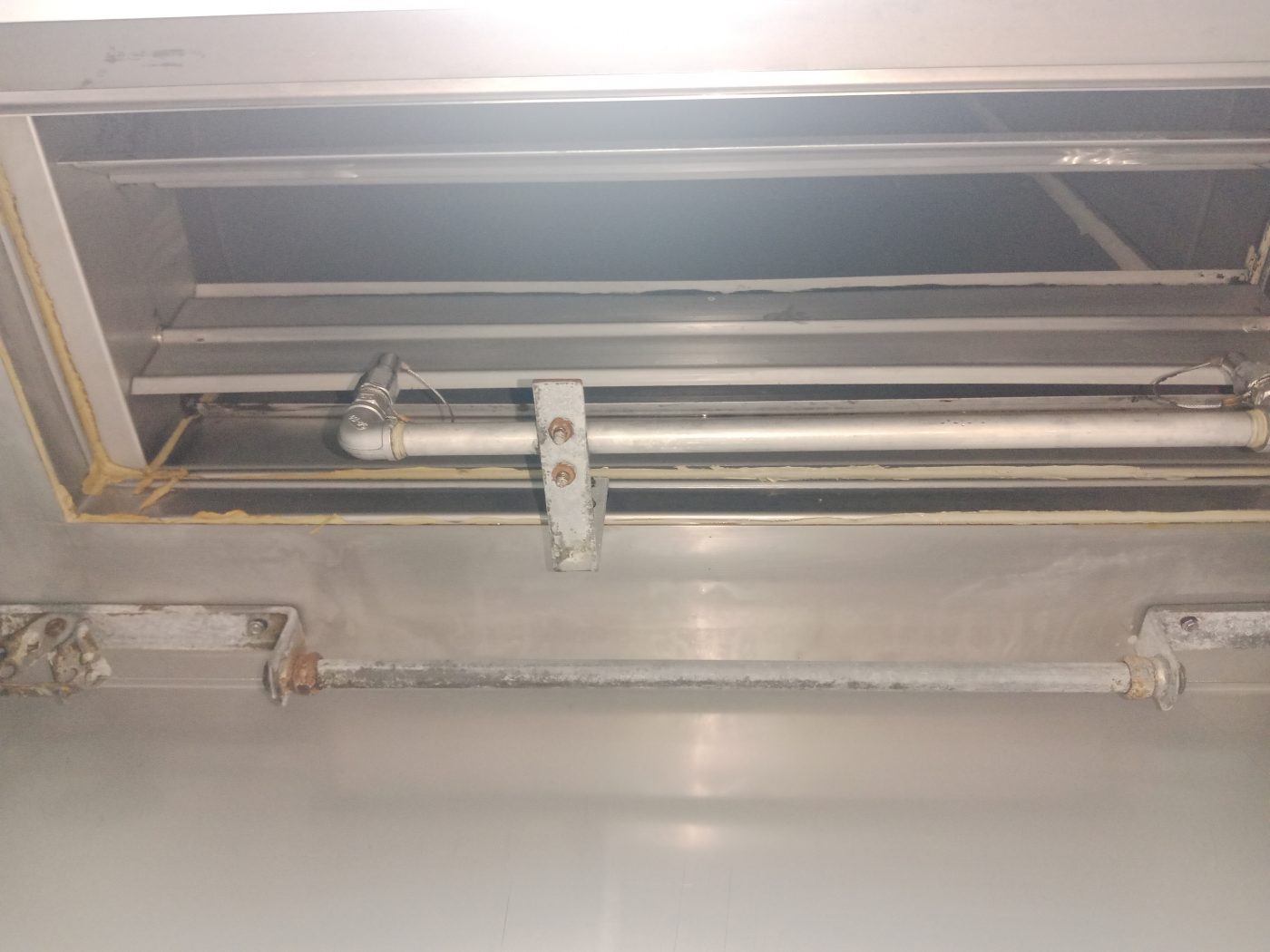
Pictured above: looking up inside a hood over a cooking line, at the filter bank and the fittings fixed beneath it, on one of BC Air’s projects (Timbre, Yishun). This is a photo from our own work, reused here because it shows the space the flames sit under. Whatever the burners below are doing, the air that feeds them has to get through here.
The flame on one wok burner leans hard towards the back of the hood. The one next to it lifts off the burner and roars. A pilot goes out every time the back door shuts. The cook says the stove is faulty, the gas company says the stove is fine, and the exhaust contractor says the fan is working. Everybody is right, and the flames are still misbehaving.
Gas flames are the most sensitive instrument in the kitchen. They react to the air movement around them long before anyone can feel a draught or read a figure off a gauge. When a flame behaves differently with the exhaust running than it did the day the stove was installed, it is telling you something about the room’s air. This is how to read it, what you can safely check, and which part belongs to whom.
A flame that is starved of air burns badly. It runs yellow and lazy, throws soot, and can produce carbon monoxide, which you cannot see or smell. A flame that blows out while the gas keeps flowing fills the space with unburnt gas. Neither is a nuisance to put up with until the next service.
“The flame is unstable” covers three separate faults. They need different people, so the first job is telling them apart.
The exhaust fan removes air and every cubic metre has to come back in from somewhere. When there is no designed path for it, the kitchen goes into negative pressure and pulls air through whatever gaps it can find: the back door, the drain, the gap under the shutter. Flames near those paths lean towards them or flicker, and burners can lift, lean or refuse to stay stable. That is one of the recognisable negative-pressure symptoms we describe in make-up air and air balancing, next to doors that are hard to open and a kitchen that smells of drain.
The clue: it is worse when the exhaust is running hard, worse at peak when every burner is lit, and it changes when a door is opened or shut.
Replacement air is not harmless just because it exists. Air blown or drawn across the cooking line strips the thermal plume off the equipment and bends flames sideways. A supply outlet aimed at the line, a door opening straight onto the burners, a fan-coil blowing across the end of the range: any of them can push a flame off a burner or out of the hood’s capture zone. A make-up air path has to arrive low, slow and away from the capture zone, which is why where it enters matters as much as how much of it there is.
The clue: the flames lean the same way every time, usually away from one particular opening, and the burners nearest that opening are the worst.
Some flame faults are on the gas side: a blocked burner port, a dirty orifice, a regulator that is out of adjustment, a pilot assembly that is worn. The classic sign is one burner misbehaving while its neighbours stay steady, and doing it with the exhaust off as well. That is a job for a licensed gas installer or the appliance supplier. BC Air looks at the air side of the system, not the gas appliances.
The clue: the same burner, the same behaviour, whatever the fan and doors are doing.
None of this needs tools. Do it at a quiet time with someone watching the burners and someone at the door.
Do not respond by turning the fan down to calm the flames and calling it solved. Less extraction means less capture, so heat, smoke and grease go into the room instead. The flame problem has gone, and a worse one has arrived.
When the flames misbehave, the instinct is to ask for more extraction or to blame the stove. The more usual cause is that the exhaust is already pulling more air than the kitchen can replace. A bigger fan removes more air from a room that is already short, deepens the negative pressure and makes every symptom stronger, including the flames.
The same applies to a fan that was changed. A new motor or drive that moves more air than the old one changes the balance of the whole room, and the first thing to show it is often the flame on the burner nearest the door. We cover the airflow checks that belong after a change like that in after a fan, motor or drive replacement.
It depends on which problem you have. In outline:
Whichever applies, the repair should end with a measurement and not an opinion: the airflow at the hood, the pressure relationship between kitchen and dining area, and a capture check with the equipment actually running. Our CFD modelling and air balancing service covers modelling airflow at design stage and measuring it at commissioning.
We do not publish a price for this work. It depends on what the survey finds: whether the kitchen is short of replacement air, whether something is cutting across the line, how many hoods share the fan and how accessible the dampers and supply outlets are. We assess the kitchen first and quote from what is there.
Flames behaving differently since the exhaust changed? WhatsApp BC Air on 8989 2833 with the details above. We are on 24/7 standby, and scope and pricing follow an assessment. If you can smell gas, shut the gas supply and call your gas supplier first.
Related reading: make-up air and air balancing · hood, fan, gas and suppression interlocks · the exhaust is running but the kitchen is still smoky
We design, clean, repair and maintain commercial kitchen exhaust systems across Singapore — on 24/7 standby.