21 Sep 2026 · Design & Build
A kitchen exhaust hood is sized against a specific list of appliances in specific positions, so adding a heavier-duty appliance changes the assumption the system was built on. Check four things before ordering equipment: whether the new appliance is hotter, greasier or smokier than what it replaces; whether it sits properly under the hood with the designed overhang; whether the fire suppression nozzles still cover it in its new position; and whether make-up air can match any increase in extract.
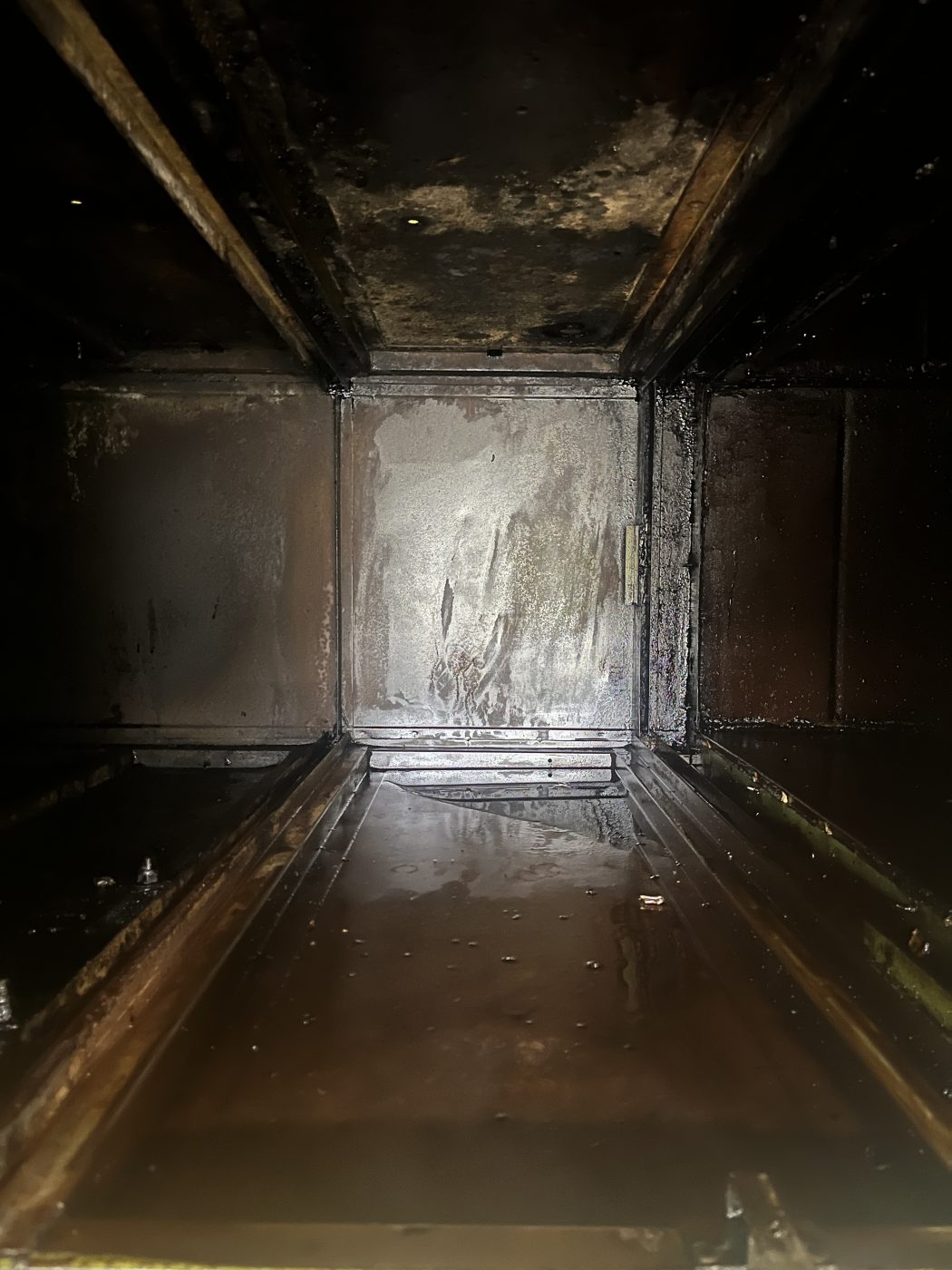
Pictured above: the inside of a grease-laden exhaust duct at an access panel, from our project archive (Khan Saab, Chai Chee). This is what a cooking line puts into the ductwork, and it is why the cleaning interval follows the menu rather than the calendar.
It is one of the most common calls we get, and it almost always comes too late. The kitchen has been running for a year or two. The menu has grown. A wok range is going in where the griddle was, or a second fryer is being squeezed onto the end of the line, or a salamander is being added above. The equipment is already ordered, sometimes already delivered, and someone asks whether the exhaust will cope.
Sometimes it will. Often it will, with an adjustment. Occasionally it will not, and the reason is not the one operators expect. Here is what actually changes when you put a new appliance under an existing hood, and why the call should come before the purchase order rather than after.
This is the part that gets missed. A kitchen exhaust hood is not a generic box that removes air from a room. It was sized, positioned and its extract rate set against a specific list of appliances in specific positions, because different cooking duties throw off very different amounts of heat, grease and smoke, and they throw it off in different directions.
Swap a piece of equipment for something of a heavier duty and you have changed the assumption the whole system was built on. The hood does not know that. It carries on extracting at the rate it was set to, and the difference shows up as grease and smoke escaping at the edges of the line instead of being captured.
The practical test is simple: if the new appliance is hotter, greasier or smokier than what it replaces, the extract question is real. If it is equivalent or lighter, it usually is not. What matters is duty, not footprint — an appliance can be the same size and a great deal heavier in what it produces.
Even where the extract rate is adequate, capture depends on the appliance being under the part of the hood designed to capture it, with the right overhang around it. Push a new unit onto the end of the run so that it sits half outside the hood, and it does not matter what the fan is rated at. The plume is not under the hood.
The same applies to height. An appliance that is significantly taller than the one it replaced changes the distance between the cooking surface and the filters, and that distance is part of the design.
So the question to ask is not only "can the fan handle it" but "does it sit properly under the hood, with the overhang the line was designed with".
If your kitchen has a fire suppression system over the cooking line, this is the part to take most seriously, because it is the part with a consequence that is not about performance.
A suppression system is designed with nozzles aimed at specific appliances in specific positions. The coverage is not a general blanket over the whole line. Move an appliance along the line, swap it for a different type, add one, or raise its height, and the protection that was designed for that position may no longer be protecting what is now standing there. A fryer that has been shifted a metre along can end up outside the coverage it was commissioned with.
Any change to the cooking line is a reason to have the suppression design reviewed. That is not an upsell, it is the whole basis on which the system was accepted. If you are adding a deep fryer in particular, raise it early — hot oil is exactly the risk these systems exist for.
If the answer to a heavier line is to increase the extract rate, that decision does not stop at the fan. Air being pulled out of the kitchen has to be replaced, and if the make-up air supply is not increased to match, the kitchen goes more negative than it was designed to.
You feel that before you measure it. Doors become hard to open or pull themselves shut. Air drags in from the dining room, taking the kitchen's heat and smell with it the wrong way. And capture at the hood actually gets worse rather than better, because the air simply is not there to be drawn in.
So "just turn the fan up" is rarely a complete answer. Extract and make-up air are one system and they are balanced against each other.
Almost every expensive version of this problem comes from doing it in the wrong order. The version that works:
Doing it this way costs a site visit and a conversation. Doing it the other way round is how an operator ends up with a new fryer that cannot be commissioned, or a kitchen that fills with smoke on the first busy service and has to be fixed while trading.
Changing your cooking line? WhatsApp BC Air on 8989 2833 with your location, what is on the line now and what you want to add, and we will tell you what needs to change before you order. How hoods are sized is on the commercial kitchen ventilation page, suppression on the fire suppression page, and cleaning intervals on the cleaning frequency page.
Related reading: how we size a hood to the cooking line · make-up air and air balancing · when a kitchen exhaust fails inspection
We design, clean, repair and maintain commercial kitchen exhaust systems across Singapore — on 24/7 standby.