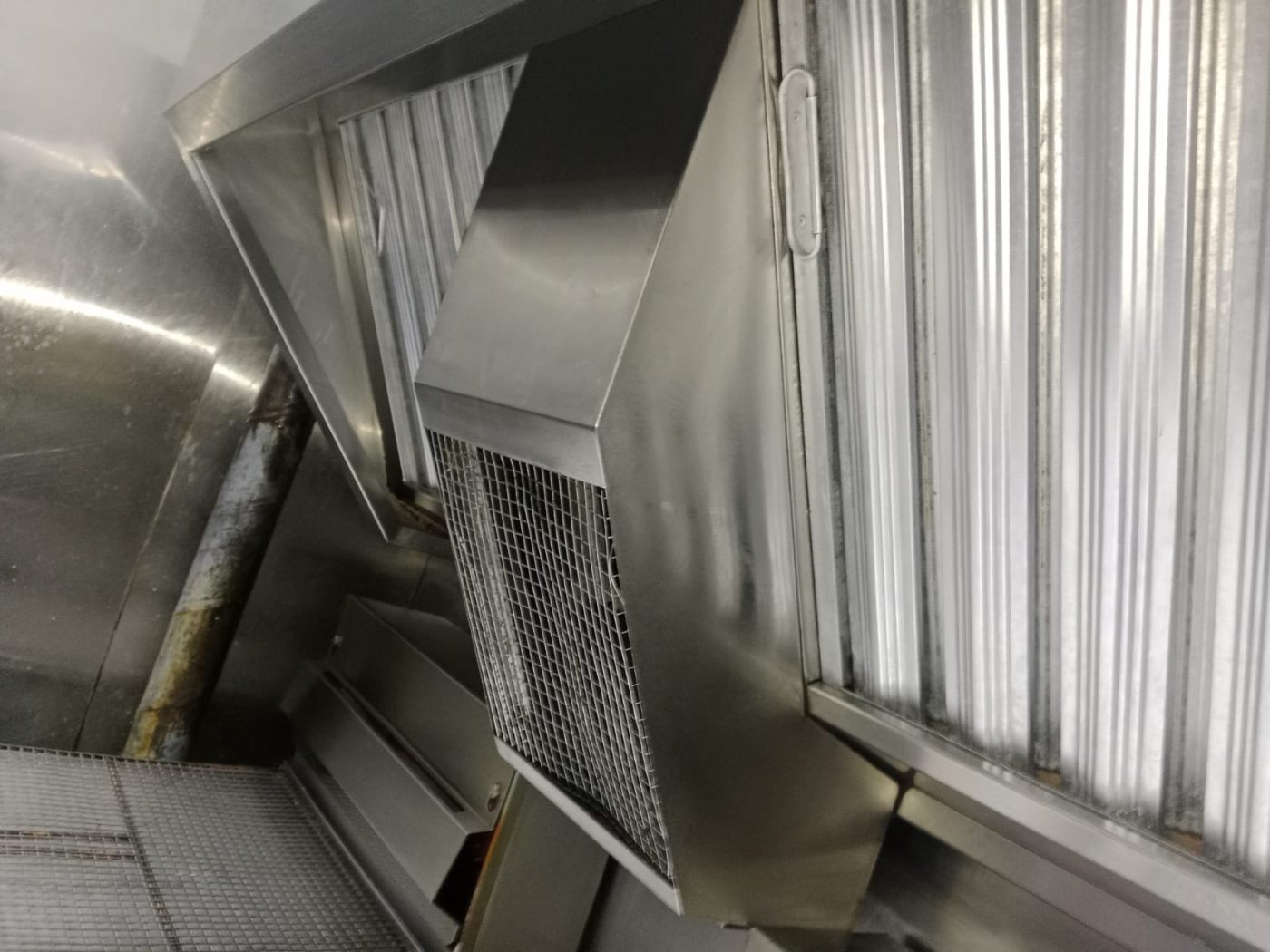
Pictured above: a hood and its baffle filters on one of our projects (Old Chang Kee, Aljunied). The filters only do their job while the fan is pulling air through them, which is the whole point of this post.
It is the middle of the lunch rush. The lights flicker, the screens go dark for a second, and the kitchen carries on. Then someone notices the cooking line is quiet in a way it was not before: the roar of the exhaust fan has gone, and smoke is starting to sit under the hood instead of leaving through it.
A short power dip or a power trip is easy to forget about, because the lights come back and the till restarts. The exhaust fan is the one piece of equipment that may not. This post is about what happens to a commercial kitchen exhaust when the power drops for a moment, why some fans come back on their own and some do not, and what a kitchen team should do in the first five minutes.
Why your fan may not come back on its own
When power is lost, the fan stops. What happens when power returns depends on how the fan was wired, and that is a design choice, not a default.
- Some fans restart by themselves. The control is set so that the starter pulls in again as soon as power is back. The kitchen may never notice, apart from a gap of a few seconds or minutes.
- Some fans wait to be started. The starter drops out when the power goes and stays out until somebody presses the start button or turns the switch off and on again. Nothing is broken. The fan is doing what it was built to do, which is not to start on its own while someone may be working on it.
- Some fans are on a variable speed drive (VSD). A drive can be set to restart on its own, to wait for a command, or to show a fault and hold until it is cleared. The same drive can behave differently after a long outage and after a short dip, and what it does depends on how it was commissioned.
We cannot tell you from here which one you have. What we can say is that the person on the evening shift should not be finding out for the first time during a power dip with a full dining room. Ask your service contractor to write it down: when the power comes back, does this fan restart by itself, or does it wait for someone?
What is happening under the hood while the fan is down
The cooking does not stop when the fan does. The fryers, woks and grills are still hot, and the oil on them is still giving off vapour. With no extraction, that vapour and the heat leave the hood the other way: into the kitchen, into the ceiling void, and into the dining area if the hood is close to it. The baffle filters and the duct do nothing while there is no airflow through them.
That is why we would not keep a fryer or a wok running at full tilt under a hood with no extraction, and why the first job after a dip is to find out whether the fan is actually turning. It is the same reasoning as in our post on leaving the fan on after the last order: hot surfaces keep producing vapour, and the fan is what carries it out.
The gas, the make-up air and the suppression system
The fan is usually not the only thing that reacts to a loss of power. Three other connections are worth knowing about before it happens.
- The gas. Where the gas supply is interlocked to the exhaust, a fan that is not running can mean the gas will not come on or will not stay on. That is the interlock working, not a fault. We explained the logic, and the most common way it goes wrong, in hood, fan, gas and suppression interlocks. If the gas will not light after a dip, look at whether the fan is running before anything else.
- The make-up air. If the kitchen has a make-up air unit, it has its own supply and its own controls. It may restart on its own, or not, independently of the exhaust fan. What the kitchen does while one is running and the other is not is part of the design, and it is worth asking about.
- The suppression system. Ask whether the detection and the shut-offs on yours depend on mains power, and what they are set to do when power is lost and when it comes back. That is a question for the company that serviced it, and the answer should be in its documentation, not in somebody’s memory.
The first five minutes after a dip
- Look and listen. Is the fan turning? A running fan is audible from the hood. If the hood is quiet and the line is still hot, treat it as having no extraction.
- Ease off the cooking. Do not carry on at full load. The smoke at the hood front is the first warning, not the last.
- Check the display, if there is one. If the fan has a VSD or a control panel, take a photo of what it shows before anyone touches it. A fault code is the quickest way for an engineer to tell what happened.
- Reset once, at most. If your procedure allows it, restart the fan once. If it trips again, or starts and stops, leave it off and call. A fan that keeps tripping is telling you something is wrong downstream, and repeated resets are how a motor that needed a look becomes one that needs replacing. We say the same in our guide to troubleshooting commercial kitchen ventilation.
- Do not bypass anything. If the gas will not come on because the fan is down, the answer is a running fan, not a way round the interlock. A bypass put in on a busy night is almost never taken out again.
- Write it down. Time of the dip, what the fan did, what you did, and how long until normal. That one line is useful the next time it happens, and useful to the engineer when he arrives.
If the power was out for hours rather than seconds, the checks are closer to a restart after a closure than a restart after a dip; the restart checks after a long closure cover what to look at first.
Questions to settle on a quiet day
None of the following needs to be decided during a power dip, and all of it is easier before one.
- When power returns, does the exhaust fan restart on its own, or does someone have to start it? Is that written on a label at the panel?
- Who on each shift knows where the fan’s start switch or panel is, and who is allowed to use it?
- If there is a make-up air unit, does it restart on its own, and what does the kitchen do in the gap between the two?
- If the fan has a VSD, what does it do after a power cut, and at what speed does it come back?
- Do the gas interlock and the suppression system depend on mains power, and what do they do when it is lost and when it returns?
- Who do you call, and is the number on the wall at the line?
Put the answers on a single sheet by the panel. The team on a Friday night will not remember a conversation from a service visit months ago, but they will read a sheet.
The short version
- A power dip stops the exhaust fan. Whether it starts again by itself depends on how it was wired, so find out which yours does.
- The cooking line stays hot while the fan is down, and the vapour has nowhere to go. Do not carry on at full load without extraction.
- Check the fan first, then the gas, the make-up air and the suppression system; they may react differently.
- Photograph any fault display, reset once at most, and never bypass an interlock to keep cooking.
- Settle the restart questions and write the answers on a sheet by the panel before the next dip.
Not sure what your fan does when the power comes back? WhatsApp BC Air on 8989 2833 with your location and what you cook, and we will tell you what we would check. Fan, motor and control panel faults are covered on the repair page, routine upkeep on the maintenance page. Scope and pricing follow an inspection.
Related reading: hood, fan, gas and suppression interlocks · troubleshooting commercial kitchen ventilation · restart checks after a long closure
Questions
Common questions
Will a kitchen exhaust fan restart by itself after a power cut?
It depends on how the fan was wired. Some fans restart on their own when power returns, some wait until someone presses the start button, and a fan on a variable speed drive follows whatever the drive was set to do. Ask your service contractor to write down which one yours is.
What should I do if the exhaust fan has stopped after a power dip?
Check whether the fan is actually turning, ease off the cooking while there is no extraction, and photograph any fault display before touching it. Restart the fan once if your procedure allows. If it trips again or starts and stops, leave it off and call for help.
Why will the gas not light after a power trip?
Where the gas is interlocked to the exhaust fan, gas cannot come on unless the fan is running. If the fan has not restarted after the dip, the interlock is doing its job. Get the fan running instead of bypassing the interlock.
Is it safe to keep cooking while the exhaust fan is off?
We would not keep a fryer or wok running at full load under a hood with no extraction. Hot oil keeps giving off vapour and the heat and smoke leave the hood into the kitchen instead of through the filters and duct.
Does the fire suppression system need mains power?
That depends on how it was designed and what it is connected to, and we cannot tell from here. Ask the company that services it what the detection and the shut-offs do when power is lost and when it returns, and ask for the answer in writing.