
14 Sep 2026 · Troubleshooting
To troubleshoot a commercial kitchen ventilation system, treat it as a chain - hood, filters, plenum, duct, fan, discharge, controls and make-up air - and find the weak link before replacing any part. A stopped fan points to power, controls or the motor; a running fan with a smoky kitchen points to filters, the plenum or missing make-up air. Reset a tripped breaker once at most, isolate before opening anything, and record when the fault started, what changed and what the control panel shows before calling a technician.
Most ventilation faults in a commercial kitchen get reported in one of a handful of sentences. The fan has stopped. The kitchen is smoky. It has gone loud. It is unbearably hot on the line. Grease is dripping from the hood. The neighbours are complaining about the smell. Each of those sentences can come from several different parts of the system, which is why a first call-out so often ends with a part replaced and the same problem back the following week.
A kitchen extract system is a chain. The hood captures, the filters separate grease, the plenum and duct carry the air, the fan moves it, the discharge releases it, the control panel switches and protects the motor, and make-up air replaces what leaves. Troubleshooting is working out which link is weak. This is the order to do it in, what your own team can safely look at, and what to write down before anyone arrives, so the first visit fixes the right thing.
The fan is not running at all. Work from the kitchen outwards. Is the switch or control panel actually calling for the fan, or was it switched off at closing? Has a breaker or motor overload tripped? Is there an isolator near the fan, on the roof or in the riser, that someone has turned off for other works? If the system has a variable speed drive, is its display showing a fault? If power is reaching the motor and it hums without turning, or starts and stops, the problem is the motor, a bearing, a belt or the starter, and it needs a technician. The first checks are in kitchen exhaust fan not working, and the usual causes in why exhaust fan motors fail.
The fan runs, but the kitchen is smoky. Here the fan is rarely the suspect. Look at the filters (clogged, missing, fitted the wrong way round, or mesh sitting where baffles belong), at the plenum behind them, and at the air coming in. A test that costs nothing: open a door to the outside while the line is cooking. If capture improves straight away, the kitchen is short of make-up air. The full order of checks is in the exhaust is running but the kitchen is still smoky.
Smoke escapes at one station only. Something local has changed. A new or bigger appliance under a hood that was sized for the old one, a filter missing from that section, or a menu change that has put more grease vapour into one position than the hood was designed around. See when a menu change outgrows your kitchen exhaust.
It has gone louder, or it vibrates. A new squeal or rattle from the fan end is usually mechanical: a belt, a bearing, or an impeller thrown out of balance by grease on the blades. A steady roar or a hum carried through the structure is a different problem with a different fix, and treating one as the other is where money gets wasted. Kitchen exhaust noise and vibration complaints sets out how to tell them apart.
The kitchen is hotter than it used to be. Gradual heat build-up usually means extract volume has fallen slowly: filters loading up, grease narrowing the plenum and duct, a belt starting to slip. Kitchens adapt to it rather than reporting it, so compare with how the line felt a few months ago, not yesterday.
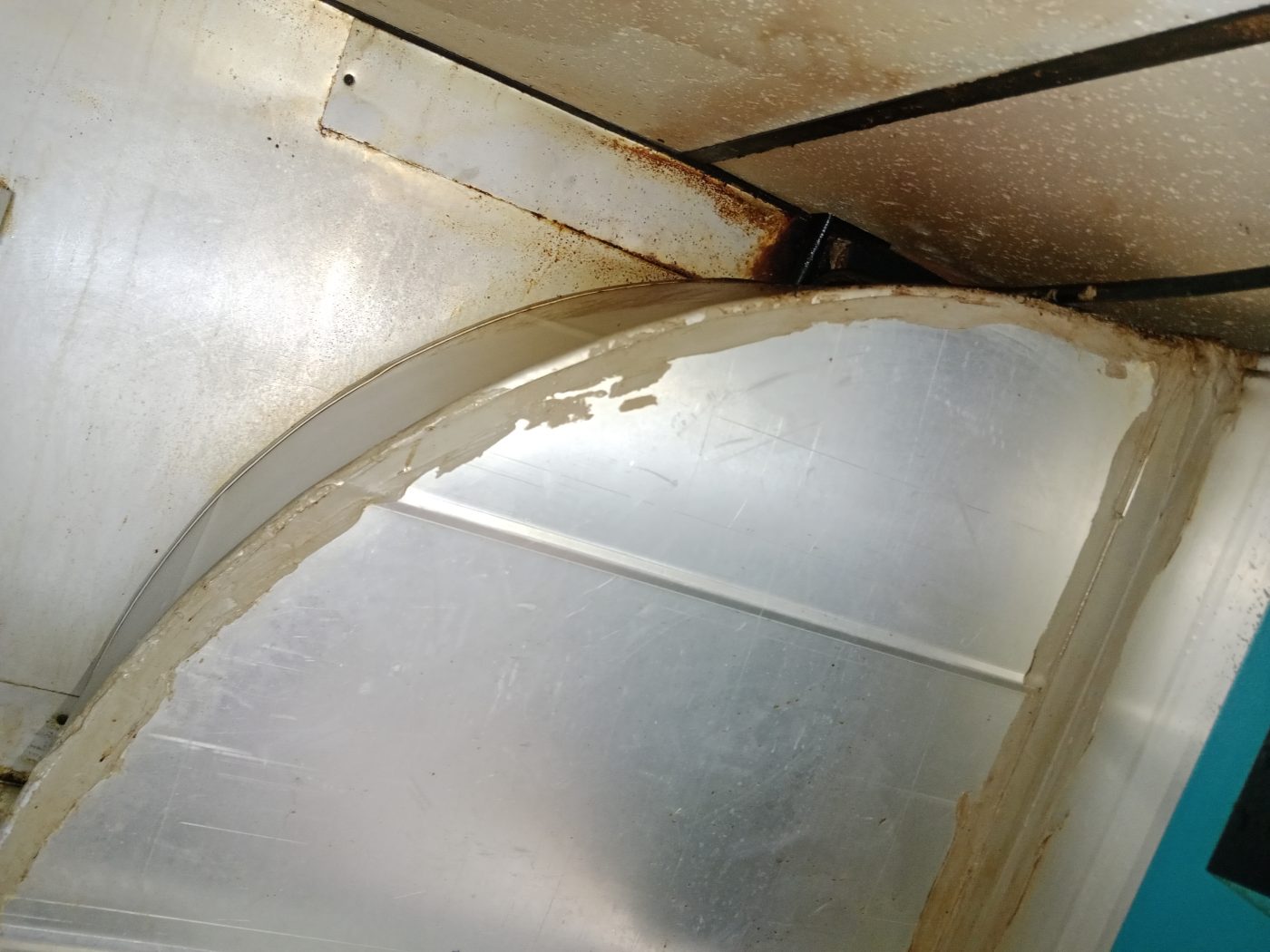
Grease is dripping from the hood, or staining the ceiling around it. Check the grease channel and cup first: overflowing means it is not being emptied often enough, and filters fitted backwards drain into the hood instead of the channel. If the channel is fine, liquid is coming from further up: condensate and liquefied grease running back from a duct with no fall, or leaking at a joint. The photograph at the top is from our project portfolio, looking up at exhaust metalwork: sealant lifting along a curved edge and rust-brown staining along the joints. That kind of staining is worth photographing, because it shows where liquid has been running. Why ducts leak is covered in what your kitchen exhaust duct is made of.
Doors are hard to pull open, or whistle when shut. The kitchen is extracting more air than it is replacing. A bigger fan makes this worse, not better. The supply side is explained in make-up air and air balancing.
Neighbours are complaining about the smell. Look at where the duct discharges, how clean the system is, and whether the filtration suits what you cook. The discharge end is covered in where your kitchen exhaust actually discharges.
The slowest part of most call-outs is not the repair. It is reconstructing what happened from a kitchen team that was busy when it happened. Ten minutes with a phone saves most of that:
A named cause, not "reset and running". If the fix was a reset, ask what tripped and why. A fault that cleared itself has not been found.
A check that the hood captures afterwards. A fan that turns is not the same as a kitchen that is extracted. Airflow and capture at the hood are on our kitchen exhaust servicing checklist for exactly that reason: clean or repaired but underperforming is still a problem.
An honest line between today's repair and what fails next. Sometimes a repair is the right call; sometimes an ageing motor is about to fail again, and a repair that buys little time is not a saving. Either way the price should be clear before the work is done.
Scepticism about the bigger-fan answer. When the symptom is smoke with the fan running, or doors that are hard to open, a larger fan usually treats the wrong link.
We stock motors, MV fans, fan parts, control panels and starters in-house, and in many cases the technician can diagnose on site and replace on the same visit. We also work on exhaust equipment we did not install. But a part in the van only helps if it is the right part. That is the whole point of the pattern above: it turns a first visit that guesses into one that fixes.
A fault that returns is no longer a breakdown. It is either an interval problem or a design problem. The same motor failing again points at grease on the impeller, belt tension, or a fan working against more resistance than it was chosen for. The same smoky kitchen straight after every clean points at capture or make-up air rather than dirt. Both are cheaper to settle on a schedule than mid-service, which is what our maintenance programmes are for, and the cost argument is in why preventive maintenance beats a breakdown.
If your kitchen ventilation is misbehaving now, WhatsApp us on 8989 2833 with what is happening, when it started and what the control panel shows, and we will tell you which link to look at first. Our kitchen exhaust repair page sets out what we repair and replace; we are on 24/7 standby, and scope and pricing follow a site inspection.
We design, clean, repair and maintain commercial kitchen exhaust systems across Singapore — on 24/7 standby.