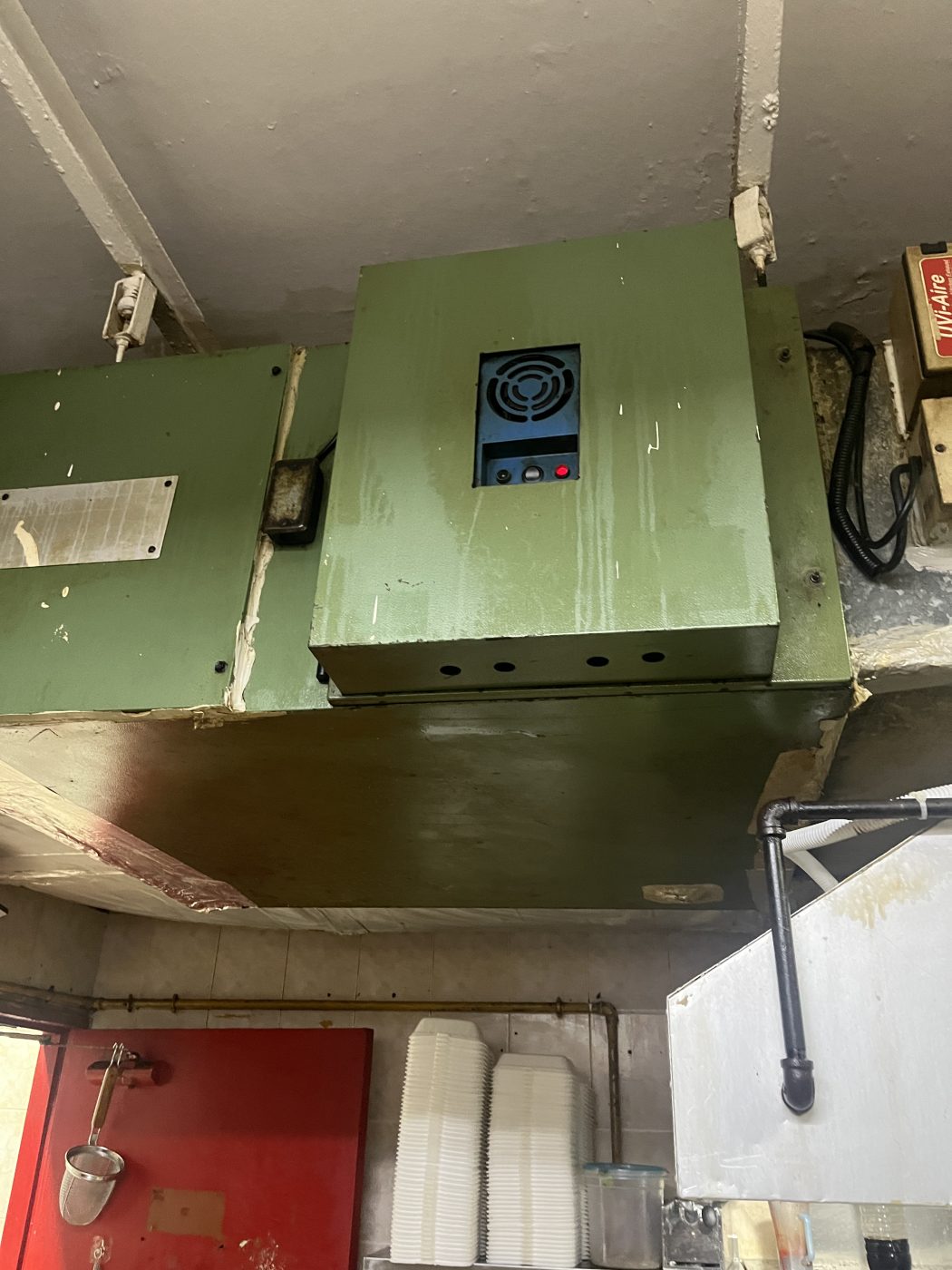
Odour complaints get attention because they are obvious. Noise complaints are the ones that close kitchens.
A smell drifts and people argue about where it came from. A hum does not drift — it arrives through the building structure, it is there every evening at the same time, and the person above you can point at exactly when it starts and when it stops. That makes it easy to attribute and easy to escalate, which is why noise is the complaint most likely to end in a letter from building management with a deadline on it.
It is also, more often than not, fixable — but only if you work out which of the three things you actually have.
Three different problems that all get called "noise"
Airborne noise. Sound travelling through the air — the roar at the discharge point, the rush at a grille, the fan itself heard through a wall. This is the one people expect, and usually the least of the three.
Structure-borne noise and vibration. The fan is mechanically coupled to the building. Its out-of-balance forces go into a slab, a beam or a wall and re-radiate somewhere else entirely — often two floors up, often in a room with no obvious connection to your kitchen. This is the complaint that arrives from a tenant you have never met, and it is by far the most common cause of a dispute that will not go away.
Regenerated noise in the duct. Air moving too fast, or moving through something it does not like — a sharp bend, a badly made transition, a damper left half closed. The fan is behaving; the ductwork is making the noise. This one is often self-inflicted after a fit-out change, and it is closely related to what we cover in how duct routing affects performance.
The reason to separate them before doing anything is that the fixes do not overlap. Anti-vibration mounts do nothing for a whistling damper. A silencer does nothing for a fan bolted rigidly to a slab.
What we usually find
- The fan is hard-mounted. Bolted directly to concrete or to a steel frame that is itself bolted to concrete, with no anti-vibration mounts, or with mounts that have been shimmed solid during a later repair. A fan that was fine at commissioning becomes a problem the day the mounts are bridged.
- Rigid duct connections at the fan. Flexible connectors at the inlet and outlet exist so that the fan can move without dragging the whole duct run with it. When they harden with grease and heat, or when a replacement fan is installed without them, the duct becomes a very efficient loudspeaker for the fan.
- An imbalanced or worn impeller. Grease loads onto the blades unevenly. As the imbalance grows, the vibration grows with it, and it grows quietly enough that nobody notices until a neighbour does. Worn bearings do the same thing with a different signature. Both show up long before failure — which is the argument in exhaust fan motor failure.
- Duct velocity too high. A duct sized for one hood now serving two, or a fan replaced with a larger one to "fix" poor capture, pushes air faster than the duct was designed for. Noise rises steeply with velocity, so a modest increase in airflow can be a dramatic increase in noise.
- A duct that touches something it should not. A duct resting on a ceiling hanger, a wall penetration packed hard instead of resiliently sealed, a support rod screwed to a partition that a bedroom is on the other side of. These are the ones that produce a complaint from a room nowhere near the kitchen.
- Loose access panels, dampers and unsupported flexible sections — rattles rather than hums, and usually the cheapest thing on the list to fix.
How to find out which one it is, before spending anything
A short structured check settles most cases:
- Establish when it happens. Only during service hours? Only at full speed? Only when the make-up air unit is also running? A noise that appears only in a certain combination points at the interaction, not the fan.
- Switch the fan off and listen. Obvious, and frequently skipped. If the complaint persists with the kitchen exhaust off, it is somebody else's plant and you have just saved yourself a great deal of money.
- Feel the structure, not the fan. Hand on the slab, the wall, the duct support, at increasing distance from the fan. Vibration you can feel three metres away in the structure is a structure-borne problem regardless of how the fan sounds standing next to it.
- Listen where the complaint is, not where the fan is. This sounds obvious and it is the step most often missed. The character of the sound in the complainant's room — a low hum, a whine, a rattle — tells you more than anything measured in the kitchen.
- Check what changed. Almost every new noise complaint follows an event: a fan replacement, a speed increase, a new tenant above, a fit-out, a repair where a mount was packed out to make something line up.
The fixes, cheapest first
- Clean and rebalance the impeller. On a kitchen fan, uneven grease loading is a genuinely common cause of a vibration complaint, and cleaning is work the system needs anyway. Sometimes the whole problem.
- Restore the anti-vibration mounts. Correct mounts, correctly selected for the weight, free to move, with nothing bridging them — no rigid conduit, no packed shim, no support rod added later.
- Restore flexible connectors at the fan inlet and outlet, and check they are actually flexible rather than grease-hardened.
- Break the contact paths. Resilient hangers for the duct, resilient packing at wall and slab penetrations, and no support taken off a partition that separates the kitchen from an occupied room.
- Attenuation. A silencer sized for the duct, or an acoustic enclosure at the discharge — effective for airborne noise, and useless if the path is structural. This is why the diagnosis has to come first.
- Reduce speed where the airflow allows it. If the system was over-specified, or if it only needs full extraction during peak cooking, a drive can take the fan down at quiet times — which is also where the energy case is, as we set out in variable speed drives. Never at the cost of capture at the hood: a quiet kitchen that does not capture grease has traded a noise complaint for a fire risk and an odour complaint.
- Re-size or re-route the duct. The real answer where velocity is the cause, and the most expensive one. Worth establishing properly before it is proposed.
The mistake that costs the most
Fitting a silencer because a silencer is what you fit for noise, without establishing whether the path is airborne or structural. It is a real cost, it involves opening the duct, and where the transmission is through the slab it changes nothing at all. The complaint continues, the operator has now spent money and can show they tried, and the next conversation with building management is harder rather than easier.
The second most expensive mistake is turning the fan down until the complaint stops. It works, until the kitchen fills with smoke at dinner service and the grease that is no longer being captured starts loading the duct instead — which is the beginning of the problem described in how a grease fire travels up ductwork.
Where noise should be dealt with
At design stage, and this is not a platitude — it is the cheapest hour anyone will ever spend on it. Fan selection with the duty and the sound level considered together, an equipment position that is not directly under an occupied room, a duct sized for the velocity rather than for the ceiling void, mounts and flexible connections specified rather than assumed, and a discharge point chosen with the neighbours on the drawing. That is part of what we do on design and build, and the same thinking applies to neighbour odour complaints, which are the same problem with a different symptom.
Retrofitting acoustics into a system that was installed without them is always possible and always dearer.
Tell us what the complaint says
Where the kitchen is, what is above and beside it, when the noise happens, what changed recently, and what the person complaining actually describes hearing. That is enough for us to tell you which of the three problems you have before anybody opens a duct.
WhatsApp 8989 2833 about a noise or vibration complaint →
Also worth reading: kitchen exhaust in a conservation shophouse - why timber and masonry carry fan vibration further than concrete does.
Noise is one of eight symptoms covered in commercial kitchen ventilation troubleshooting, which shows where to look first for each one and what to photograph before a technician arrives.
Questions
Common questions
Why does a neighbour two floors up hear our kitchen exhaust fan?
Because the path is through the building rather than through the air. A fan that is bolted rigidly to a slab or to a frame fixed to a slab puts its out-of-balance forces straight into the structure, and that energy re-radiates as a low hum in rooms with no direct connection to your kitchen. It is why a complaint can come from somewhere that seems unrelated, and why anti-vibration mounts and flexible duct connections at the fan matter more than how loud the fan sounds when you stand next to it.
Will fitting a silencer stop the complaint?
Only if the noise is travelling through the air. A silencer in the duct attenuates airborne sound and does nothing at all where the transmission path is structural. Fitting one before establishing the path is the most expensive mistake we see on this problem - real cost, duct opened, complaint unchanged. Establish whether the vibration can be felt in the slab, the wall or the duct supports away from the fan first.
Can a dirty fan cause a vibration complaint?
Yes, and it is one of the commonest causes. Grease loads onto the impeller blades unevenly, the imbalance grows gradually, and the vibration grows with it slowly enough that the kitchen team stops noticing. Cleaning and rebalancing the impeller is work the system needs anyway and sometimes resolves the complaint entirely. Worn bearings produce a similar result with a different sound.
Can we just slow the fan down until the complaints stop?
Not as a solution on its own. Reducing speed does reduce noise, and a drive is the right answer where the system is genuinely over-specified or only needs full extraction at peak service. But if the reduction takes capture below what the cooking line needs, the kitchen fills with smoke and the grease that is no longer captured at the hood loads the ductwork instead. That trades a noise complaint for a fire risk.
When is the cheapest time to deal with exhaust noise?
At design stage. Selecting the fan against the duty and its sound level together, keeping the equipment out from directly under an occupied room, sizing the duct for the velocity rather than for the ceiling void, specifying anti-vibration mounts and flexible connectors, and choosing the discharge point with the neighbours already on the drawing. Every one of those is inexpensive on paper and costly to retrofit once the system is installed and running.