
08 Sep 2026 · Design & Build
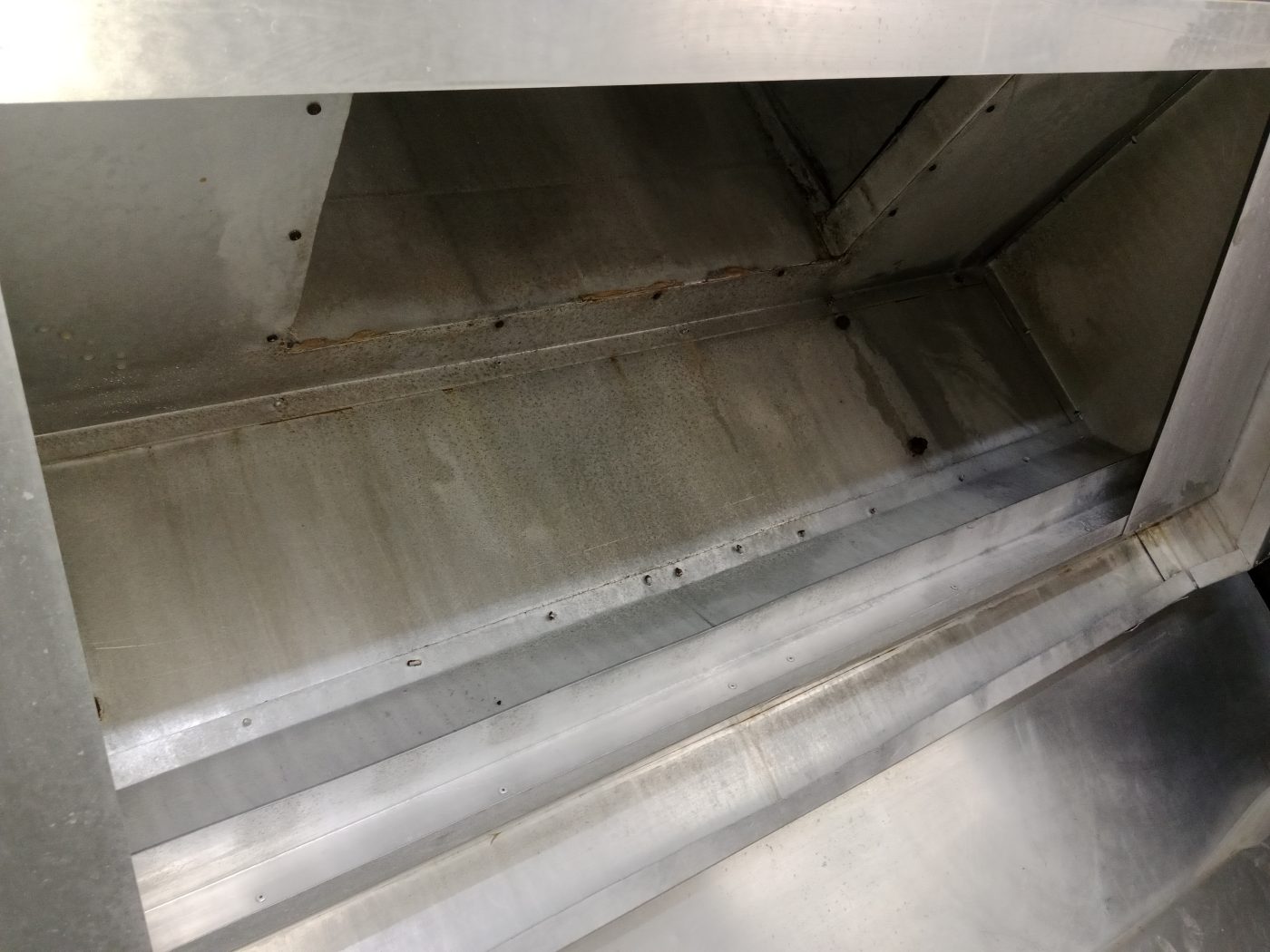
A kitchen exhaust duct rarely fails through a panel; it fails at a seam, at a low point in the run, or at an access panel. Thin gauge flexes under fan pressure and with heating and cooling, and that movement is absorbed at the joints, so a light duct that sealed well when new can work its seams loose within a couple of years. Cleated seams rely on mastic that is cooked, soaked in oil and washed with hot degreaser several times a year; flanged joints rely on a gasket and correctly tightened bolts; continuously welded seams have nothing to age or work loose, which is why they are the right choice for any section running above space that is not yours. A horizontal run should be set with a fall so condensate drains back to the hood or a drain point, because a dip in the duct becomes a permanent grease reservoir sitting against the lowest seam.
Kitchen exhaust gets specified at the two visible ends. The hood, because it is the expensive thing you can point at, and the fan, because it is the thing with a motor. The several metres of sheet metal in between are treated as plumbing — a route from one to the other, priced by the metre.
That middle section is where grease actually lives, and it is the part that produces the complaints nobody can explain: a brown stain spreading on a ceiling tile in the unit next door, a smell in a corridor with no visible source, water coming through a false ceiling a day after the cleaners were in.
None of those are mysteries. They are joints. Here is what a kitchen exhaust duct is actually made of, why the joints are the thing that matters far more than the metal, and what to look at before you sign for a system or take one over.
A duct carrying air out of an office and a duct carrying air off a wok line are the same shape and a completely different item. General ventilation ductwork is normally light galvanised sheet steel, joined with slip-and-drive or cleated seams, sealed with mastic and expected to carry nothing but air.
A kitchen grease duct has to carry hot, wet, greasy air continuously for a whole trading day, be cleaned with high-pressure water and aggressive chemicals several times a year, and contain a fire long enough for it to be dealt with. Those are different duties, and they lead to a heavier material, a heavier gauge, and a different way of joining the sections together.
The problem in practice is that both look identical once they are above a ceiling. A duct installed to the wrong specification does not announce itself on day one. It announces itself in year three, through somebody else's ceiling.
Gauge is the thickness of the sheet. Thin duct is cheaper, lighter and quicker to hang, and it is not usually the flat panel that fails.
What happens is this. A thin panel flexes under fan pressure and drums — the effect installers call oil-canning. It flexes again every time the system starts and stops, and again when it heats up and cools down over a trading day. All of that movement is absorbed at the stiffest points, which are the joints and the supports. So a light duct with a good seal on day one works its joints loose over a couple of years while the panels themselves stay perfectly sound.
Heavier material does not just resist corrosion better. It holds its shape, welds properly, and does not transmit its own movement into every seam. That is the actual argument for gauge, and it is worth knowing when you are looking at two quotations and one is noticeably cheaper.
There are broadly three ways to join two sections of duct, and they are not interchangeable on a grease system.
Cleated and slip-joint seams. The sheet metal is folded and hooked together, then sealed with mastic. Fast, cheap, entirely appropriate for ordinary ventilation. On a grease duct, the seal is doing all the work, and mastic in a grease duct is being cooked, soaked in oil and washed with hot alkaline degreaser several times a year. It ages. When it lets go, the leak is usually on the underside of a horizontal run, where the grease has been pooling.
Flanged joints with a gasket. Sections bolted together through angle flanges with a gasket between. Stronger, and the joint can be undone for maintenance, which is genuinely useful. The gasket is still a consumable, and the bolts are still something that can be under-tightened on a Friday afternoon in a tight ceiling void.
Continuously welded seams. The two sections become one piece of metal. Nothing to age, nothing to perish, nothing to work loose. This is what a grease duct wants, particularly on any section that runs above a space belonging to someone else. It costs more, it is slower, and it is the difference between a system that is quietly fine for fifteen years and one that generates an argument in year four.
Where duct is fabricated matters here too, and not for the reason people assume — it is less about price than about whether the person making it is the person who has to come back and clean it. We have written separately about in-house fabrication against outsourced ductwork.
Grease-laden air cools as it travels, and what condenses out of it is a liquid. Liquid does what liquid does: it runs to the lowest point available and stays there.
A horizontal duct run should be set with a slight fall so that what condenses drains back to a point where it can be dealt with — normally the hood or a purpose-made drain point. What frequently happens instead is that the duct is threaded around a beam, a sprinkler main or a structural column, and ends up with a dip in it. That dip becomes a standing reservoir of grease.
Two consequences follow. It is a concentrated fuel load in exactly the place a cleaner's brush finds hardest to reach, which is the mechanism behind how a grease fire travels up ductwork. And it sits permanently against the seam at the bottom of that section, which is the seam most likely to be the one that eventually weeps. If you are trying to work out where a stain came from, look for the low point rather than the nearest joint. Rain that gets in at the roof end collects in the same low points; see kitchen exhaust after heavy rain.
Sagging does the same thing after the fact. A duct hung on supports spaced too far apart, or on supports sized for an empty duct rather than one carrying years of accumulated deposit, develops its own low points over time. This is one of the quieter reasons that how a duct is routed matters as much as how big it is.
This one causes real friction between operators and cleaning contractors, and it is worth understanding before the phone call.
A proper duct clean puts hot water, detergent and mechanical action inside the duct at a pressure the duct never sees in normal operation. If the seams are sound, nothing happens. If a seam has been quietly held together by a hardened crust of grease — which is common on an older system that has been cleaned rarely — then removing the grease removes the seal. The leak was already there. The clean revealed it.
That is not an argument against cleaning, and an operator who concludes "we should clean less" has drawn exactly the wrong lesson. It is an argument for knowing the condition of your ductwork before the first deep clean on a system you have inherited, and for cleaning often enough that a crust never becomes structural. What a clean should include, and what evidence you should get back, we covered in what a kitchen exhaust clean should include.
A duct you cannot open is a duct that will not be cleaned properly, whatever the contract says. Access panels have to be positioned so that every section can actually be reached — at changes of direction, at the fan, at either side of any section passing through a wall, and at intervals along straight runs.
The panels themselves are also joints, and the same rules apply: the frame has to seal, the gasket has to survive degreaser, and the fixings have to be re-tightenable rather than one-time. A panel that has been forced open and refitted crooked is one of the most common single leak points on any system. There is more on this in our piece on duct access panels.
If you are having a system installed or a kitchen fitted out:
If you are taking over an existing unit: the honest answer is that you usually cannot tell from below. What you can do is open the nearest access panel and look at the seams, ask for the previous cleaning reports, and look at the ceiling in the spaces the duct passes over. Stains in a neighbour's unit tell you more than anything you will see in your own kitchen. This is part of the wider check we set out in taking over an F&B unit, and it is worth doing before the lease rather than after, because reinstatement at the end of the lease can land on you for a duct you never installed.
A kitchen exhaust duct does not usually fail in the middle of a panel. It fails at a seam, at a low point, or at an access panel, and it fails years after the decision that caused it. The material and the gauge matter because they decide how much the joints have to absorb; the joint type matters most of all; and fall and support decide where the grease sits while it waits.
If a duct runs above somebody else's ceiling, that is the section to spend the money on. It is the only part of the system where the cost of getting it wrong is not yours to control.
Seeing stains, drips or a smell you cannot place? WhatsApp us on 8989 2833 — tell us what you are seeing and where the duct runs, and we will tell you what is worth opening up first. Our commercial kitchen ventilation page sets out how we design and build these systems.
Related: material, gauge, joint type and access panels are exactly the lines that go missing from a cheap quotation, because nobody sees them again once the ceiling closes. See reading a kitchen ventilation quotation.
Related: a drip that appears the day after a clean is one of several things your opening team can catch early. See what to check before you cook after a kitchen exhaust clean.
Related: not every drip at a joint is a failed joint — condensate can form inside the duct, and a cold duct nearby can sweat. See condensation or a leak: how to tell.
Related: once a seam or section has failed, the next question is whether to patch it, replace the section or re-run the duct. See damaged or leaking kitchen exhaust duct: patch, replace a section or re-run it.
We design, clean, repair and maintain commercial kitchen exhaust systems across Singapore — on 24/7 standby.