
05 Sep 2026 · Troubleshooting
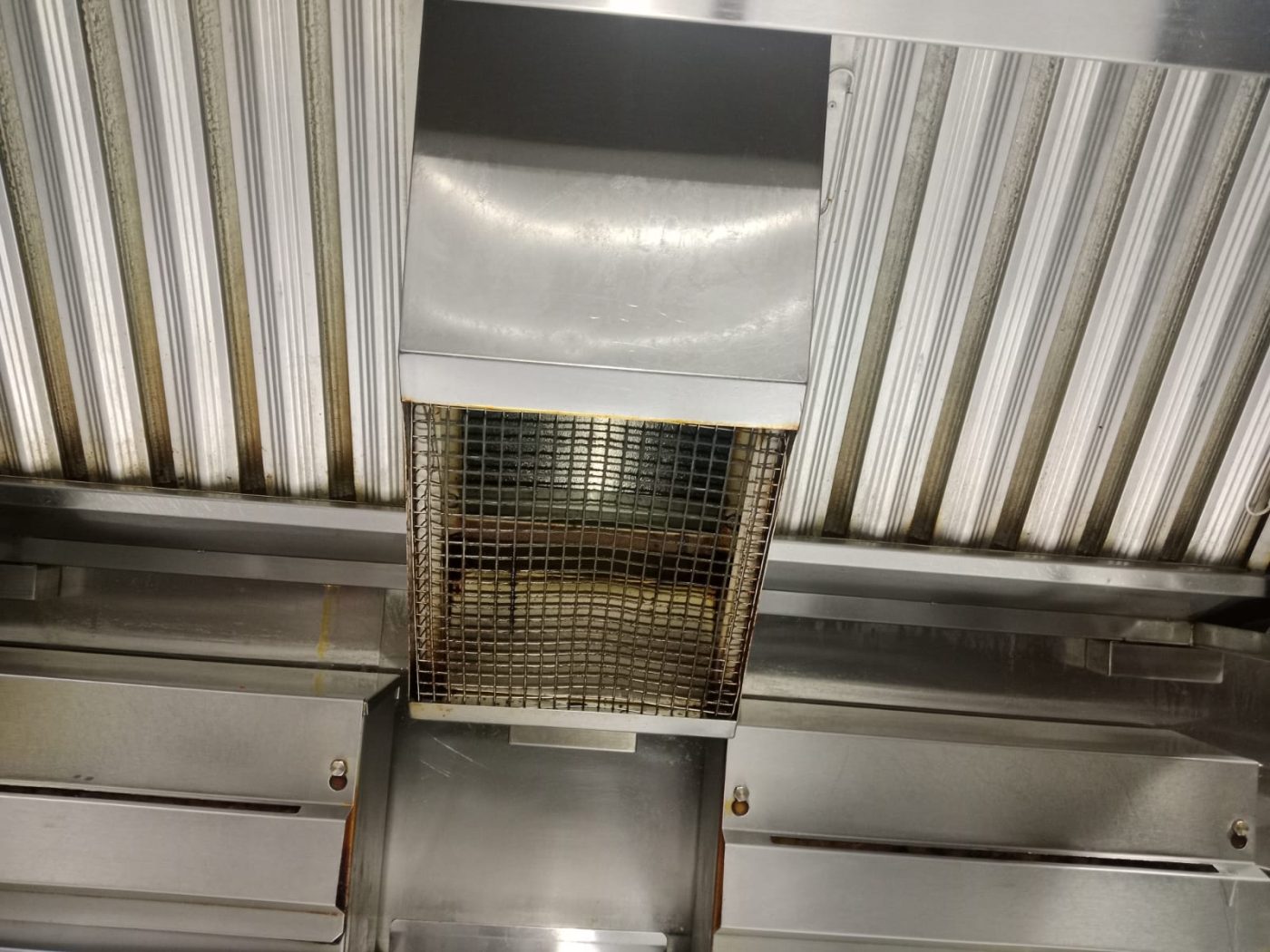
A kitchen exhaust fan can run normally while the kitchen stays smoky, because extraction is a chain rather than a fan: air must be captured at the hood, pass the filters, travel the duct, get through the fan and leave at the discharge, and an equal volume must enter the kitchen to replace it. The most common cause is inadequate make-up air, which is identified by opening a door while the line runs - if the smoke clears, the extraction is working and the kitchen is starving.
A fan that turns is not the same thing as a kitchen that is being extracted, and the gap between those two is where most of the complaints we get actually sit.
The call usually sounds like this: the exhaust is running, everyone can hear it, nothing has broken — and smoke still rolls out from under the front of the hood, the ceiling is going yellow, and the staff are working in it. Nobody wants to spend money on a system that is visibly running.
But extraction is a chain, not a fan. Air has to be captured at the hood, pass the filters, travel the duct, get through the fan and leave at the discharge — and it has to be replaced by an equal volume of air coming into the kitchen from somewhere. Any one of those links can be the weak one while the fan turns exactly as it always did.
Here is how to work out which link it is, roughly in the order the causes actually occur.
With the line running and the kitchen as smoky as it gets, open the back door or a window and watch what happens.
If the smoke clears noticeably within a minute or two, the extraction is fine and the kitchen is starving. That single observation eliminates most of the expensive possibilities and points at make-up air, which is the most common cause and the one least often suspected.
The reason is simple physics that gets forgotten in a busy kitchen: a fan cannot remove more air than the room can replace. Pull out several thousand cubic metres an hour and the same has to come in, through a make-up air unit, a supply grille, a transfer path from the dining room, or gaps around doors. When the replacement path is inadequate, the kitchen goes negative, the fan works against that pressure and moves far less air than its rating, and the hood loses its grip on the plume. It rolls out at the front edge instead of going up.
The tells are consistent. The kitchen door is hard to pull open, or slams. Doors whistle when shut. The extract seems worse when the front door is closed, or at the busiest hour when everything is running at once. This is set out fully in make-up air and air balancing, and it is worth reading before spending anything on a bigger fan — a bigger fan in a starved kitchen mostly makes the doors harder to open.
If opening the door changes nothing, look at where the smoke escapes rather than at the fan.
Smoke escaping at the front edge, at one station only, is usually a capture problem local to that station. A hood captures by containing a rising plume inside its canopy, which needs enough overhang past the cooking surface, enough depth, and the right height above the equipment. Too high and the plume spreads before it reaches the canopy. Too shallow at the front and the plume simply misses it.
This gets worse without anyone touching the ventilation, because the kitchen changes under the hood. Equipment gets replaced with a deeper model, a fryer moves to the end of the line, a chargrill arrives where a steamer used to be, a table gets pushed forward for prep. The hood was sized around a line that no longer exists. How a hood is sized against a cooking line covers what should have driven the original dimensions, and when a menu change outgrows the exhaust covers the version of this that arrives with a new dish rather than new equipment.
Cross-draughts are the other capture killer and they are almost always man-made. A pedestal fan aimed at a hot cook, a split unit blowing across the line, a propped-open door creating a through-draught, a new supply grille pointing the wrong way. A rising plume is a fragile thing; a modest sideways air current tips it out from under the canopy before the hood can take it. If the smoke problem started when someone brought in a fan to cool the kitchen, you have both your cause and a difficult conversation, because the fan is treating the symptom of a kitchen that is too hot — which is itself usually a make-up air problem.
Everything in the chain narrows as grease accumulates, and it happens slowly enough that nobody notices the day it became a problem.
Filters. Loaded baffle or mesh filters raise resistance across the hood, and the fan responds by moving less air. This is the cheapest thing to eliminate and the easiest to check — pull one and look at it. If they are being washed but the smoke is still escaping, look at what sits behind them: the plenum behind the filters collects grease that filter-washing never reaches, and a coated plenum restricts the hood whatever the filters look like. Which type you have matters too — baffle versus mesh filters behave differently as they load.
Ductwork. Grease lines the duct from the day the system is commissioned. It narrows the cross-section, roughens the surface and increases resistance, and on a long or bendy run that adds up to a real loss of airflow. It is also the fire risk that makes duct cleaning a safety job rather than a performance one — grease build-up in ductwork covers that side of it.
The fan itself. A centrifugal impeller works by its blade shape. Cake grease onto the blades and the shape is gone, so the wheel spins at full speed and moves a fraction of the air it should. The motor sounds completely normal. This is one of the most common reasons a system quietly loses half its performance without a single fault code, and it is invisible unless someone opens the fan.
Four things break in a way that does not stop the fan, which is exactly why they get missed.
The fan is turning the wrong way. On a three-phase supply, swapping two phases reverses rotation. A centrifugal fan running backwards still turns, still sounds like a fan, and still moves some air — a small fraction of its rating. This happens after a motor change, a board replacement, or work by the landlord on the incoming supply, and the kitchen simply becomes smoky the week after an unrelated electrical job. If the problem appeared immediately after any electrical work, check rotation first.
A slipping or worn belt. On belt-driven fans, a glazed or loose belt lets the motor run at full speed while the impeller turns slower. Motor sounds right, airflow is down.
A damper that is not fully open. Motorised or gravity dampers stick part-open in grease. The fan runs into a partly closed door.
The discharge is obstructed. Bird mesh clogged with grease and debris, a cowl that has closed up, or a discharge point that has ended up next to a fresh air intake so a share of what leaves comes straight back in. Worth checking after any roof or facade work.
Cheapest and most likely first, so nobody buys a fan they did not need.
1. Open a door while the line is running. Clears the smoke? Make-up air.
2. Look at where the smoke escapes. One station means capture and geometry; the whole line means system airflow.
3. Pull a filter. Loaded means cleaning, and a hood clean should include the plenum.
4. Ask what changed. New equipment, a new dish, a repair, an electrical job, shopfront works, a new fan in the kitchen. Something almost always changed, and dating the change usually names the cause.
5. Have the fan and duct looked at. Rotation, belt, impeller condition, damper position, discharge.
What settles it properly is measurement rather than opinion: airflow at the hood, static pressure across the system, and a comparison against what the hood needs for the equipment underneath it now. That is the difference between knowing the fan is undersized and guessing. For complex or repeatedly argued cases there is a modelling route too — when a CFD ventilation study is worth it sets out where that is proportionate and where it is not.
Worth being blunt, because the two get sold interchangeably and only one of them will work.
It is a cleaning problem if performance has degraded gradually, the kitchen used to be fine with the same menu and the same equipment, and the filters, plenum, duct or impeller are loaded. Cleaning restores what the system was designed to do. What a proper clean covers is on our cleaning page.
It is a design problem if it has never worked properly, or if it stopped working when the cooking changed. No amount of cleaning gets a hood to capture a plume from equipment it was never sized for, and no amount of cleaning creates make-up air that the premises does not have. Paying for repeated cleans on a design problem is the most common way money gets wasted on kitchen ventilation.
The mixed case is the common one: a system that is both dirty and marginal, where cleaning helps enough to be worth doing and not enough to fix it. A survey should tell you that plainly, before the invoice rather than after.
A kitchen that is not extracting properly is not only unpleasant. The grease that is not being captured lands somewhere else — on ceilings, on light fittings, on the walls, and in the parts of the duct that do get airflow. Staff work in the heat that is not being removed. Odour reaches neighbours, which is how odour complaints begin. And a system running hard against its own resistance is a system whose fan and motor are working harder than they were meant to.
BC Air is a Singapore commercial kitchen ventilation contractor working on hoods, ductwork, fans, cleaning and fire suppression. What a compliant system looks like is set out on the commercial kitchen ventilation page, and what a proper clean covers is on the kitchen exhaust cleaning page.
Exhaust running and the kitchen still smoky? WhatsApp us on 8989 2833 — tell us whether opening a door improves it, whether the smoke escapes at one station or all of them, and what changed before it started, and we will tell you which part of the chain to look at first.
Not sure the smoke is the only symptom? Commercial kitchen ventilation troubleshooting matches each symptom to the part of the system to check first, and lists what to write down before anyone is called out.
Also worth reading: when the smoke sets off the building fire alarm — what to record each time and why the detector is left alone.
Also worth reading: gas flames leaning or going out while the exhaust runs — the same air-balance fault showing up at the burners instead of in the room.
We design, clean, repair and maintain commercial kitchen exhaust systems across Singapore — on 24/7 standby.