24/7 Standby · Always At Your Service 💬 WhatsApp +65 8989 2833

Roast Meat Shops: Why Fat, Glaze and a Hot Oven Door Test the Kitchen Exhaust

25 Oct 2026 · Design & Build
Roast Meat Shops: Why Fat, Glaze and a Hot Oven Door Test the Kitchen Exhaust
A roasting oven gives off fat vapour, smoke from dripping fat and glaze, and heat, and it releases them in a burst each time the door opens. The weak point is usually capture at the oven door rather than the fan, and the fat coats the plenum and duct behind the filters before it shows on the front. The cleaning interval follows the cooking volume and hours and starts with an inspection.

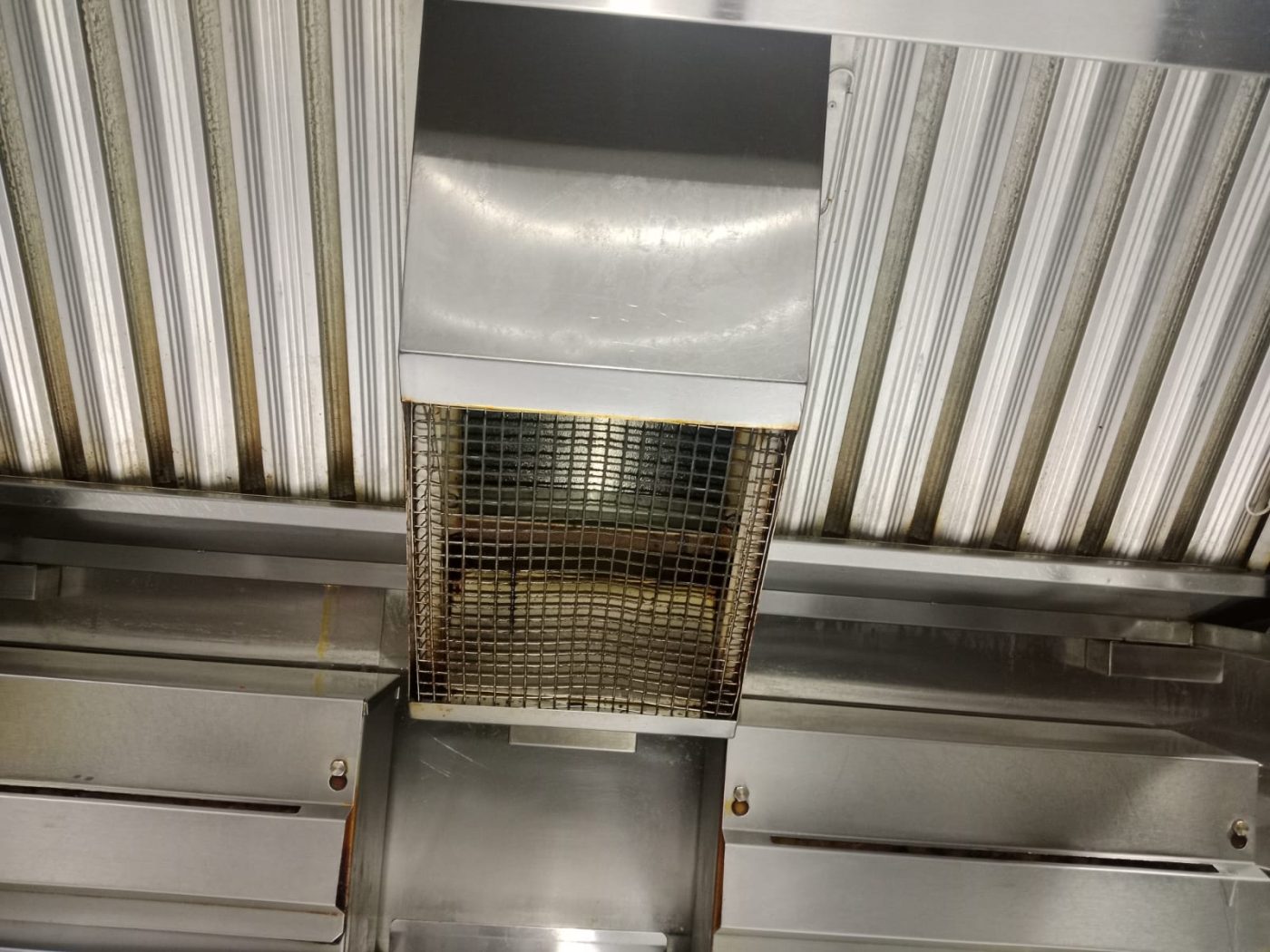
Pictured above: the underside of a hood on one of our projects (Aljunied). The baffle filters either side carry dark grease streaks along their lower edges, and the guarded opening at the centre is coated as well. A roasting kitchen puts a great deal of rendered fat into exactly this part of the hood.

A roast meat shop looks calm next to a wok line. There is no wall of flame under a pan and no fryer spitting oil. Ducks, pork and chicken hang in an oven or sit on trays, and most of the work seems to happen quietly behind a door. It is easy to conclude that the exhaust has an easy life and that the hood over a roasting oven can be sized and cleaned like any other.

That conclusion deserves a second look before it costs you a smoky kitchen at the lunch peak. A roasting kitchen is its own case: not the dry heat of a bakery, and not the open flame of a wok range. This post is about what a roasting oven actually puts into the exhaust, what to ask before you design or take over a roast counter, and what to watch once you are trading.

What a roasting oven puts into the exhaust

Roast ducks, char siew, roast pork and chicken all do the same thing in the heat: they give up fat. Some of it drips into the bottom of the oven or onto the burner or coals. Some of it leaves as a fine vapour with the hot air. A basting or maltose-type glaze adds sugar to the mix, and sugar burns and smokes at the surface of the meat and wherever it drips.

So the air that leaves a roasting oven is hot, fatty and smoky at once. It does not look like the heavy plume over a wok, because it leaves in bursts rather than continuously, but over a day it is a steady load of fat on the hood.

  • Fat vapour that condenses on the first cool surface it meets: the filters, the plenum behind them and the lowest point of the duct.
  • Smoke from dripping fat and glaze, which is most visible when the oven is opened.
  • Heat from the oven body and the open door, which does not rise neatly into a hood the way a wok plume does.

The moment that matters is the door

In a closed oven the exhaust and the oven chimney do most of the work. The trouble starts when the door opens. A blast of hot air, fat vapour and smoke comes out at once, often at the height of the cook's face, and it has to be caught by the hood before it reaches the room.

That is a capture question, and it depends on where the oven door sits relative to the hood: how far the hood extends beyond the front of the oven, how high it is above the door opening, and whether the cook is working in a draught. The same lesson applies to a fan or air-con unit blowing across the line, which bends the burst of smoke away from the hood. A roast counter that is open to the shopfront has the same weakness if a door or the street air pulls across the front of the oven.

If smoke rolls out each time the door opens and clears a minute later, the hood is not wrong in the sense of being broken. It is marginal at that spot, and the first check is the layout rather than the fan. If it never clears, see why an exhaust can be running and the kitchen still smoky.

Gas, charcoal or electric changes the question

Roasting ovens in Singapore come in several kinds, and the exhaust question is different for each:

  • Gas ovens need a proper air supply for combustion, and the ventilation and the gas supply have to work together. We cover how the hood, fan, gas and suppression connect in the interlocks post.
  • Charcoal-fired ovens add embers, soot and a fire that cannot be switched off. That is a solid-fuel kitchen, and it is covered in charcoal grills, tandoors and wood-fired ovens. Do not treat a charcoal roasting oven as a gas one with a different label.
  • Electric ovens remove the flame but not the fat or the smoke. The exhaust still has to deal with both.

Whichever you have, tell the designer the exact oven: its fuel, its size, the position of its door and how many hours it runs. A hood sized for a generic cooking line is a guess for a roasting oven. How a hood is matched to a cooking line is covered on the commercial kitchen ventilation system page.

Where the fat ends up

Because the fat leaves as vapour, it coats the surfaces behind the filters before it ever builds up on the front of them. The grease streaks in the photograph are the visible edge of that. What you cannot see from the floor is the plenum and the duct beyond it.

  • Filters. Baffle filters should be taken out and degreased, never cleaned in place. A filter bank with a gap in it lets fat straight into the plenum.
  • The plenum. The space behind the filters collects grease that washing the filters never reaches. It is worth looking at, as we describe in what is behind the baffle filters.
  • The grease cup or gutter. A roast counter that renders a lot of fat into the hood can fill it faster than staff expect, and an overfull one drips. See grease dripping from the hood onto the cooking line.
  • The duct and the fan. Fat that gets past the hood coats the duct and the fan blades. A fan with grease on the blades moves less air, and the smoke problem at the oven door gets worse without anything having broken.

How often to clean a roasting kitchen

The honest answer is that the interval follows the cooking, not the category. BC Air publishes that most commercial kitchens need cleaning every 1 to 3 months, that heavy wok, grill and deep-frying kitchens often need monthly cleaning and that lighter kitchens can run quarterly. A roast counter does not appear on that list by name, so we do not give it a number in advance. We inspect the hood, duct and fan and look at the cooking volume and hours before recommending an interval.

The practical test is the one you can do yourself: pull one filter and look at the plenum behind it, and look at the grease cup. If either is heavily loaded, the interval is too long, whatever it was set at. The cleaning frequency page sets out how we decide.

What kitchen staff can do

  • Empty the grease cup or gutter on a routine, not when it overflows.
  • Keep the oven door closed between loads and open it with the exhaust already running.
  • Keep the oven under the hood and the front of the hood clear. Do not stack trays against the filters.
  • Do not aim a pedestal fan at the person working at the oven door.
  • Note when the smoke gets worse and what changed that week: a new oven, a new glaze, a fan, a repair, or an electrical job.

Before you design or take over a roast counter

  1. Give the designer the oven: fuel, model, door position and operating hours.
  2. Ask how the hood captures the burst at the door, not just the plume above the oven.
  3. Ask where the grease is collected and how it is emptied.
  4. If the oven is charcoal, ask for its own extract arrangement and how embers are kept off the filters.
  5. Ask for access panels at the low points of the duct so the whole run can actually be cleaned. We cover this in duct access panels.
  6. If you have fire suppression, ask whether the oven is covered by name. The protection is designed around specific appliances in specific positions.
  7. Agree the replacement air path, because an exhaust can only pull what the kitchen can replace. See make-up air and air balancing.

The short version

  • A roasting oven puts fat vapour, smoke and heat into the hood together, and it does so in bursts when the door opens.
  • The weak point is usually capture at the oven door, not the fan.
  • Fat coats the plenum and duct behind the filters before it shows on the front. Look behind one filter.
  • Gas, charcoal and electric ovens each change the exhaust question. Tell the designer which you have.
  • The cleaning interval follows the cooking volume and hours and starts with an inspection.

If you run or plan a roast counter and see smoke at the oven door, drips from the hood or a smell in the dining area, WhatsApp BC Air on 8989 2833 with the oven type, where the door sits under the hood and a photo of the plenum behind one filter, and we will tell you what we would check first. The design side is on the commercial kitchen ventilation system page, cleaning on the cleaning page and our 10-point servicing checklist is a fair test of any contractor's scope, ours included. We clean, repair and maintain the system in-house, with 24/7 standby if something fails mid-service. Scope and pricing follow an inspection.

Related reading: bakery oven exhaust · wok and deep-fry grease loading · neighbour odour complaints · how often a kitchen exhaust should be cleaned

Questions

Common questions

Does a roast meat shop need a proper kitchen exhaust hood?
A roasting oven gives off fat vapour, smoke from dripping fat and glaze, and heat, all of which have to be captured at the hood. The hood should be matched to the actual oven, its fuel, the position of its door and its operating hours, rather than sized as a generic cooking line.
Why does smoke come out when we open the oven door?
Opening the door releases a burst of hot air, fat vapour and smoke at once. If the hood does not extend far enough in front of the door, or a fan or air-con unit pulls the air sideways, the burst escapes before the hood takes it. Check the layout and any cross-draught before the fan.
How often should the exhaust of a roast counter be cleaned?
BC Air publishes that most commercial kitchens need cleaning every 1 to 3 months, with heavy wok, grill and deep-frying kitchens often monthly and lighter kitchens quarterly. A roast counter is not given a fixed number in advance. The interval is recommended after an inspection of the hood, duct and fan and the cooking volume and hours.
Is a charcoal roasting oven the same as a gas one for the exhaust?
No. Charcoal adds embers, soot and a fire that cannot be switched off, which makes it a solid-fuel kitchen. It normally needs its own extract arrangement and a specific answer on how embers are kept off the filters and the duct.
What can staff do to reduce the load on the hood?
Empty the grease cup or gutter on a routine, open the oven door with the exhaust already running, keep trays and stock away from the filters, do not aim a pedestal fan at the oven door, and look at the plenum behind one filter regularly.

Need This Sorted in Your Kitchen?

We design, clean, repair and maintain commercial kitchen exhaust systems across Singapore — on 24/7 standby.

Chat on WhatsApp