24/7 Standby · Always At Your Service 💬 WhatsApp +65 8989 2833

A Fan or Air-Con Blowing Across the Cooking Line: Why Smoke Escapes the Hood

23 Oct 2026 · Troubleshooting
A Fan or Air-Con Blowing Across the Cooking Line: Why Smoke Escapes the Hood
A kitchen hood catches the plume that rises from the cooking line, and a sideways air current from a pedestal fan, an air-conditioning unit, a grille or an open door can bend that plume past the canopy edge even when the exhaust fan is working normally. Switch the suspected source off during service and watch the front edge of the hood: if smoke is lost on one side only and improves, it is a cross-draught. A bigger fan rarely helps and can add to the draught.

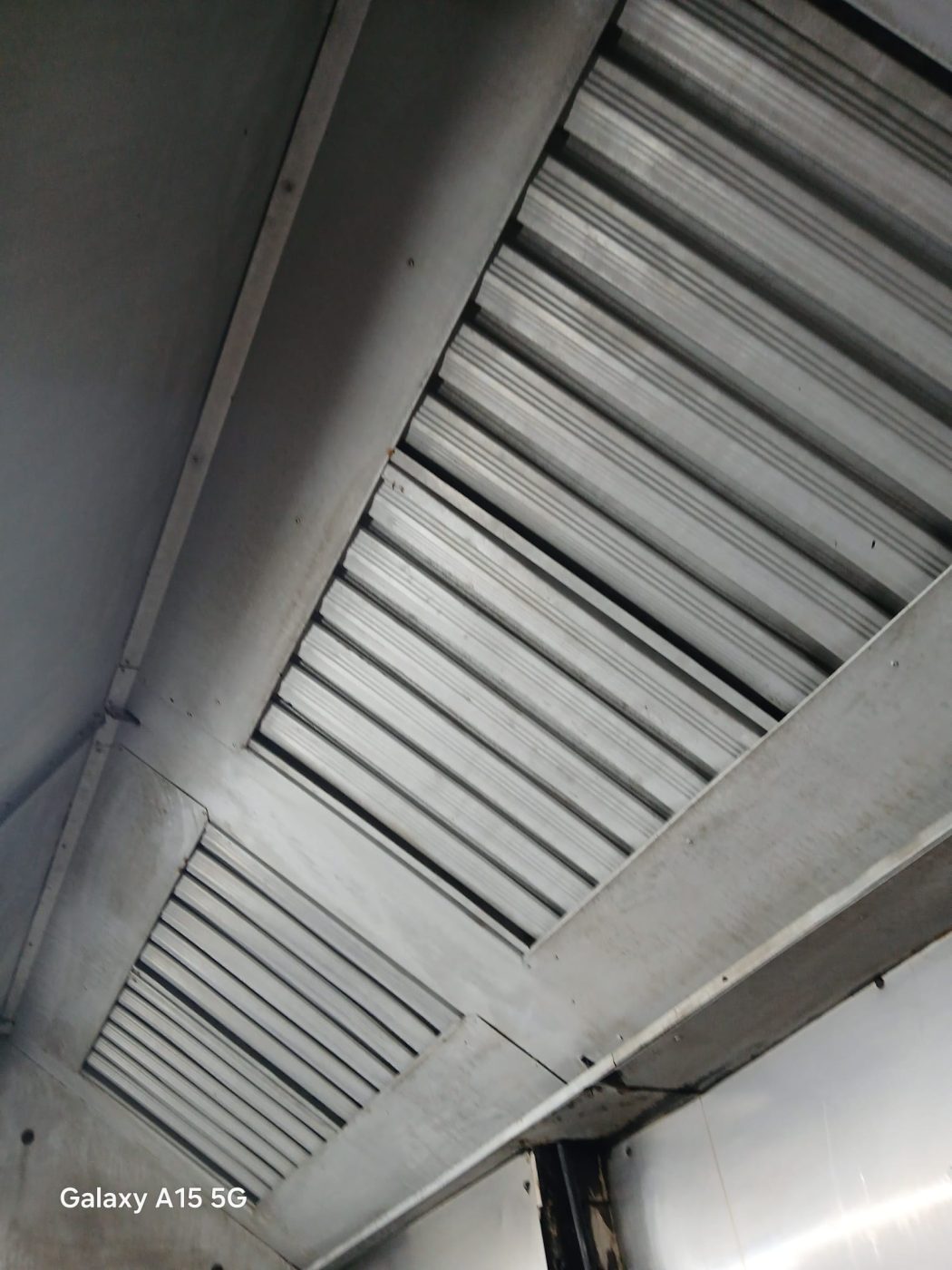
Pictured above: the underside of a hood canopy on one of our projects (S Luck, Serangoon), looking up at the baffle filters. A hood does not suck smoke in from across the kitchen. It catches a rising plume that arrives underneath it, and anything that pushes that plume sideways can carry it past the edge.

The kitchen is hot. The cooks are sweating, so someone brings in a pedestal fan and points it at the line. Or the landlord adds an air-conditioning unit that blows straight across the cooking area. Or the back door is propped open for air. Within a day or two the hood that used to cope is letting smoke roll out into the room, and the first conclusion is that the exhaust fan has got weak.

Often the fan is fine. The air has changed direction. This post is about that one cause: a sideways air current across the cooking line, why it defeats a hood that is otherwise doing its job, and what to do about the heat that made someone reach for the fan in the first place.

How a hood actually catches smoke

Hot air rises. Over a wok, a fryer or a griddle, the heat lifts the smoke, steam and grease vapour upwards in a plume. A canopy hood sits above the cooking line and catches that plume as it arrives, then the exhaust fan carries it away through the filters and the duct.

The important word is arrives. The hood relies mostly on the plume's own upward movement to get it under the canopy. The fan then draws it through the filters. A plume is a gentle, fragile thing, and a moderate sideways breeze is enough to bend it. If the breeze is strong enough, the plume leaves the cooking surface at an angle and never meets the canopy at all. It goes past the edge and into the kitchen.

That is why the same hood, with the same fan and the same duct, can work on Monday and fail on Wednesday. Nothing in the exhaust system changed. The air around the cooking line did.

The usual sources of a cross-draught

  • A pedestal or wall fan aimed at the cooks. The most common cause by a long way, and well meant. It cools the person and tips the plume.
  • An air-conditioning unit or supply diffuser blowing across the line. A new split unit in the kitchen, a ceiling cassette moved during a refit, or a supply grille that now points along the cooking line instead of down and away from it.
  • A door or hatch left open. A back door propped open creates a through-draught from one side of the kitchen to the other, and a service hatch open to a cool dining room does the same. Which way the air moves through it depends on the pressure difference, which we cover below.
  • A make-up air supply that is too strong or badly placed. Replacement air has to come from somewhere, and where it enters matters. Air delivered at speed close to the hood, or blown across the front of it, does the same job as a pedestal fan.
  • People and trolleys. A cook stepping back from the wok moves air. On an island line with access on every side this is more noticeable, because there is no wall behind the plume to steady it.

Island canopies are the most sensitive, since a wall at the back helps contain the plume and an island has no such help. We went through that difference in choosing a commercial kitchen exhaust hood, and it is why open kitchens need extra care, as covered in ventilation for open and show kitchens.

How to tell a cross-draught from a weak system

This matters, because the fixes are different and one of them is free.

Run the kitchen at its normal service load and watch where the smoke goes. Do this once with the fan or door as it normally is, and once with the suspected source switched off or closed.

  • If the smoke is lost from one side or one station only, and that side is the downwind side of a fan, a diffuser or an open door, it points to a cross-draught.
  • If the smoke escapes evenly along the whole front edge, whatever you switch off, look first at the problems we describe in a kitchen that is still smoky with the exhaust running: a starved kitchen, a hood that is too small for the line, or a fan running the wrong way.
  • If it improves the moment the fan is switched off, you have your answer. If nothing changes, the fan was not the cause.

A thin strip of tissue held at the front edge of the hood, or the smoke from a lit incense stick, shows the direction of the air without needing any instruments. Move it along the length of the hood. Where it leans away from the canopy, the air is being pushed.

Why more extraction is the wrong answer

When smoke escapes, the instinct is to ask for a stronger fan. In this case it can make things worse. Pulling harder on a kitchen that is already short of replacement air pulls air in from wherever it can find a path, usually through the doors and the hatch, which adds to the cross-draught. The point of balancing supply and extract is covered in make-up air and air balancing. A fan upgrade should follow a measurement, never replace one.

Fix the heat, not the symptom

The cook with the pedestal fan has a real problem: the kitchen is too hot to work in. Taking the fan away without fixing that only moves the problem. Look at where the heat and the air are coming from:

  • Is the hood capturing the heat? A hood that captures well takes a large share of the heat away with the smoke. A kitchen that gets hotter when the cooking line is busy is often a kitchen where the plume is escaping.
  • Is there enough replacement air, delivered gently? Cool replacement air that arrives slowly and low, away from the cooking line, helps the cooks without bending the plume. The same air delivered fast across the line does harm. Where it enters is part of the design, and it can be moved.
  • Is the kitchen being cooled by the dining room's air-conditioning? If the only cooling comes through a hatch or door from the dining area, you get both a cross-draught and a smell problem in the dining area. We covered that in the smoky-kitchen post.

If the aim is to cool staff, spot cooling that does not blow across the hood's capture zone is the principle to follow. Where the air has to go, and how fast, is something we would agree on site, not guess in a post.

What to do this week

  1. Switch off or move any fan that blows across or toward the cooking line, during a service, and watch the front edge of the hood.
  2. Check which way every door and hatch in the kitchen lets air move, and close the ones that are propped open unnecessarily.
  3. If an air-conditioning unit or supply grille was added or moved recently, find out whether it blows across the line.
  4. Write down which station loses smoke, at what time, and what was switched on.
  5. If it is still not clear, ask for a survey rather than a quote for a bigger fan.

What to tell your exhaust contractor

Describe it in terms of what changed and where the smoke goes: which station, which side, whether it began after a fan, a unit or a door change. Say what is on the cooking line and for how many hours. A diagram of the kitchen with the fans, units, grilles and doors marked on it is worth more than a paragraph. Pricing, if any work is needed, follows a site survey, since the right fix depends on the line and the room.

The short version

  • A hood catches a rising plume. A sideways breeze can bend the plume past the edge, even when the fan is working perfectly.
  • The usual sources are a pedestal fan, an air-conditioning unit or grille, an open door and a badly placed make-up air supply.
  • Switch the suspected source off during service and watch the front edge. If the smoke is lost on one side only, suspect a cross-draught.
  • A bigger fan is rarely the cure, and it can add to the draught.
  • Cool the kitchen in a way that does not blow across the cooking line, and plan the replacement air as part of the system.

If smoke has started escaping from your hood and a fan, a unit or a door has changed lately, WhatsApp BC Air on 8989 2833 with the station that loses smoke, what you cook, and what was moved or added, and we will say what we would check first. The whole system is described on the commercial kitchen ventilation system page, routine upkeep on the maintenance page and duct and hood cleaning on the cleaning page. We design, fabricate, install, clean and maintain the system in-house, with 24/7 standby if something fails mid-service.

Related reading: exhaust running but still smoky · choosing an exhaust hood · make-up air and air balancing · how we size a hood to the cooking line

Questions

Common questions

Why does smoke escape my kitchen hood after someone put a fan next to the cooking line?
A hood catches the plume that rises from the cooking surface. A sideways air current from a pedestal fan, air-conditioning unit or open door can bend that plume past the edge of the canopy, so the smoke is lost even though the exhaust fan is working normally.
How can I tell a cross-draught from a weak exhaust system?
Run the kitchen at normal service load and switch off or close the suspected source. If smoke is lost on one side or one station only, on the downwind side of a fan, grille or door, and it improves when that source is off, it is a cross-draught. If smoke escapes evenly along the whole front edge whatever you switch off, look at replacement air, hood size and fan rotation instead.
Will a stronger exhaust fan stop smoke escaping from the hood?
Usually not in this case. More extraction in a kitchen short of replacement air pulls air in through doors and hatches, which can add to the cross-draught. A fan change should follow a measurement, not replace one.
How do I keep cooks cool without spoiling hood capture?
Do not blow air across the cooking line. Cooling that arrives gently and low, away from the hood capture zone, and replacement air placed as part of the design, help the cooks without bending the plume. Where the air enters is agreed on site, after seeing the line and the room.
Are island hoods more sensitive to draughts than wall-mounted hoods?
Yes. A wall behind the cooking line helps contain the plume, while an island line has open sides and no wall to steady it, so a modest cross-draught moves the plume more easily.

Need This Sorted in Your Kitchen?

We design, clean, repair and maintain commercial kitchen exhaust systems across Singapore — on 24/7 standby.

Chat on WhatsApp