
14 Oct 2026 · Maintenance
Grease dripping from a kitchen hood means grease has left the path it was designed to take: filters, gutter, cup. The usual causes are a full gutter or cup, a filter put back the wrong way round or not seated, a bent filter or gutter edge, grease built up on the hood surfaces that softens and runs when hot, and an open seam. With the system off and cold, check the gutter, check every filter is seated and the same way round, and note whether it started after a wash, builds across a service or follows the rain. Do not tape or seal it. Quote-only.
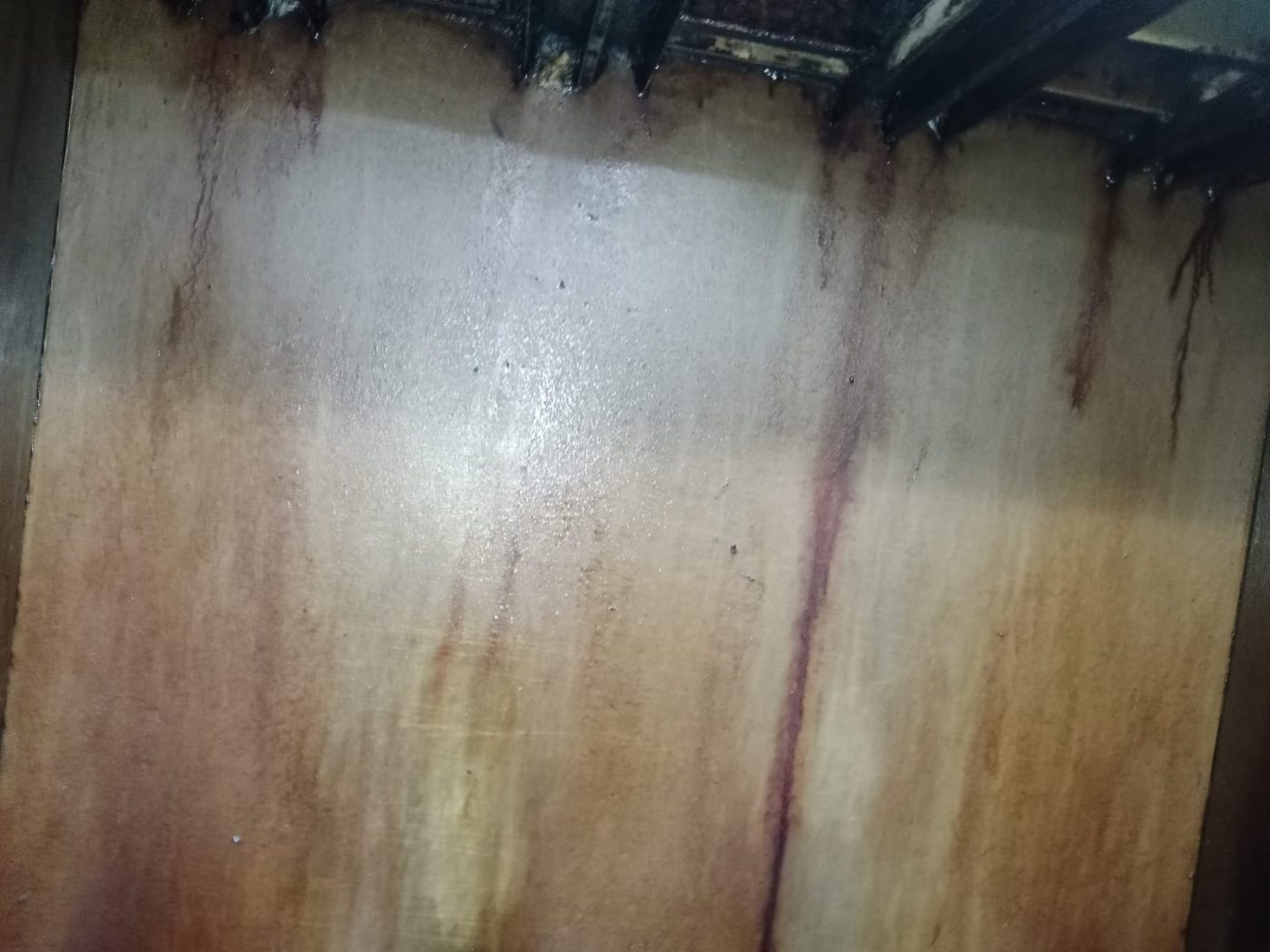
Pictured above: grease runs and hanging drips along the lower edge of a hood panel, below the filter frame, on one of BC Air’s projects (Old Chang Kee, Aljunied). This is a photo from our own work, reused here because it shows what a hood looks like when grease has stopped draining where it was meant to and has started to travel on its own.
It is mid-service and a bead of brown grease forms on the lower edge of the hood, swells, and drops onto the pass, the chopping board or the hot plate under it. A minute later another one follows. The cook wipes it with a cloth and carries on, because the orders are coming in, and by the end of the night it has become a habit.
A hood that drips is telling you that grease is leaving the path it was designed to take. Grease is meant to be caught by the filters, run down into the gutter, and be emptied or cleaned out on a routine. Every drip means one of those steps has failed somewhere upstream of the drip. The useful question is not “how do I stop the drip” but “which step failed”, because the answer decides who fixes it and how fast.
Grease landing on food is a hygiene problem. Grease landing on a flame or a hot surface is a fire problem. Either one is a reason to act today, not a reason to note it in the log and carry on.
From the floor, every drip looks the same. In practice there are about six sources, and they leave different clues. Stand under the hood after a service, with the kitchen cold and the system off, and look at where the grease is and where it is not.
Filters drain into a gutter at the bottom, and many hoods have a cup that collects what the gutter carries. When it is full, it has nowhere left to put what the filters send down, and the grease spills over the lip. We cover the daily habit in the daily kitchen routine for the exhaust system. The clue is that the drip comes from the lowest edge of the hood, just under the filters, and gets worse towards the end of a long service.
A baffle filter is built to drain in one direction, towards the gutter. Put it back upside down or turned and the grease runs to the wrong edge, or gets thrown past the gutter altogether. A filter that does not sit properly in its runners leaves a gap, and grease finds the gap. The clue: it started the morning after a filter wash or a professional clean, and one panel in the bank sits crooked or proud of its neighbours. See what to check after a cleaning night.
A dropped filter, or one levered out of a tight frame, can have a crushed bottom edge. The channels can no longer carry the grease to the gutter, and it goes back into the airflow or runs off the side. A bent gutter lip does the same. The clue is a drip in one spot that does not move, under one particular panel. If that panel is damaged, treat it as out of service. We explain how to judge that, and what to measure, in when a baffle filter is damaged.
This is the one in the photo. Grease does not only collect in the filters. It film-coats the inside walls and the underside of the hood, and over months it turns tacky and heavy. When the hood is hot, it softens and runs, and it runs towards the lowest edge. The clue is drips that are worst at the end of service when the hood is hot, with runs and streaks visible on the inner panels, and a drip that comes from wherever the grease finds an edge, not from a fixed point. This is a cleaning job, not a repair job, and the answer is in kitchen exhaust cleaning. If it keeps happening between cleans, the interval is too long for what the kitchen cooks. We cover that in how often to clean a commercial kitchen exhaust.
Hoods are fabricated from sheet metal. Where panels join, a seam can open with age, heat and repeated cleaning, and grease that should have stayed inside the hood weeps through. A similar leak can come from a joint where the hood meets the duct collar. The clue is a drip that appears on the outside of the hood or from a joint line, sometimes with a stain trail leading to it, and sometimes appearing even when the filters and gutter are clean. This needs a repair rather than a wipe-down, and the repair has to be done in metal, not with a smear of sealant. Damage and rust are covered in damaged, leaking or rusted kitchen hood: repair or replace.
Steam condenses on cool metal, and a hood in an air-conditioned kitchen can sweat. Water also gets in after heavy rain. If the drip is clear or only faintly brown, runs from a duct or the collar rather than the filter edge, and is worst in humid or wet weather, read kitchen exhaust duct condensation and water at the hood after heavy rain before assuming grease.
Do this when the kitchen is cold and the system is off and isolated, never while the fan is running or anything is hot.
That last point is the most useful single piece of information you can give a contractor. A drip that started the morning after a wash points at filters. One that builds across a service points at a full gutter or a hot, loaded hood. One that follows the weather points at water.
Hood dripping onto the line? WhatsApp BC Air on 8989 2833 with the details above. We are on 24/7 standby, and scope and pricing follow an assessment. We look at what is actually causing the drip before quoting, because a hood that drips because of a full gutter and one that drips because of an open seam are different jobs.
Related reading: what sits behind the baffle filters · the daily kitchen routine for the exhaust system · when a baffle filter is damaged
We design, clean, repair and maintain commercial kitchen exhaust systems across Singapore — on 24/7 standby.