
02 Sep 2026 · Cleaning & Compliance
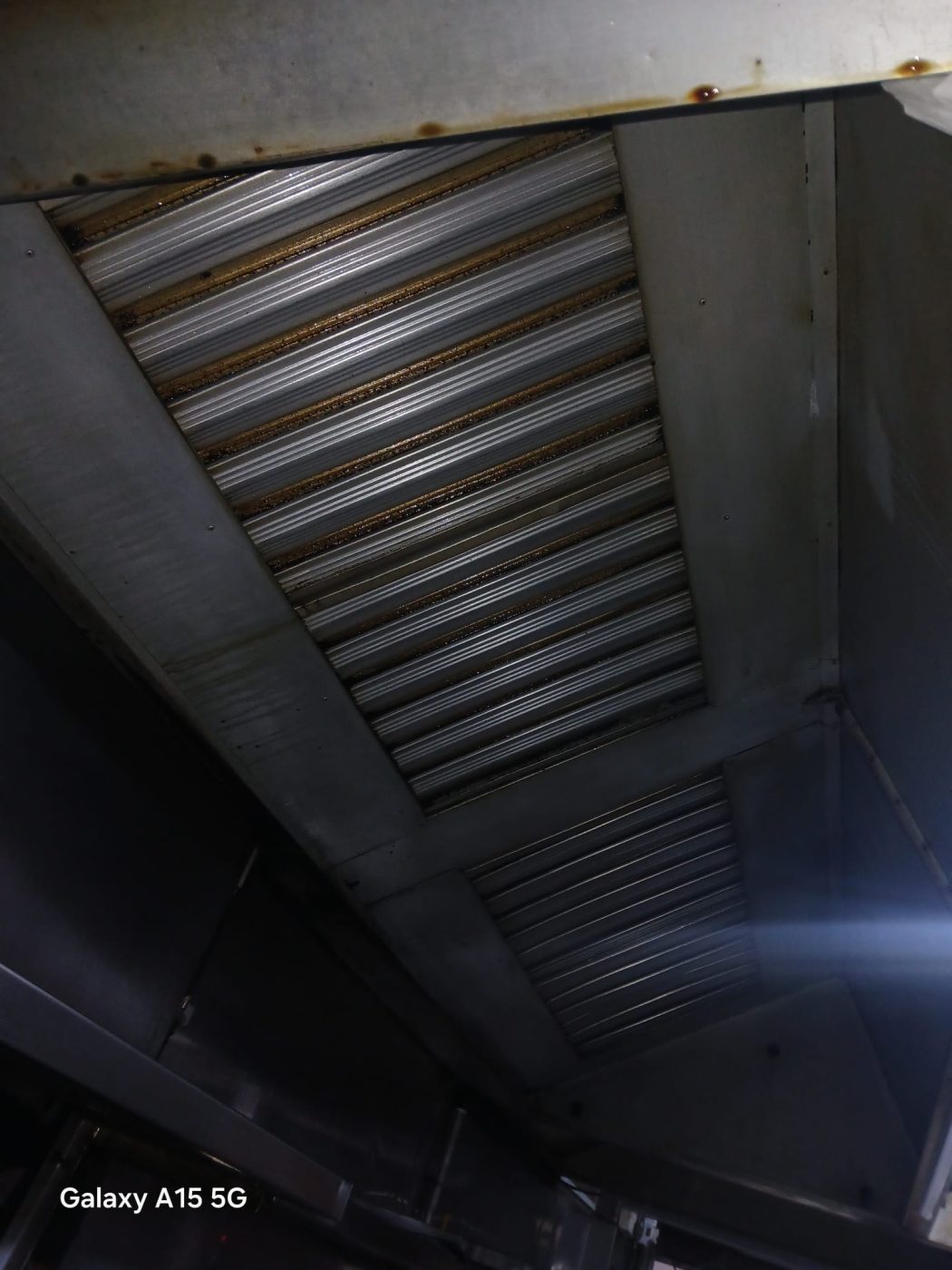
A baffle filter works by inertial separation - interlocking channels force the air to turn sharply, and grease droplets too heavy to follow the turn strike the metal and drain into the gutter. That means it is designed to let air through freely and that it never catches fine aerosol and smoke, which follow the air round the corner. What passes through settles in the plenum, the chamber between the back of the filter bank and the duct collar, where the air slows and changes direction. Filters are washed weekly or nightly; nothing removes what builds in the plenum unless it is deliberately cleaned.
Almost every conversation about a kitchen hood stops at the filters. Are they baffle or mesh, are they clean, when were they last taken out. Fair enough — they are the only part of the system a kitchen crew can see and handle.
But the filters are not where the problem usually is. They are a screen in front of the problem. Behind them sits a space most operators have never looked into, and the condition of that space decides whether your hood is doing its job, whether your next inspection goes smoothly, and how much of a fire risk you are actually carrying.
It is called the plenum. This is what is in there, why it matters more than the filters, and how to check it without taking anything apart.
A baffle filter is not a sieve. There is no fine mesh in it. It is a set of interlocking metal channels that force the incoming air to change direction sharply, two or three times, in a short distance.
Grease droplets carried in that air are heavier than the air itself. When the air turns and the droplet cannot, the droplet hits the metal, condenses, and runs down the channel into the grease gutter at the bottom of the filter. That is the whole principle: inertial separation. The air goes round the corner, the grease does not.
Two things follow from that, and both are commonly misunderstood.
A baffle filter is designed to let air through freely. If a new filter feels like it barely restricts airflow, that is correct, not a defect. Anyone who tells you a good filter should feel tight has it backwards.
A baffle filter never catches everything. It is very good on larger droplets and much less effective on fine aerosol and smoke particles, which follow the air round the turn because they are light enough to. Those carry straight through. This is not a failure of the filter — it is physics, and it is why what sits behind matters.
The plenum is the chamber between the back of the filter bank and the duct collar. It is where all the air from the filters gathers before it is drawn into the duct.
Everything the filters did not catch passes through here, and the plenum is the first place the air slows down and changes direction after the filters. Slower air holds less. So the fine grease and smoke that got through starts coming out of suspension on the plenum's back wall, its top surface, and the shoulders around the duct collar.
It builds as a soft tacky film first and hardens over months into a brown-black varnish, thickest in the corners and around the collar where air movement is slowest. In a wok or deep-fry kitchen it can build faster than most operators would believe.
The reason this matters more than the filters is straightforward. Filters get taken out, washed and put back — often weekly, sometimes nightly. Nobody takes the plenum out. If it is not deliberately cleaned as part of a scheduled service, nothing ever removes what accumulates there, and it simply keeps thickening year after year.
Grease anywhere in a system is a fire load. The plenum is a worse place for it than most, for three reasons.
It is the closest accumulation to the cooking line that is not routinely cleaned. A flare-up at a wok range sends flame up into the hood. The filters are designed to resist flame passing through them — that is the second reason baffle filters exist and why they are required where mesh often is not. But the plenum is directly behind that barrier, and it is holding fuel.
It is where a fire finds its way into the duct. A grease fire that gets past the filter bank travels through the plenum to the collar and up. The transition from a contained cooking fire to a duct fire happens here. We have written before about how a grease fire travels up kitchen ductwork — the plenum is the first act of that story.
Suppression is aimed at the appliances and the plenum, not at what is deeper in. A wet chemical system typically has nozzles covering the cooking line and the plenum area. That design assumes the plenum is a manageable amount of residue, not a decade of hardened varnish. Heavy accumulation gives the fire more to work with than the system was sized for.
Fire is the headline risk, but the everyday cost is performance, and it arrives so gradually that kitchens adapt to it instead of reporting it.
A plenum coated in hardened grease is a smaller plenum with rougher walls. Both increase resistance. The fan turns at the same speed and moves less air. Capture at the hood edge weakens first — you notice steam or smoke drifting out at the ends of the line before you notice anything at the centre. Heat starts building in the kitchen. Odour complaints go up, because what is not captured at the hood ends up in the dining room or drifting to a neighbour.
Almost nobody attributes any of that to the plenum. It gets blamed on the fan, and we are regularly asked to quote for a bigger fan on a system whose fan is fine.
You do not need tools and you do not need to dismantle anything. Do this when the kitchen is cold and the system is off.
Take one filter out — one from the middle of the line, above the heaviest cooking. Not the end one. The middle filter sits where the load is worst and gives you the honest picture.
Shine a torch into the opening and look up and back. You are looking at the back wall of the plenum and the underside of its top. Clean metal, or a light film you could wipe, is fine. A brown or black coating you can see the texture of is overdue. If you can see runs or drips that have set solid, it is well past overdue.
Touch the back wall with a gloved finger. Tacky means recent build-up. Hard and varnish-like means it has been there a long time and will need chemical treatment rather than wiping.
Look at the grease gutter and the collection cup. Overflowing tells you the filters are working and the cup is not being emptied often enough. Bone dry under a heavy cooking line usually tells you the opposite of what people assume — not that there is no grease, but that it is going somewhere else, which means past the filters.
Check the corners and the area around the duct collar. These are always the worst, because that is where air moves slowest. If the corners are clean, the whole plenum is fine.
Do this once a quarter, take a photograph each time from the same position, and you will have something far more useful than an opinion: a record of how fast your kitchen actually loads its system, which is what should set your cleaning interval rather than a number someone quoted you.
If the plenum is loading quickly, the filter bank in front of it is usually part of the reason.
It is not a wipe. The plenum needs the filter bank out, degreasing agent applied and given contact time on hardened residue, mechanical work in the corners and around the collar, and a rinse with the run-off controlled so it does not simply go into the kitchen. The area around the duct collar and the first section of duct behind it are part of the same job — cleaning the plenum and stopping at the collar leaves the transition dirty, which is exactly the piece that matters for fire spread.
Two things to insist on. Ask for photographs before and after, taken from inside the plenum, not of the filters sitting in a sink. Filters in a sink prove nothing about the chamber behind them. And ask what the interval should be for your kitchen specifically, based on what you cook and how many hours you run — a wok and deep-fry line loads a system far faster than a bakery or a steamer-based kitchen, and one interval for all kitchens is a scheduling convenience rather than an engineering answer.
Baffle filters work by making air turn a corner that grease cannot follow, so they are meant to flow freely and they were never going to catch fine aerosol and smoke. What gets through settles in the plenum immediately behind them — the one part of the hood that is never taken out, never washed by the kitchen crew, and closest to the flame. Pull the middle filter, put a torch in, and look at the corners and the duct collar. That five-minute check tells you more about the state of your system than the filters ever will.
Related reading: baffle versus mesh hood filters, grease build-up in ductwork and the fire risk it carries, and how often a commercial kitchen exhaust really needs cleaning. Full scope on the kitchen exhaust cleaning page.
Not sure what is behind your filters? WhatsApp us on 8989 2833 — tell us what you cook and how long you run each day, and we will tell you what interval that kitchen actually needs.
The plenum is also the first place to look when a pest problem will not clear - the rest of the route is in what lives in the hood.
Also worth reading: a commercial kitchen exhaust system, part by part: what you can check from the floor
Also worth reading: one filter bent or missing: what to measure to replace it, and what to do about the gap.
Also worth reading: grease dripping from the hood onto the cooking line: where it comes from and who fixes it.
We design, clean, repair and maintain commercial kitchen exhaust systems across Singapore — on 24/7 standby.