
19 Aug 2026 · Design & Build
An oven-led kitchen is a heat and moisture problem, not primarily a grease problem. Ovens and proofers run continuously and radiate into the room, so capture-based sizing alone leaves the kitchen hot. Steam condenses in ductwork that has no fall or drain point. Flour dust combines with butter and pastry fat to form a deposit that still requires a cleaning interval, and finely divided flour is combustible.
Almost everything written about commercial kitchen ventilation is written about a wok line. Heavy grease, high flame, short violent bursts of cooking. That is the kitchen the design rules of thumb come from, and it is the kitchen most contractors have in their heads when they walk into a unit with a tape measure.
A bakery is not that kitchen. Neither is a patisserie, a pizza shop, a roast counter, or any operation whose main equipment is an oven rather than a hob. The heat is different, the moisture is different, the deposit inside the duct is different, and the thing that gets you a complaint is different.
Design one as though it were the other and it usually still works — for a while, and badly. Here is where the two actually diverge.
A wok line produces a short, intense plume of hot, grease-laden air. Capture it and you have solved most of the problem.
An oven produces something else entirely: a large, steady output of sensible heat over hours, with far less airborne fat. Deck ovens, rack ovens and proofers do not stop between orders. They run through the whole shift, radiating into the room whether or not anything is being loaded.
That changes what the ventilation is for. On a wok line the exhaust is primarily a capture problem. In a bake kitchen it is substantially a heat removal problem, and a system sized only by capture logic will leave a kitchen that passes every inspection and is still unbearable to work in by mid-afternoon.
It also changes where the equipment sits. Radiant heat from an oven door does not go up in a neat plume; it goes out into the room and into whoever is standing in front of it. Hood coverage that is correct for a hob can leave a bakery hot in exactly the place the staff are.
Proofers, combi ovens and steam-injected deck ovens put real moisture into the air. So does a sink and a wash-up area running continuously in a small unit.
That moisture goes into the duct with everything else, and unlike grease it condenses. In a long horizontal run, or where a duct crosses an unconditioned space before rising, you get liquid collecting inside the ductwork.
Grease-focused designs frequently have no provision for this at all — no fall, no drain point, no accessible low point. The result appears months later as staining on a ceiling under the duct run, or a drip on the floor of somebody else's tenancy. It is a straightforward thing to design in and an unpleasant thing to retrofit through a finished ceiling.
This is the most consequential misunderstanding in bake-heavy kitchens, and it is usually delivered as reassurance: you are a bakery, you have hardly any grease, you do not really need a cleaning schedule.
Two things are wrong with that.
First, bakeries are not fat-free. Butter, pastry, laminated dough, egg wash and caramelising sugar all put airborne fat into the extract, and roasting and pizza operations put in a great deal. It accumulates more slowly than on a fry line, but it accumulates.
Second, and more importantly, a bakery adds something a wok line does not: flour dust. Airborne flour settles inside hoods and ductwork, mixes with whatever fat is there, and forms a deposit that is not the same material a grease-focused inspection is looking for. Finely divided flour is itself combustible. A duct carrying a layer of flour-and-fat deposit above an oven is not a low-risk duct just because it never fried anything.
So the cleaning question for a bake kitchen is not "do we need it", it is "what interval matches this deposit". That is set by looking inside the system rather than by category. The signs a hood is overdue for a deep clean apply here as much as anywhere, and before-and-after documentation is what tells you whether the interval you have chosen is right.
Every kitchen that extracts air has to get that air back from somewhere. In a bake kitchen the consequences of getting it wrong are more visible than usual.
Pull hard on the extract without a designed make-up air path and the unit runs at negative pressure. Air arrives through whatever gap it can find: the shopfront, the back-of-house door, a service riser. In a Singapore mall that means untempered air arriving straight into a room where dough is proofing. Proofing is sensitive to temperature and humidity, so the ventilation design quietly becomes a production-consistency problem — a bakery that behaves differently in the morning than in the afternoon, and nobody connects it to the fans.
Negative pressure also drags odour in from neighbouring tenancies, which is how a bakery ends up smelling faintly of somebody else's fried food. Make-up air and air balancing covers how that balance is set.
If the ovens are gas fired, the exhaust design and the gas installation are not separate projects, however separately they may be quoted.
Gas appliances need adequate air for combustion, and where mechanical ventilation and gas appliances share a space the arrangement between them — including any required interlock, so that gas is not available when the ventilation is not running — is part of what the gas installation has to satisfy. Settle that with the licensed gas service worker and the authority before the ductwork is fabricated, not after. Discovering an interlock requirement once the ceiling is closed is one of the more expensive ways to find out about it.
Bake kitchens rarely generate the visible smoke that gets a fry line noticed. What they generate is smell — and in the early hours, when a bakery is at its busiest and the surrounding units are not.
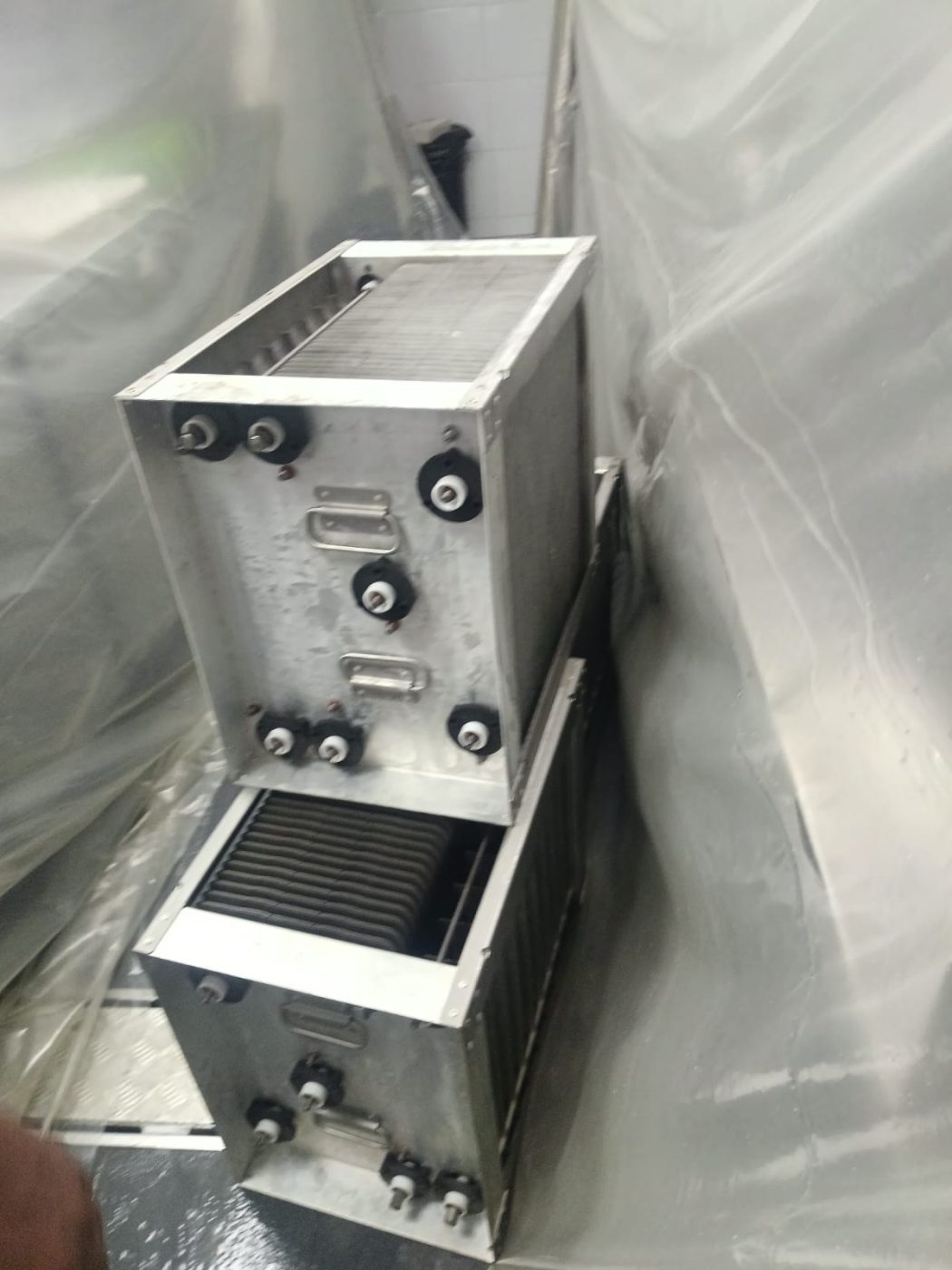
Where the discharge point sits relative to fresh-air intakes, walkways, residential windows and other tenants decides whether that becomes a complaint. So does whether anything is doing meaningful odour and particulate treatment before discharge. An electrostatic precipitator is the usual answer where discharge is constrained, and where one is fitted its cells have to come out and be cleaned on a schedule — an ESP that has not been serviced is doing very little except adding resistance to the system. Neighbour odour complaints goes through how these are usually resolved.
A bake kitchen is a heat-and-moisture problem wearing the clothes of a grease problem. Size for the oven load rather than the hob, give the condensate somewhere to go, do not accept "low grease means no cleaning" when flour dust is part of the deposit, design the make-up air path properly or your proofing will vary with the weather, coordinate ventilation with the gas installation before fabrication, and check the discharge point against everything around it before the first complaint arrives at 6am.
We design, build and maintain commercial kitchen ventilation, and an oven-led kitchen gets sized differently from a wok line. Tell us the equipment and the unit, and we will tell you what the system has to do. Message us on WhatsApp, or see kitchen exhaust design and build and kitchen exhaust cleaning.
We design, clean, repair and maintain commercial kitchen exhaust systems across Singapore — on 24/7 standby.