Most kitchen exhaust cleans happen with nobody from the restaurant watching. The crew arrives after the last order, works through the night and is gone before the morning prep team walks in. That is how it should be: a typical single-kitchen clean takes a few hours and is scheduled after operating hours, so no trade is lost. But it also means the two moments that decide whether the clean was worth paying for, the hour before the crew starts and the ten minutes before the first burner is lit, usually belong to nobody.
This is the operator's side of a cleaning night: what to have ready so the crew reaches the whole system, and what to check before cooking, because some things that go wrong on a cleaning night only show up once the line is running.
A week before: agree what is being cleaned, and where it stops
A clean that covers the hood and filters but never opens the duct or the fan leaves grease exactly where it does the most damage. Before the date is fixed, know which of these are in the job:
- The hood, inside and out, not just a wipe-down of the stainless you can see.
- Filters taken out and degreased, never cleaned in place.
- Accessible ductwork degreased internally. If the duct is not opened, it is not cleaned.
- The exhaust fan opened and degreased, with the bearings, belts, motor and connections looked at while it is open.
- Make-up air grilles, because an exhaust only works when replacement air can get in.
- Airflow and capture checked at the hood afterwards, plus before-and-after photographs and a service report.
That is our published ten-point servicing checklist, and it is a fair test of any contractor's scope, ours included. What each part should involve is covered in what a kitchen exhaust cleaning service should include.
Then ask the one question that decides whether the duct really gets cleaned: where are the access panels, and is there any section the crew will not be able to reach? A duct run with no access door gets written up as "not accessible" on every visit. Better to hear that before the night than in a report afterwards.
The keys and permissions that stop a clean halfway
More cleaning nights are cut short by access than by grease, and the fan is usually why, because it is rarely inside your unit.
- Where the fan is, and who holds the key. On a roof, in a riser, behind a plant room door. If the crew cannot get to it, the fan does not get cleaned that night, and grease left on the impeller unbalances it and wears out the bearings.
- Building management approval. In a shopping centre or a managed building, after-hours work, roof access and lift use normally have to be arranged in advance. Ask your centre management what notice they need rather than assuming it can be sorted on the day.
- Who lets the crew in, and who checks the kitchen in the morning. Name both.
- The fire suppression system. Tell the cleaning contractor whether your hood has one, and who services it. Work inside the hood happens right next to its detection and discharge nozzles.
- Your last cleaning report, if you have one. It tells the crew which sections were heavy last time and which were not reached.
The evening: clear the line, then hand over the power
A crew that spends its first hour moving stock is a crew that runs short of time at the far end of the duct. Before they arrive:
- Put the food away. Nothing open on the line, the pass or the shelving under the hood. Degreasing puts chemical and hot water inside the hood and duct, so treat everything underneath the work as exposed.
- Clear the floor and the surfaces under the hood, so equipment can be covered and, where practical, moved.
- Let the line cool with the fan still running. Hot surfaces and oil keep giving off vapour after the last order. The fan should go off when the crew is ready to isolate it, not the moment service ends.
- Show the crew the isolators for the fan and the control panel, and where the gas shut-off is. Where a hood is interlocked so that the gas shuts off when the exhaust stops, isolating the fan will shut off the appliances too. That is expected, and it should be reset properly before the crew leaves rather than discovered at 7am.
On the fire suppression system, one rule applies whoever does the work. If it is isolated before work in the hood begins, it is re-armed and recorded before the crew goes home. A hood should never go back into service with its suppression still isolated because the paperwork was left for the morning. The same grease that loads the duct also fouls suppression nozzles and coats fusible links, which is why we can service the suppression system on the same visit as the clean.
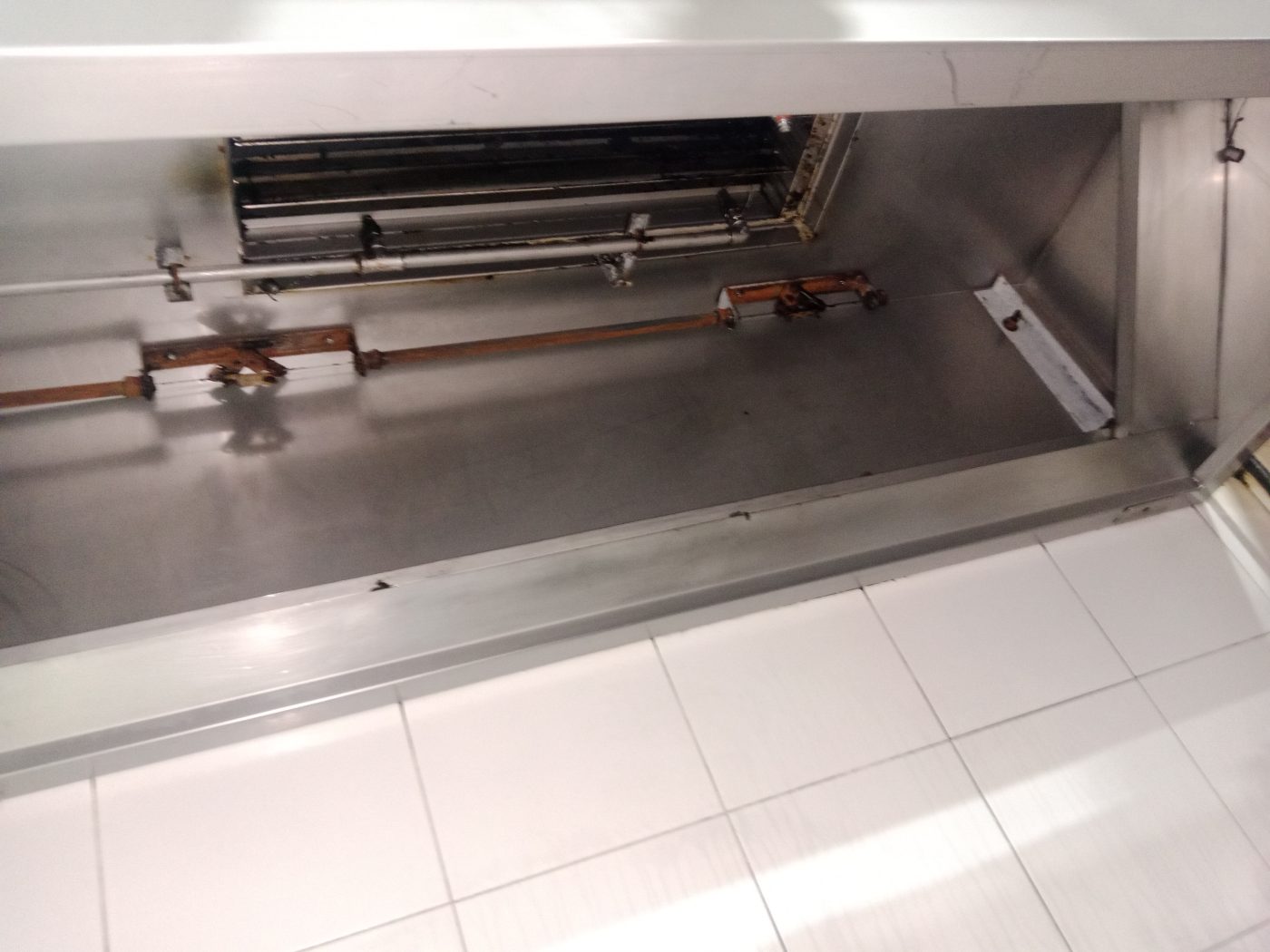
The photograph at the top is from our project portfolio: the inside of a hood canopy on one of our jobs, with the filters lifted out and the pipework and fittings that run along the inside of the hood exposed. That is what a crew works next to all night, and it is what should look the same in the morning as it did the evening before.
Before the first burner is lit: a ten-minute check
This is the part most kitchens skip, and it is where a good clean gets quietly undone. Give it to whoever opens up.
- Every filter is back in the hood. Count the frames. A single service cooked with empty filter frames puts more grease into the duct than weeks of normal running, which undoes the clean on its first night.
- The filters are the right way round. A baffle filter drains in one direction, towards the grease gutter. Put back upside down or reversed, it still looks normal in the hood, but grease collects where it was never meant to sit and eventually runs down the front of the hood or onto the cooking surface.
- The grease gutter or cup is back in place and empty.
- Nothing inside the hood looks moved, and the suppression system is confirmed back in service. Nozzles should still have their blow-off caps on and the pipework should look as it did before. If a cap is missing or a fitting looks knocked, call whoever services the suppression system before cooking, not after.
- Every surface that touches food is wiped down before use, whether or not it looks affected.
- The fan goes on before the burners, and you listen to it. A new rattle, squeal or vibration that was not there yesterday is worth a call the same morning. Grease on the blades is one of the things that makes a fan run rough; a fan that has just been opened and degreased should not sound worse than it did.
- Light one appliance and watch the smoke. It should rise into the hood and stay there. If capture is worse than before the clean, something has changed: a filter out of position, a damper moved, or the fan not running the way it should.
- Look up along the duct route. Every access panel that was opened should be closed, and any ceiling panel that was lifted should be back.
- The doors behave normally. A kitchen door that suddenly slams or will not close means the balance between the air going out and the air coming in has shifted.
The two problems that turn up a day or two later
A drip or a stain on the ceiling under the duct. A proper duct clean puts hot water, detergent and mechanical action inside the duct. If a seam on an older, rarely cleaned system was being held together by a hardened crust of grease, removing the grease removes the seal. The leak was already there; the clean revealed it. That is not a reason to clean less. It is a reason to have the seam dealt with, and to clean often enough that grease never becomes the thing holding a joint shut. Why ducts fail at the joints is explained in what your kitchen exhaust duct is made of, and why it leaks grease.
Smoke escaping at one station, when it did not before. Where several hoods share one duct, the air is shared between them by resistance, and a damper knocked during a clean or a filter refitted in the wrong place can move that share. Report it straight away rather than living with it until the next visit. With a dated report and photographs of the same locations, tracing what changed is quick. How that balance works is in make-up air and air balancing.
What you should have by the next morning
- A service report with the date and the scope actually completed, section by section.
- Before-and-after photographs of the hood, the ductwork and the fan, from locations you can recognise. Photographs of the canopy alone do not show that the duct was cleaned.
- Any section that could not be reached, named plainly, with the reason.
- Defects found, such as a worn belt, a rough bearing, a damaged filter or a leaking seam, with a recommendation. Because we stock motors, fans, fan parts and control components, we can often repair or replace a faulty part on the spot rather than booking a second visit.
- If the suppression system was isolated, a record that it was re-armed.
File it with the previous reports. That dated record is what you show NEA, SCDF, your landlord or your auditor, and it is also the baseline the next clean is measured against.
Book the next one while the report is fresh
Heavy wok, grill and deep-frying kitchens often need cleaning monthly; lighter kitchens can run on a quarterly cycle. We inspect before recommending an interval rather than applying a fixed rule. If the same sections come back heavily loaded visit after visit, the interval is too long. What happens on the line between cleans decides how much there is to remove; see what your kitchen team does daily decides what the deep clean costs.
The short version
- Agree the scope, and which duct sections cannot be reached, before the night.
- Sort out fan access and building management approval, and tell the contractor about the suppression system.
- Before cooking: filters back and the right way round, nozzles capped, surfaces wiped, fan on first, capture checked, panels closed.
- Report a new drip, noise or smoky station straight away.
To book a kitchen exhaust clean, or have the system surveyed first, WhatsApp us on 8989 2833 with what you cook, how many hoods you have and when the kitchen is closed. We clean the hood, ductwork, fan and make-up air grilles, document every visit with before-and-after photographs, and are on 24/7 standby if something turns up that cannot wait. Scope and pricing follow an inspection.
Questions
Common questions
How long does a kitchen exhaust clean take, and will we lose a night of trade?
A typical single-kitchen clean takes a few hours and is scheduled after operating hours, overnight or during a closed period, so the kitchen is ready at opening. Larger or heavily soiled systems can need a longer window, which is confirmed after the system has been inspected.
How should we prepare the kitchen for an exhaust clean?
Agree the scope first, including which duct sections have access panels. Arrange access to the exhaust fan on the roof or in the riser, and any approval your building management needs for after-hours work. Tell the contractor whether the hood has a fire suppression system. On the night, put food away, clear the line and the floor under the hood, and leave the fan running until the crew is ready to isolate it.
What should we check before cooking after the exhaust has been cleaned?
Count that every filter is back and fitted the right way round, the grease gutter or cup is in place, suppression nozzles still have their blow-off caps and you have been told the suppression system is back in service. Wipe down food surfaces, switch the fan on before the burners and listen for new noise, light one appliance to check the hood captures the smoke, and make sure every access panel along the duct is closed.
Why is grease dripping from the duct after it was cleaned?
On an older, rarely cleaned system a leaking seam can be held shut by a hardened crust of grease. A proper clean removes the crust, and with it the seal, so the leak was already there and the clean revealed it. The seam should be repaired, and the system cleaned often enough that grease never ends up holding a joint together.
What documentation should we receive after a kitchen exhaust clean?
A dated service report with the scope completed section by section, before-and-after photographs of the hood, ductwork and fan, any section that could not be reached and why, defects found with a recommendation, and a record that the suppression system was re-armed if it was isolated. Keep it with previous reports for NEA, SCDF, your landlord or your auditor.