
29 Sep 2026 · Maintenance
A commercial kitchen exhaust system is a chain of parts: hood and filters, the plenum and ductwork behind them, the fan, replacement (make-up) air, the controls and the fire suppression system. From the floor you can check whether smoke spills past the hood edge, whether the filters sit snugly, where the duct access panels are, whether the fan sounds or feels different, whether kitchen doors are hard to open or whistle, whether the controls work without a workaround, and whether dated service reports with before-and-after photos exist.
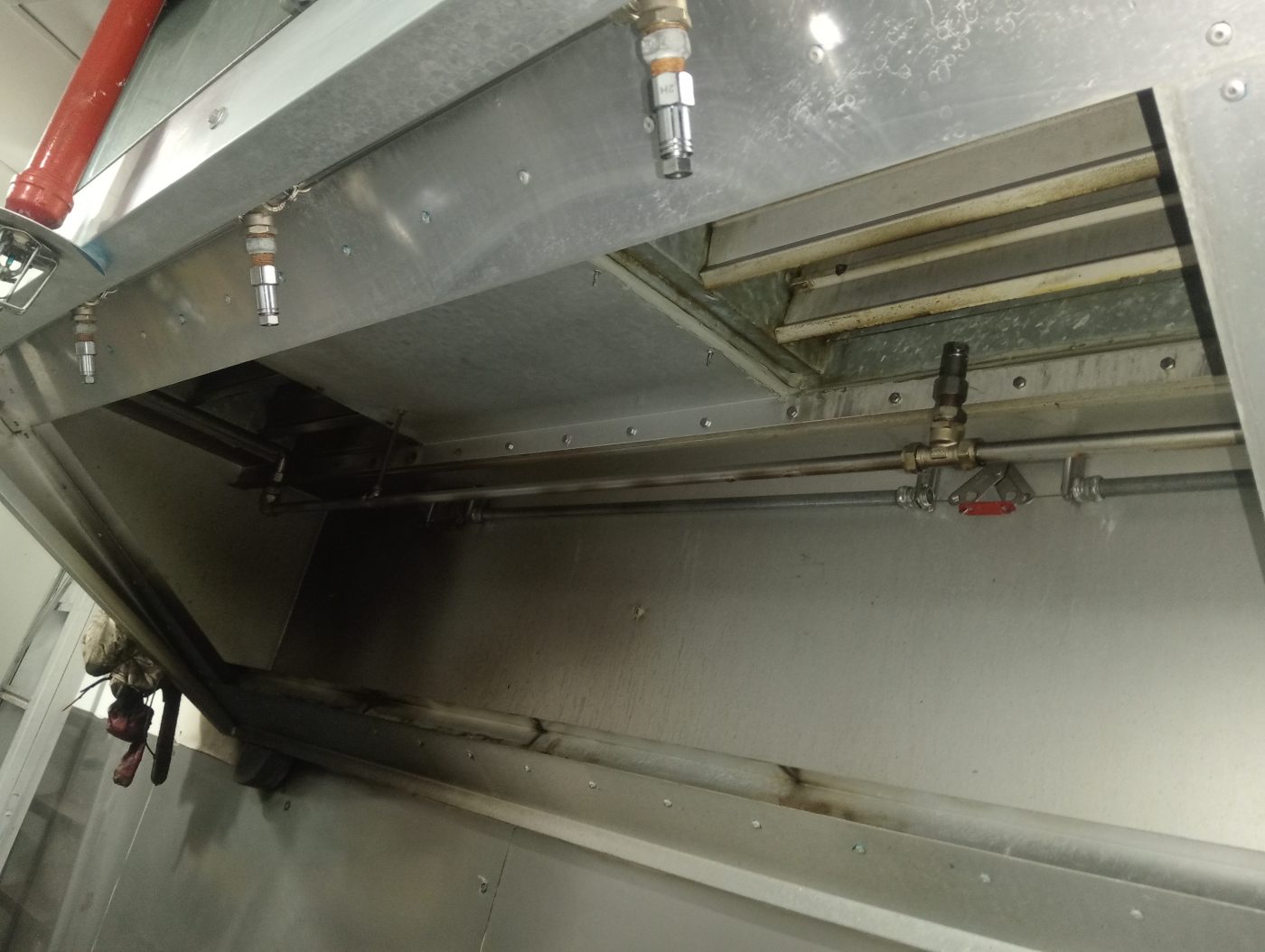
Pictured above: the underside of a hood from one of BC Air’s jobs — the filter bank at the upper right, and the nozzles and pipework that run along the top edge above the cooking line. Most of what decides whether a kitchen exhaust system works is out of sight like this, which is why it is worth knowing where to look.
A commercial kitchen exhaust system is not one machine. It is a chain of separate parts — hood, filters, ductwork, fan, replacement air, controls and fire protection — and a fault in any one of them shows up in the kitchen as the same handful of complaints: smoke, heat, smell, noise. That is why “the exhaust isn’t working” is such an unhelpful diagnosis, and why an owner who knows the parts can tell a contractor much more than that.
This is the system in the order the air travels, with one thing at each stage that you can check from the kitchen floor, without tools and without opening anything.
The hood’s only job is to capture heat, smoke and grease vapour rising off the cooking line. The check costs nothing: with the line at full service, watch the front edge of the hood. If smoke or heat is spilling out past the edge and into the kitchen, the system is not capturing, however clean it looks. That can come from the hood, the fan or the replacement air — the hood is just where you see it first. The exhaust is running but the kitchen is still smoky walks through the likely causes in order.
Also look at the filters fitted in the hood. They should be seated snugly with no visible gaps, so that air is drawn through the filter and not around it. Check whether they are baffle type or mesh, because the two behave differently — baffle vs mesh hood filters covers what each does — and look for grease that has built up enough to drip or run down the hood face.
Behind the filter bank is the hood plenum, where the air collects before it enters the duct. Grease that gets past the filters ends up here and in the duct beyond, and you cannot see it from below. Behind the baffle filters explains what is in there and why it matters.
The floor-level check is simple: ask where the access panels are. A duct can only be cleaned where a person can get at its inside. BC Air’s own servicing checklist puts it bluntly: if the duct isn’t opened, it isn’t cleaned. If nobody in the kitchen can tell you where the panels are, or whether the duct has any, that is a finding in itself. The duct you cannot open is the duct that never gets cleaned goes through what to ask for.
Where the duct is visible — in a back-of-house corridor, a plant room, a store — look at it rather than past it. Grease staining or wet marks at joints and around access panels, or a duct that sags between its supports, are all worth writing down with a photo and the date. You are not diagnosing anything; you are giving whoever services it a starting point. If a stain appears on a ceiling under the duct, water at the kitchen exhaust duct when it hasn’t rained explains how to tell the possible sources apart before anyone opens the ceiling.
Duct that passes through other spaces can be subject to fire-safety requirements of its own. Where that applies, it is a question for the designer and the authority, not something to settle by eye — see fire-rated ductwork.
The exhaust fan usually sits at the end of the duct run, on the roof, in a riser or at a plant deck, so you may never see it. You can still listen. A fan that has started to grind, squeal, rattle or shake the duct it is attached to is telling you something has changed. BC Air’s checklist notes that grease on the blades unbalances a fan and wears out its bearings, which is one reason a fan is opened and cleaned as part of a proper service and not left as an afterthought.
If you can safely see the roof or discharge area from a window or with building management’s help, look for grease staining around the fan. Grease on the roof around your kitchen exhaust fan covers what it means and what to fix. And note where the exhaust finally discharges: where your kitchen exhaust actually discharges is the source of many neighbour complaints.
Air that leaves through the exhaust has to be replaced from somewhere. If it isn’t supplied on purpose, the kitchen pulls it in wherever it can — through doors, gaps and other openings. You can spot it from the floor: kitchen doors that are hard to open or that whistle at the gap, or a hood that seems weaker when the doors are shut. The make-up air grilles, where the kitchen has them, also need to be clear of grease and dust, which is why BC Air lists them in its cleaning scope. For the fuller picture, make-up air and air balancing explains why a big hood can still fail to capture.
Two things belong here. First, the controls: the switch or panel that starts the fan and hood should do exactly what its labels say, every time. If someone in the kitchen has learned a trick to get it running, that is a fault, not a workaround. Where the hood, fan, gas supply and fire suppression are linked, that link should be tested and not assumed — the wiring nobody tests describes it.
Second, the suppression system. The nozzles above the cooking line are positioned for the appliances that were under them when the system was designed. If the line has been rearranged or new equipment added, ask whether anyone has confirmed that the coverage still fits. Ask, too, who services the system and when the last visit was; fire suppression systems sets out what BC Air covers.
The last part of the system is not physical. A properly serviced system leaves evidence: dated before-and-after photos and a written service report after each visit. Those records are what you can show a landlord, an auditor or an inspector, and they are also how you tell whether the interval you are on is right. BC Air’s cleaning frequency guide puts most commercial kitchens at every 1–3 months, with heavy wok, grill and deep-frying lines often needing monthly attention — but the real answer for your kitchen depends on what you cook and how much, and an inspection is how you find it.
None of this replaces an inspection by someone who can open the system up. What it does is turn “the exhaust is bad” into a short list of specific observations, which is what makes a quote or a diagnosis worth having. When you are ready to get the inside cleaned, the scope is on the kitchen exhaust cleaning page, and the 10-point servicing checklist lets you hold any contractor’s scope, BC Air’s included, against the same list.
Want a second pair of eyes on what you found? WhatsApp BC Air on 8989 2833 with what you noticed and your kitchen type. Scope and pricing follow a look at the actual system.
Related reading: the exhaust is running but the kitchen is still smoky · commercial kitchen ventilation troubleshooting · choosing a commercial kitchen exhaust hood
We design, clean, repair and maintain commercial kitchen exhaust systems across Singapore — on 24/7 standby.