
24/7 Standby · Always At Your Service 💬 WhatsApp +65 8989 2833

Grease on the Roof Around Your Kitchen Exhaust Fan: Where It Comes From and What to Fix

19 Sep 2026 · Cleaning & Compliance
Grease on the Roof Around Your Kitchen Exhaust Fan: Where It Comes From and What to Fix
Grease on the roof around a kitchen exhaust fan is a symptom, not the problem. Photograph it before anyone cleans it: a fine spray downwind of the outlet means too much grease is getting past the filters or the fan is overloaded; a pool under the fan means the housing's collection point is full, blocked or missing; streaks from one spot mean a failed seal at the duct connection or access door; a mess after cleaning night points to the clean itself. Fix it in order - filters in every slot with no gaps and removed for cleaning, a cleaning interval matched to the cooking (most kitchens every one to three months), the fan actually included and photographed in the clean - and clean the roof last.

The first anyone in the kitchen hears of it is usually a message from building management: there is grease on the roof around your exhaust fan, or brown streaks running down the wall below your discharge, please rectify. The fan is outside, nobody from the kitchen ever goes up there, and the natural reaction is to ask someone to “clean the roof”.

Cleaning the roof removes the evidence and nothing else. Grease on the outside of a kitchen exhaust fan is a symptom, and the pattern it leaves tells you which part of the system is producing it. Most operators who reach this point search for kitchen exhaust fan cleaning, and cleaning is part of the answer, but only once you know why the grease got out. Here is how to read what is on the roof, what to fix and in what order, and what to send back to building management.

Why grease reaches the fan at all

Every kitchen exhaust carries grease past the filters. A baffle filter catches a large share of it, never all of it; the rest travels up the duct as vapour and fine droplets, cools, and settles on the duct walls, on the fan blades and inside the fan housing. That is normal, and it is why a proper service opens the fan up. Our servicing checklist lists “Exhaust fan opened and degreased” as its own line — housing and impeller blades cleaned — because grease on the blades unbalances the fan and wears out the bearings.

A fan that is cleaned at the right interval and is sealed properly keeps that grease inside its housing until the next visit. Grease ends up on the roof when one of four things has gone wrong: more grease is arriving than the system should pass, the fan has been left too long between cleans, the housing has nowhere to hold what it collects, or a joint is letting it out.

Read the grease before anyone cleans it

Before anyone scrubs anything, get photographs — yours, or the ones building management sent. Once the roof is cleaned the pattern is gone, and the pattern is the diagnosis. The common ones:

  • A fine speckled film spread downwind of the outlet, on the roof, the parapet and any plant nearby. Grease is leaving the discharge as droplets in the airstream. Usually that means too much is getting past the filters, or the fan and last section of duct are so loaded that the airflow is picking deposits back up and throwing them out.
  • A pool or a trail directly under the fan, running with the fall of the roof towards a drain. Grease collected inside the housing is overflowing or draining out. The collection point is full, blocked, or was never there.
  • Streaks from one spot — where the duct meets the fan, at the flexible connection, or around an access door on the housing. That is a failed seal. The same joints that let rain in, as we set out in kitchen exhaust after heavy rain, let grease out.
  • Brown runs down a facade under a wall discharge. Grease condensing in the last section of duct or in the outlet itself and running out by gravity, often after the fan stops at night.
  • A mess that appears the morning after a cleaning night. That is wash water and degreaser that escaped during the clean, not grease from normal running. It is a workmanship question for whoever did the clean, and a fair one to ask: how do they contain run-off at the fan?
  • Worse after heavy rain. Rain filling the fan’s collection point floats the grease out and across the roof. Fixing the rain entry fixes this one.

Most roofs show more than one of these, and only one of the fixes is “clean more often”.

Start at the filters, not the roof

The most common root cause is simply that more grease is getting into the duct than should. That is decided at the hood, and it takes five minutes to check with the fan off:

  • Is there a filter in every slot? One missing filter is an open hole straight into the plenum and the duct.
  • Do the filters sit tight, with no gaps at the ends and no bent frames? Air takes the easy path round a filter, not through it.
  • Are they baffle filters? A mesh filter that clogs pushes air round itself, and a mesh filter that has been cleaned hard lets more through. The difference is set out in baffle against mesh hood filters.
  • Are they being taken out and cleaned? The checklist is plain on this: filters are removed and chemically cleaned, or replaced when worn, and never cleaned in place.

If the filters are wrong, cleaning the fan more often only treats the result. The plenum behind them can also feed grease downstream by itself; see behind the baffle filters.

Then check the interval, and whether the fan is actually in it

Grease on the roof is often the first visible sign that the fan is being cleaned less often than the kitchen needs. Most commercial kitchens in Singapore need their exhaust cleaned every one to three months. Heavy wok, grill and deep-frying kitchens often need it monthly; lighter kitchens can run quarterly. The right interval for a particular kitchen comes from inspecting the hood, ducting and fan against the actual cooking volume and hours, not from a fixed rule; our guide to how often a kitchen exhaust must be cleaned sets out how that is decided. A kitchen that changed its menu, added a fryer or extended its hours is on a different clock from the one it started on.

The second question is less comfortable: is the fan being cleaned at all? The fan sits on a roof or a ledge, often behind a locked door, and it is the easiest part to leave out unnoticed. Look at your last cleaning report. On ours, every clean is documented with before-and-after photographs of the ductwork, hood and fan. If your reports only ever show the hood and the filters, the fan may not be part of the job. That is one of the doubts we describe in changing your kitchen exhaust cleaning contractor, and roof grease is often the moment it becomes visible.

Then the fan itself

Once the grease arriving at the fan is under control, look at how the fan holds and releases it:

  • The collection point. Where does grease that runs down inside the housing go? If it has a drain point or a container, is it clear, and is anyone emptying it? If it has nowhere to go, it will find the lowest joint.
  • The joints and the flexible connection. The connection between duct and fan moves every time the fan starts and stops, and the seal at that joint ages in grease and heat. A crust of grease can hold a failing seal together until a clean removes it, which is why a leak sometimes appears right after a good clean; we explain that in what your kitchen exhaust duct is made of, and why it leaks grease.
  • The access door on the housing. A door that has been forced, refitted crooked or closed on a perished gasket leaks every time the fan runs.
  • Balance and vibration. Grease on the impeller unbalances it, and a fan that vibrates works its own joints loose. Fan mechanicals — bearings, belts, vibration and balance — are part of a proper service for exactly this reason.

Some of these are cleaning, some are small repairs. Because we stock motors, fans, fan parts and control components in-house, a fault found on the fan during a clean can often be repaired or replaced on the spot rather than becoming a second visit.

What cleaning the roof should and should not be

Cleaning the grease off the roof is a legitimate job once the source has been dealt with, and worth doing promptly: it is a slip hazard for anyone who goes up there, it is fuel sitting outside the duct, and left to sit it can damage some roof finishes. But agree it as a separate item from cleaning the exhaust, ask how the run-off will be contained, and ask what will be different next month. If nothing upstream changes, you will pay to clean the same roof again.

What to send back to building management

A short reply that shows you have understood the cause usually closes the matter faster than a promise to clean:

  1. The photographs of what was found, before cleaning.
  2. What the pattern indicated — filters, interval, a seal, or the clean itself.
  3. What has been done: filters corrected, a joint resealed, the fan added to the cleaning scope, the interval shortened.
  4. The date of the next scheduled clean, and a copy of the report with before-and-after photographs of the fan when it is done.

Before-and-after photographs are what a landlord, NEA or SCDF can actually check, and they tell you later whether the fix held.

The hood in the photo

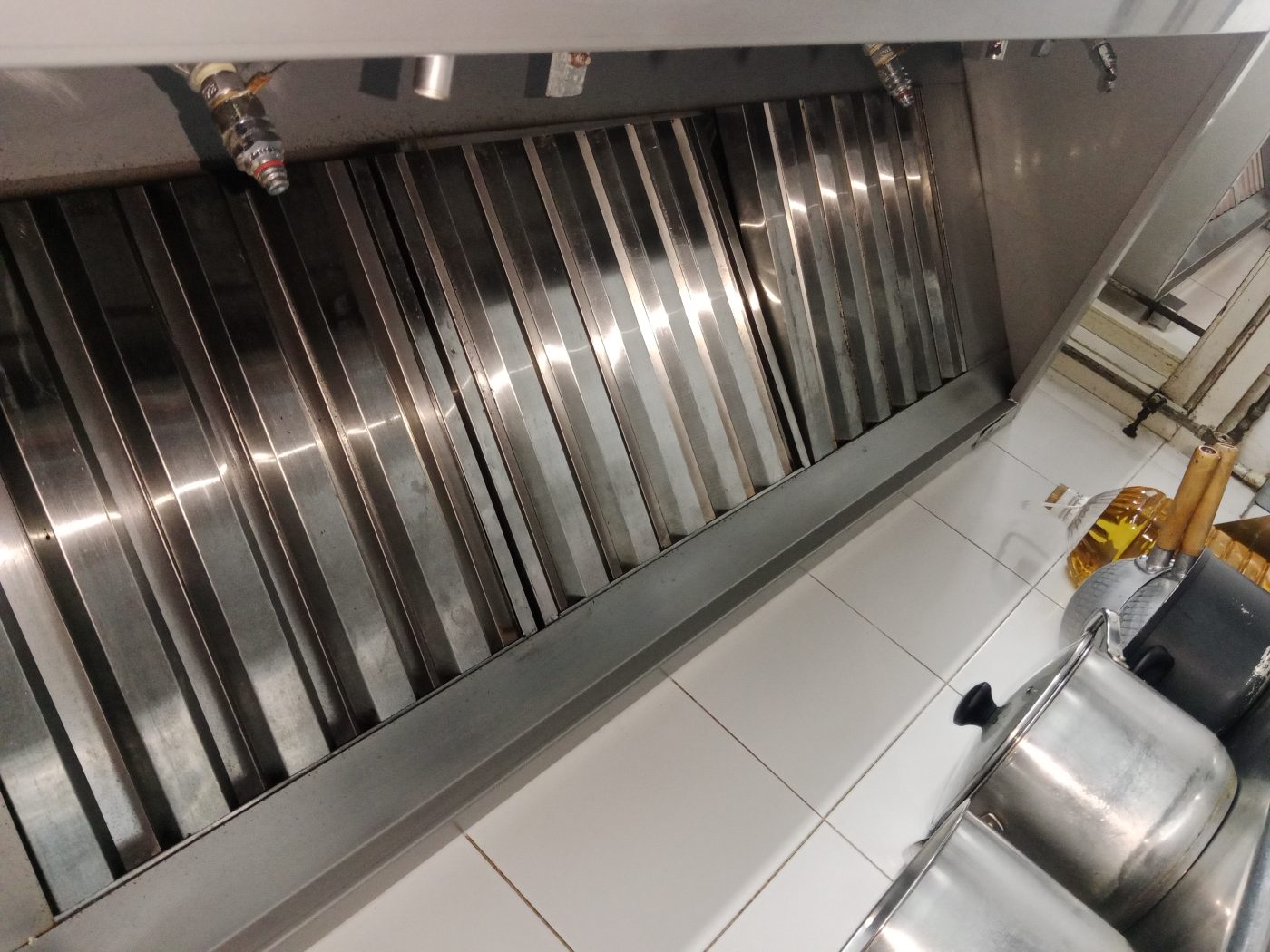
The photograph is not a roof. It is a canopy hood on one of our projects, seen from below: a full bank of stainless baffle filters sitting tight in their frame, with the fire suppression nozzles above. It is here because this is where the roof problem is usually decided — a bank with no gaps and no missing filters keeps most of the grease out of the duct and off the fan.

Getting it looked at

We clean, repair and maintain commercial kitchen exhaust systems in-house, fan included, on 24/7 standby. Our kitchen exhaust cleaning covers the hood and filters, accessible ductwork, fan blades and housing, and make-up air grilles, with before-and-after photographs every time, to NEA, SCDF and BCA requirements and bizSAFE standards. We recommend an interval after inspecting the system, and pricing follows that inspection.

If building management has sent you photographs of grease around your fan, WhatsApp BC Air on 8989 2833 and send them with your location, what you cook and when the exhaust was last cleaned.

The short version

  • Grease around an exhaust fan is a symptom. Photograph the pattern before anyone cleans it: spray downwind points to the filters, a pool under the fan to its collection point, streaks from one spot to a seal.
  • Check the filters first: one in every slot, no gaps, baffle not mesh, removed for cleaning.
  • Check the interval, typically one to three months, and that the fan appears in the report before and after.
  • Clean the roof last, as a separate item, and send building management the photographs and the plan.
Questions

Common questions

Why is there grease on the roof around our kitchen exhaust fan?
Because grease that gets past the hood filters settles in the duct and the fan, and something is letting it out. The usual causes are too much grease getting past the filters, the fan being cleaned less often than the kitchen needs or not at all, the fan housing having nowhere to hold what it collects, or a failed seal at the duct connection or access door. The pattern on the roof tells you which.
Should we just get the roof cleaned?
Not first. Photograph the grease before anyone cleans it, because the pattern is the diagnosis. Fix the source, then clean the roof as a separate agreed item. If nothing upstream changes, the same roof will need cleaning again.
What should we check first?
The hood filters, with the fan off: a filter in every slot, no gaps or bent frames, baffle rather than mesh filters, and filters taken out and cleaned rather than cleaned in place. Too much grease getting past the filters is the most common root cause.
How often should a kitchen exhaust fan be cleaned?
As part of the whole exhaust system. Most commercial kitchens need cleaning every one to three months; heavy wok, grill and deep-frying kitchens often monthly, lighter kitchens quarterly. The right interval comes from inspecting the hood, ducting and fan against the actual cooking volume.
How do we know the fan is actually being cleaned?
Look at the cleaning report. A proper clean opens the fan and degreases the housing and impeller, and the before-and-after photographs should show the fan, not only the hood and filters. If the fan never appears in the report, ask whether it is in the scope.
What should we tell building management?
Send the photographs taken before cleaning, what the pattern indicated, what has been done about the cause, and the date of the next clean with the report and fan photographs when it is done.

Need This Sorted in Your Kitchen?

We design, clean, repair and maintain commercial kitchen exhaust systems across Singapore — on 24/7 standby.

Chat on WhatsApp