
15 Aug 2026 · Cleaning & Compliance
A baffle filter forces grease-laden air through sharp changes of direction so grease strikes the blades and drains away continuously, and it presents no straight path for flame. A mesh filter captures by interception and holds the grease it catches, so it becomes progressively more restrictive until extract volume falls, the fan works harder, grease passes into the duct, and the saturated mesh itself becomes fuel above an open flame. Baffles are the commercial standard; mesh panels fitted into baffle frames are a common and avoidable finding.
The filters in a kitchen hood are the cheapest part of the whole extract system and the part that decides how expensive everything downstream becomes. They are the only thing standing between a wok burner and two hundred feet of ductwork. When they are the wrong type, or the right type left in too long, grease stops being caught at the hood and starts being deposited everywhere it is hard to reach.
Most kitchens we survey have one of three things above the cooking line: baffle filters, mesh filters, or a mesh filter sitting in a frame designed for baffles. The third is more common than it should be.
A baffle filter is a set of interlocking steel blades with no gaps you can see straight through. Air carrying grease enters, is forced to change direction sharply several times, and the grease droplets — being heavier than air — cannot make the turns. They strike the blades, run down them, and drain into the hood's grease channel and cup.
Two consequences follow from that design and they are the reason baffles are standard in commercial kitchens.
First, a baffle filter drains. Grease leaves the filter continuously while you cook, which means the filter does not gradually turn into a solid block. Second, and more important, a baffle presents no continuous path for flame. If a flare-up occurs on the range, the same tight turns that catch grease also break up the flame front, so fire is far less likely to travel through the filter bank into the plenum and the duct.
A mesh filter is layered expanded metal or wire wool in a frame. It works by interception — grease-laden air passes through a dense tangle and grease sticks to the wire. On day one, a clean mesh filter captures very effectively, often better than a baffle.
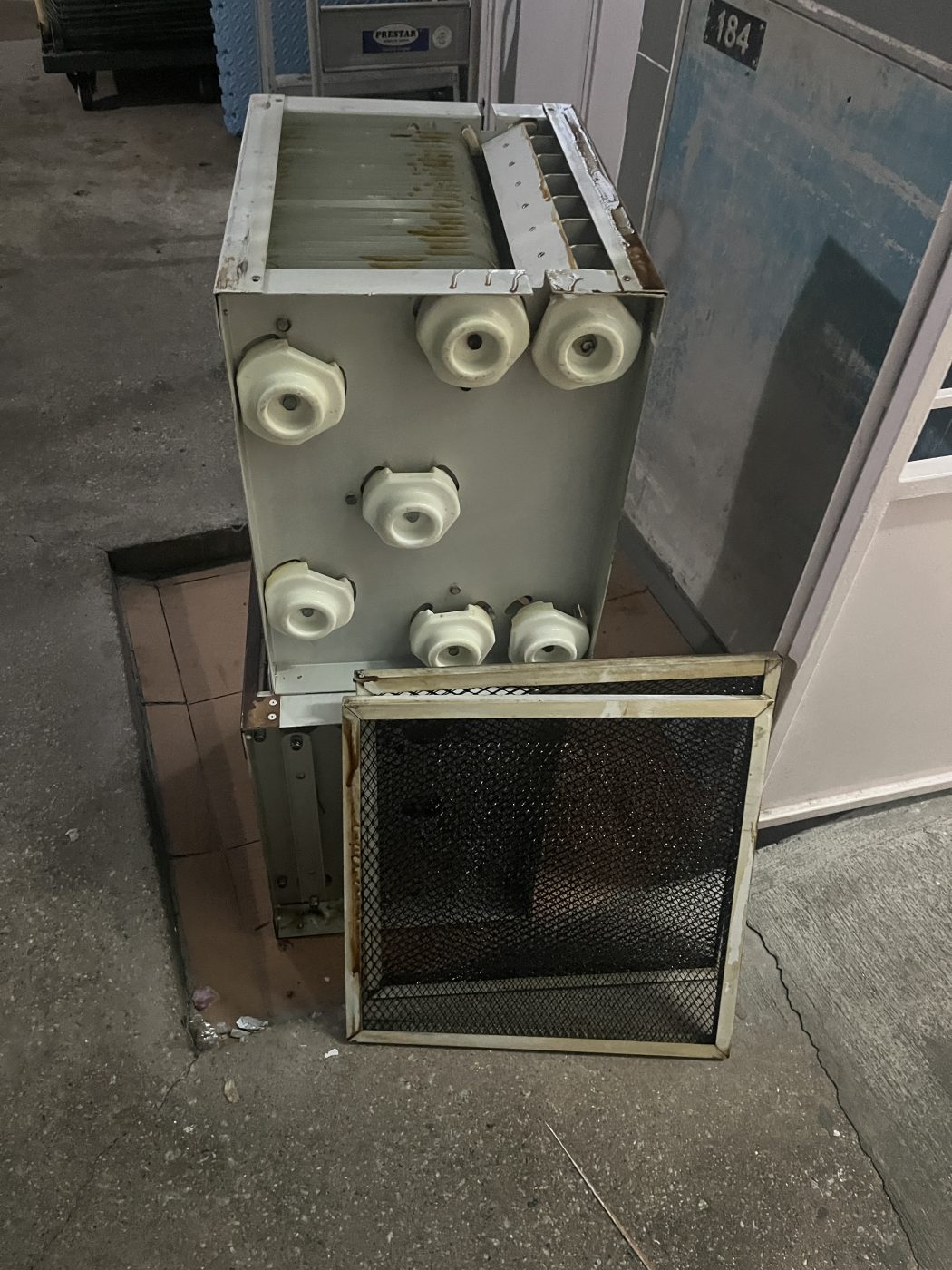
The problem is what happens on day thirty. Mesh holds rather than drains. The grease it captures stays in the filter, filling the interstices, and the filter becomes progressively more restrictive. The photograph at the top of this article shows a mesh panel we removed from a working kitchen: the frame is intact, the metal is fine, and the mesh itself is a solid black mat. Almost no air was passing through it.
That produces three failures at once, and operators usually notice them in this order:
The fire risk is the one nobody sees. A saturated mesh filter is a mat of fuel sitting directly above an open flame, and unlike a baffle it offers a continuous path rather than a series of obstructions.
Mesh filters are cheaper and they fit. A hood built for baffles will accept a mesh panel of the same nominal size, it will sit in the runners, and nothing about the installation looks wrong from the floor. If a filter is damaged and replaced quickly by whoever is available, the cheaper panel is often what arrives.
The other route is inheritance. Taking over an existing unit, you get whatever the last operator was using, and a hood with mismatched filters — some baffle, some mesh, occasionally a gap where one went missing — is a common finding on a first survey. Every gap is a straight, unobstructed path for grease into the duct.
Baffle filters are designed to be removed and washed. They come out, go through a degreasing soak, get rinsed and go back. The interval depends entirely on what you cook and how long the line runs — a wok and deep-fry operation loads filters far faster than a bakery or a sandwich line — but the honest answer for most Singapore kitchens is more often than the schedule they are currently on.
Mesh filters can be cleaned, but they do not recover the way baffles do. Grease works into the depth of the mesh and a soak does not always bring it out, so a mesh filter has a service life after which cleaning stops restoring it and it should be replaced. Operators who clean mesh on a baffle schedule are usually running filters that no longer work.
Two practical points, whichever type you have. Filters must go back the right way round — a baffle installed backwards drains into the hood interior instead of the channel. And a filter bank with a missing panel should be treated as urgent rather than cosmetic, because that opening is taking the majority of the airflow.
Cartridge filters — sometimes called high-velocity or centrifugal cartridges — take the baffle principle further by spinning the airstream inside a cylindrical element so grease is thrown out by centrifugal force. They capture a finer fraction than a plain baffle and are used where the load is heavy or the discharge is sensitive, for example where an extract terminates close to a neighbouring window or an air intake.
They are not a free upgrade. A cartridge bank imposes a higher pressure drop than baffles, so it has to be part of the fan and duct sizing rather than dropped into an existing hood. Fitting cartridges into a system designed around baffles usually produces the same symptom as a blocked mesh filter: less extract, a harder-working fan, and a hot kitchen.
You do not need us on site to know whether you have a problem. With the fan off and the appliances cold:
When we assess a hood, the filters tell us most of what we need to know before anything is dismantled. Whether the type matches the hood and the cooking. Whether they are all the same type and none are missing. Whether the grease channel and cup are draining or overflowing. How far past the filters grease has already travelled — the state of the plenum behind them is the real measure of how long the filters have been failing.
That last one decides scope. If the filters have been holding, the work is filters and hood. If they have not, the duct run and fan need attention too, and that is a different job.
BC Air is part of WCT (S) Systems Pte Ltd. We survey the kitchen and quote from what is there, rather than giving a figure over the phone against assumptions that only become visible later.
Whichever filter is fitted, how it is washed and refitted matters as much as the choice itself — including which way round it goes back in. See the daily kitchen exhaust routine.
WhatsApp 8989 2833 about hood filters →
Services: kitchen exhaust cleaning · commercial kitchen ventilation
Related reading: signs a hood is overdue a deep clean · when you need an electrostatic precipitator · grease build-up and fire risk
Also worth reading: behind the baffle filters - the part of the hood nobody looks at.
We design, clean, repair and maintain commercial kitchen exhaust systems across Singapore — on 24/7 standby.