
04 Nov 2026 · Cleaning & Compliance
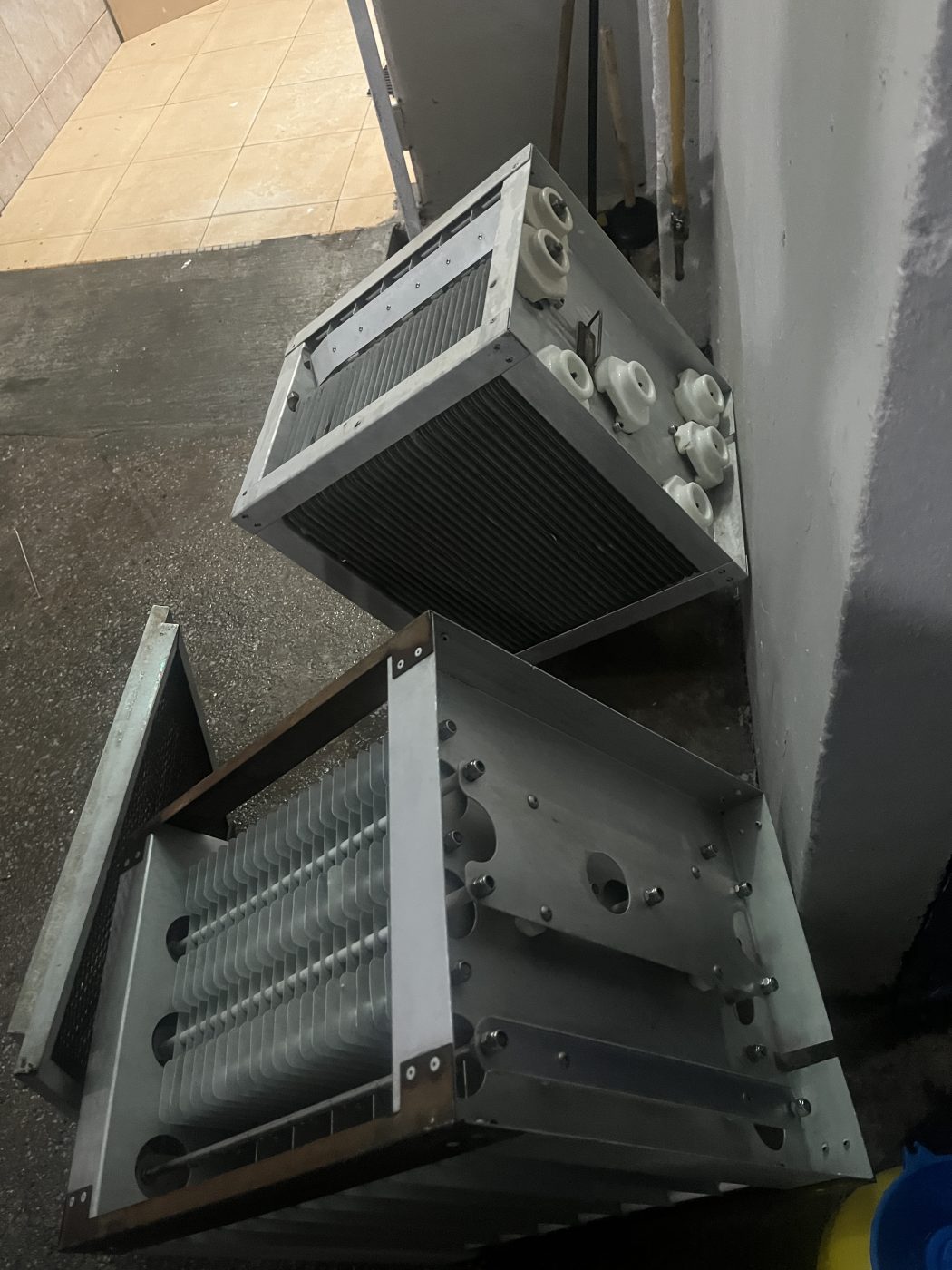
A kitchen that opens only for dinner or some days of the week may need its exhaust cleaned less often than an all-day kitchen, but the interval follows how much grease the line puts into the system, not the calendar. Published guidance is every one to three months for most commercial kitchens, monthly for heavy wok, grill and deep-frying kitchens and quarterly for lighter ones. A short, hard dinner service can still load the hood heavily, so inspect the filters and plenum before stretching the gap.
Pictured above: electrostatic filter cells taken out of a kitchen exhaust system and laid out for cleaning on one of our jobs. It is not a dinner-only kitchen in particular. It is here because it shows the part of a system that fills up with what the kitchen cooks, whatever days the doors are open.
A question we hear from operators who run short opening days: "We only cook dinner, or only Thursday to Sunday. Surely we do not need the exhaust cleaned as often as a kitchen that runs all day?"
The honest answer is that the calendar is the wrong clock. What decides the interval is how much grease the kitchen puts into the system, and that depends on what you cook, how hard the line runs and for how many hours, not on how many weeks have passed since the last clean. Fewer opening hours often do mean a longer gap, but that should come from looking at the system, and this post sets out how.
The guidance on our cleaning frequency page is that most commercial kitchens need the exhaust system cleaned every one to three months. Heavy wok, grill and deep-frying kitchens often need monthly cleaning, and lighter kitchens can run quarterly. We do not apply a fixed rule: we inspect the hood, the ductwork and the fan, and we look at your actual cooking volume and hours before recommending a schedule.
The same page sets out the NFPA-96 framework that the industry works to, which sets inspection intervals by how hard the kitchen works:
The system is then cleaned whenever grease is found to have built up to an unsafe level. Read that list for what it is: a scale of how heavily the system is used, with cooking method sitting alongside hours. A kitchen that opens four evenings a week is not automatically a "low-volume operation" because the doors are shut for three days. If those four evenings are all wok and deep-fry at full burner, the tier it belongs to is set by what the line does while it is running.
Think about how a dinner service actually works. Prep hours are quiet. Then service starts and every burner and fryer is working at once for a few hours. For that stretch the hood is handling the full load of the line, and it is that stretch that coats the filters, the plenum and the duct.
So a kitchen that cooks four hours an evening is not four hours' worth of light cooking. It can be four hours of the heaviest cooking the line does. Our note on what a kitchen team does daily covers the habits that decide how much of that reaches the duct.
Here is a simple illustration of why hours alone mislead. Say one outlet cooks six evenings a week and another cooks three, both four hours a night. That is twenty-four cooking hours a week against twelve. Half the hours does not automatically mean double the gap between cleans, because the type of cooking, how full the line is and the state of the filters all matter too. But it is a good reason to ask the question rather than carry on with a schedule written for a busier kitchen.
When we look at a kitchen to recommend an interval, these are the things that matter, roughly in the order operators can influence them:
You do not need a contractor to tell you whether a longer interval is holding up. You need to look, and to look at the same things in the same way every time. With the system off and the appliances cold:
Photograph each of these from the same position every time you look, and write the date on the photo. If you lengthen the gap between cleans, those photographs are what tell you at the next clean whether the longer gap was right. Without them, "we think it was fine" is an opinion. With them, you and your contractor can see what the extra weeks did.
The hours are fewer, but the cooking is concentrated and the line runs hard. Do not assume this belongs in the lowest tier. Count the cooking hours, check the plenum, and let the inspection set the interval.
If the kitchen opens, say, Thursday to Sunday, the weekly cooking hours are genuinely lower, and a longer gap may be sensible. The risk is that a fault appears on the last service day and nobody notices while the system sits idle. Run the fan and look over the kitchen before the first service of the week, and see our note on reopening a kitchen after a long closure for the checks that apply when a system has stood idle.
A kitchen that runs hard for a few weeks and then closes should be judged by what it cooked during those weeks. Our note on timing a clean before the festive rush covers the planning side.
A kitchen that adds lunch, a late-night menu or a delivery line is putting more through the same hood. If the schedule was set when the hours were shorter, it needs another look now, not at the next scheduled date.
The more specific you are, the better the recommendation. When you ask for an interval, give us:
Our note on what to send first for a kitchen exhaust site survey goes through the wider list.
Every clean we do includes dated before-and-after photo documentation and a service record that you can show to NEA, SCDF, your landlord or your auditor. If you choose a longer interval because of short opening days, that record is what supports the decision. Our kitchen exhaust cleaning service page lists what a clean covers, and the ten-point servicing checklist lets you compare any contractor's scope against ours.
A longer interval is a plan, not a promise. Cut it short and call someone when you notice any of these between cleans: grease dripping from the hood onto the cooking line, a burning smell from the fan, smoke that no longer leaves with the fan running, or a film appearing on the ceiling above the line. These are covered in our notes on grease dripping from the hood and a burning smell from the exhaust fan.
If you cook only some days or some hours and want an interval that fits, WhatsApp BC Air on 8989 2833 with the days and hours you cook, what you cook, the date of your last exhaust clean and a photograph of a filter and the plenum. We are on 24/7 standby. We give no price in a post: every kitchen is different, and the quotation follows an inspection of the actual system.
Related reading: how often should a commercial kitchen exhaust be cleaned · preparing for a cleaning night
We design, clean, repair and maintain commercial kitchen exhaust systems across Singapore — on 24/7 standby.