
15 Oct 2026 · Maintenance
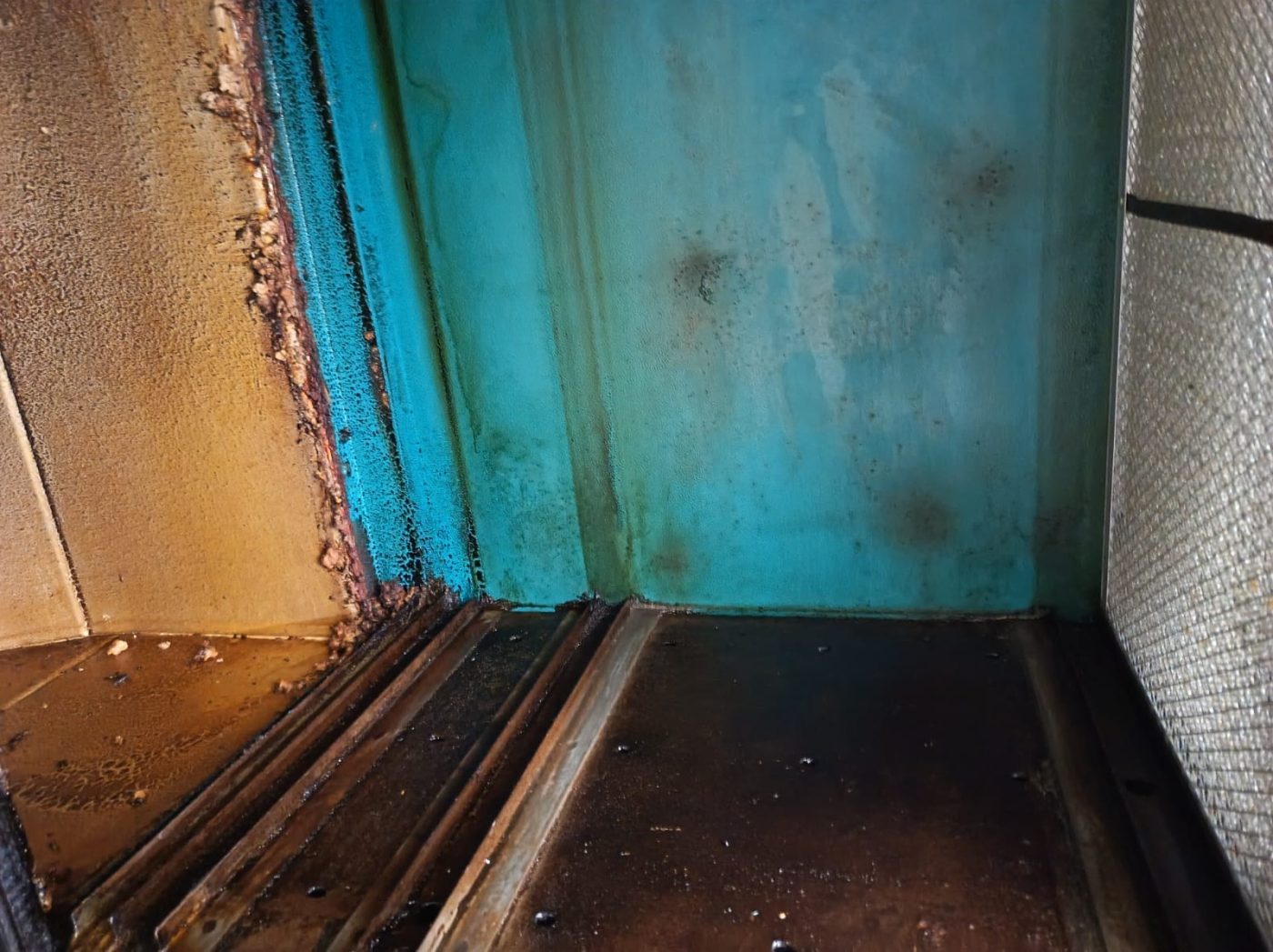
A burning smell from a kitchen exhaust fan can come from hot grease at the hood, a slipping belt, a worn bearing or an overheating motor and its electrical gear. If you see smoke or flame or the smell grows, stop cooking and call 995. If it is only a smell, pause cooking on open flame first, then isolate the fan, and do not keep resetting a tripped breaker or drive. Note where the smell is strongest and when it starts. Quote-only.
Pictured above: the inside corner of a hood on one of BC Air’s projects (Tony Cafe, Adelphi), with grease and carbon marks on the floor and walls of the plenum beside a filter. This is a photo from our own work, reused here because it shows the kind of surface that can smell hot once the cooking line is running at full heat.
There is a smell in the kitchen that is not food. It is sharper than cooking smoke, a little like hot rubber or an electrical fault, and it seems to come with the exhaust fan running. Someone says “it will go away”, the cooking line is busy, and nobody knows whether to switch the fan off or leave it on. This post is for that moment: what a burning smell from a kitchen exhaust fan usually means, when to stop cooking, what not to do, and what to tell the technician so the fault is found on the first visit.
We cannot tell you the cause from a description of a smell, and nobody honestly can. What you can do is narrow it down in a few minutes without touching anything live, and make the right call on whether the kitchen keeps cooking.
Do this first, before any diagnosis. If you can see smoke or flame in the hood, the duct or the fan room, or the smell is strong and getting stronger, treat it as a fire, not a maintenance call. Stop cooking, switch off the gas and heat sources, follow your premises fire plan, set off the fire alarm and call 995. Our guide on what to do when a restaurant fire suppression system goes off covers the hours after an incident. Diagnosis can wait until everyone is safe.
A kitchen cannot safely cook on open flame with no extraction, so switching the fan off is not a free choice. The order matters. Reduce or pause cooking on the line first, then isolate the fan at its isolator or switch. A smell that is still present with the fan off is a different problem from one that stops when the fan stops, and that difference is the most useful thing you can hand to a technician.
If the fan is off and the kitchen cannot trade safely, say so plainly to whoever approves the work. We run a 24/7 standby line for exactly this situation, and kitchens on a maintenance program get priority on that line.
Walk to three places and note where it is worst. The answer points to different causes.
These are starting points to describe to a technician, not a diagnosis. Smell is subjective, and two causes can overlap.
A motor does not usually smell hot for no reason. Grease on a fan wheel unbalances it, a duct choked with grease or a stuck damper makes the motor work harder against restricted airflow, and a worn bearing adds drag. So the part that smells hot may be the victim, not the cause. That is why a fix that only replaces the smelling part can bring the smell back.
These take about two minutes and make the first visit more useful. A photo on your phone is enough for most of them.
We repair and replace exhaust equipment regardless of who originally installed it, and we stock motors, fans, fan parts and control components in-house, so a common failure is often repaired on the first visit. We say “often”, not “always”: some faults need a proper look first. Whoever you use, you are entitled to ask:
We do not publish a price for this, because it depends entirely on what is found. We quote clearly before doing the work.
Most burning-smell calls trace back to the same two conditions: grease where it should not be and airflow that has been restricted. A scheduled exhaust clean covers the hood, the ducting and the fan blades and housing, with before-and-after photos, and we routinely schedule it overnight or when the kitchen is closed. Smaller faults such as a noisy bearing or a loose belt are cheaper to deal with on a quiet night than during service. Our maintenance programs are built around that idea. If the fan has already stopped altogether, start with kitchen exhaust fan not working: causes and fixes.
Smelling something burning from your exhaust fan? WhatsApp BC Air on 8989 2833 with where the smell is strongest, when it starts and a photo of the fan nameplate if you can reach it safely. See the full repair and replacement service for what we repair and replace.
Related reading: kitchen smoke setting off the fire alarm · commercial kitchen ventilation troubleshooting · why exhaust fan motors fail
We design, clean, repair and maintain commercial kitchen exhaust systems across Singapore — on 24/7 standby.