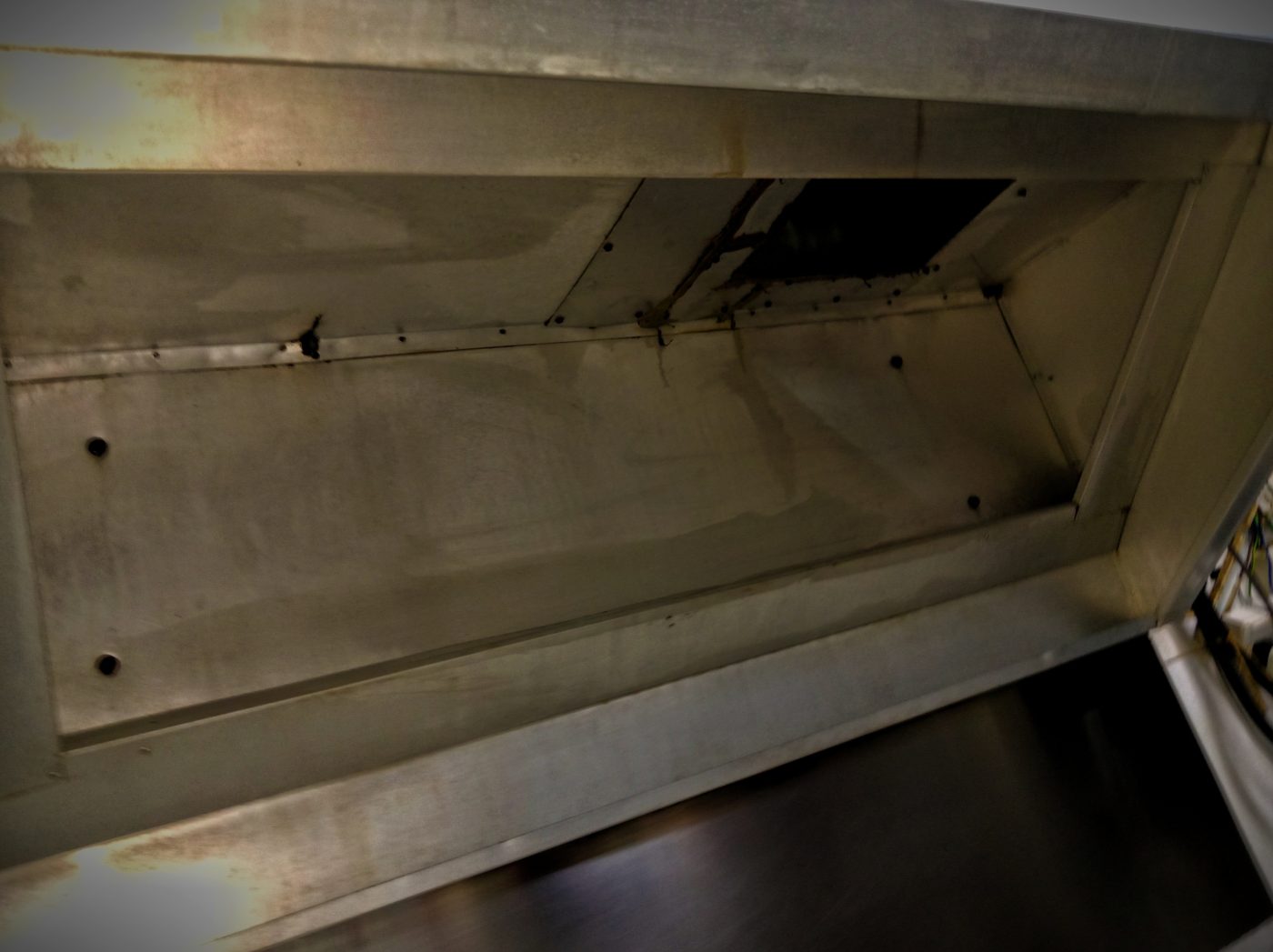
Pictured above: the inside of a hood on one of BC Air’s projects (Adelphi), with the filters out, looking up at the plenum and the opening into the duct. The staining is not even: it gathers around the seams and the opening, and the rest of the panel is lighter. This is a photo from our own work, reused here because it shows the point of this post.
Someone pulls the baffle filters out of a long hood to wash them. The three over the wok are black and slick. The two at the far end look almost fine. The natural thought is that the end filters can wait, or that the whole hood is “not that bad”. Neither is a safe conclusion.
This post is for the owner or kitchen manager who has seen this pattern on a long hood, a hood over several appliances, or one hood that serves a wok line and a prep area together. It covers why grease lands unevenly, what the uneven pattern tells you, what to check from the floor, and what to ask a cleaning contractor so the worst section gets the attention and not the easiest one. It gives no price. A price depends on the system and what is found, and we quote after seeing it.
The short answer
Grease follows heat, cooking activity and airflow. The filters directly above the hottest, greasiest appliance load first and fastest. The ends of the hood, over cold prep or a quiet corner, load slowly. So the hood is rarely “dirty” or “clean” as a whole. It has a worst section, and it is the worst section that sets how often the system has to be cleaned, not the average of the hood and not the section that is easiest to see.
Why the grease lands where it does
Four things usually combine:
- The appliance underneath. A wok burner, a fryer or a grill throws far more grease-laden vapour into the air than a steamer or a prep bench. The filters straight above it catch most of it.
- The route to the duct. The air inside the hood heads for the opening into the duct. Grease tends to gather along that route, around the seams and close to the take-off, as the photo above shows.
- The airflow along the hood. On a long hood the pull is not the same at every point. Where the pull is weak, vapour escapes the hood or settles on the surfaces near the edge, and the filters there look clean for the wrong reason.
- What the kitchen does through the day. A wok line that runs hard at dinner and sits idle at lunch loads the same filters in bursts. Equipment that has been moved or added since the hood was sized changes the pattern, and we cover that in adding cooking equipment to an existing hood.
What the uneven pattern tells you
It is information, and it is worth reading before the filters go back in:
- Heavy loading over one appliance, light everywhere else. This is normal for a mixed line. It means the cleaning interval is set by that one section, and the quiet end filters do not show how overdue the system is.
- Grease dripping or pooling at one point only. A section that is overloaded can drip onto the cooking line. We deal with that in grease dripping from the hood onto the cooking line.
- Clean filters at the ends, but smoke or steam drifting out of that end. The end looks clean because little is being pulled through it. That is a capture problem, not a clean hood. A fan or air-conditioner blowing across the line can do the same, covered in a fan or air-con blowing across the cooking line.
- The pattern has changed. If the heaviest section used to be in the middle and is now at one end, something about the airflow or the cooking line has moved. That is the moment to ask for an airflow check and not just another clean.
A five-minute check from the floor
You do not need tools, and you should not climb onto anything or open any duct. When the filters come out for their normal wash:
- Note which filter positions come out the dirtiest. If the filters are not marked, mark them with a position number so you can tell next time.
- Put the dirtiest next to the cleanest and look at the difference. If you can see through one and not the other, the light test in baffle filter washed but still dirty applies to each one separately.
- Look at the grease channel and cup under the heaviest section. Is it full, or has it overflowed?
- With the filters out, look up at the plenum behind the heaviest section and compare it with the plenum behind the lightest. Do not touch anything. A film you can see from the floor is a film the next clean has to reach.
- Write the date and what you found next to the position numbers. Over a few cleans the pattern becomes a record, and a record is what shows a change.
One rule while you do this: never run the hood with a filter position left empty. A gap lets grease straight into the plenum and the duct behind it, which is the part of the system you cannot see.
What not to do about it
- Do not clean only the dirty filters and call it done. The plenum and duct behind the heavy section are loaded in proportion to what the filters caught and missed, and they never come out to be washed in the sink.
- Do not shuffle clean filters into the heavy position as a fix. It spreads the wear, but it does not reduce what the appliance throws, and a filter that goes back damp or bent is its own problem.
- Do not cover the heavy section with foil, pads or liners. It looks as if it saves cleaning, but it blocks the filter. We explain why in foil, pads and liners on hood filters.
- Do not set the cleaning interval from the end filters. They are the least informative part of the hood.
How often, when the loading is uneven
The interval depends on what you cook and how much, and on the busiest part of the line. Heavy wok, grill and deep-frying kitchens often need monthly cleaning; lighter kitchens can run on a quarterly cycle, and we set the schedule after we have seen the system rather than by a fixed rule. The standard we work to, NFPA-96, sets its intervals by cooking volume as well: monthly for solid-fuel cooking and quarterly for high-volume cooking such as charbroiling and wok work. For the full picture see how often a kitchen exhaust must be cleaned. On a mixed hood, the heaviest appliance decides which line of that list you are on.
When it is an airflow question, not a cleaning question
Sometimes the uneven pattern is the symptom and the cause is how the air moves along the hood. Smoke or steam that lingers under one end, one end of the hood that looks spotless while a neighbouring end is black, or a pattern that keeps shifting, all point the same way. Air balancing is the measured step where exhaust and make-up air are adjusted to the design figures and hood capture is checked over the cooking line. If the hood has several sections or several hoods share a duct, several hoods on one duct explains why the balance drifts, and our CFD modelling and air balancing page explains what we measure.
What to ask whoever cleans it
- Will you clean and photograph the worst section first, including the plenum behind it, and not only the filters you can reach easily?
- Will the before-and-after photographs show the heaviest section and the duct behind it, with dates?
- Can the interval be set by the heaviest appliance, with the reason written down?
- If the pattern looks wrong for the cooking line, will you tell us, and can you check the airflow along the hood?
We ask ourselves the same questions. Our crews are in-house, and every clean comes with before-and-after photographs you can show NEA, SCDF, your landlord or your auditor.
What to send us
If your hood loads unevenly and you want it looked at, WhatsApp BC Air on 8989 2833 with the location, what is cooked under the hood, which section is the dirtiest and when it was last cleaned. A photo of the dirtiest filter next to the cleanest one helps. We quote after seeing the system. The cleaning side is on our kitchen exhaust cleaning page and the upkeep side on kitchen exhaust maintenance.
The short version:
- Grease lands where the heat and the cooking are, and along the route to the duct. A long hood has a worst section.
- The worst section sets the cleaning interval. The clean end filters tell you very little.
- Compare the dirtiest filter with the cleanest, mark the positions, look at the grease cup and write down what you find.
- Never run with a filter position empty, and never cover the heavy section with foil or liners.
- Ask for the worst section and the plenum behind it to be cleaned and photographed first, and for an airflow check if the pattern looks wrong.
Related reading: the light test for a washed baffle filter · behind the baffle filters · several hoods on one duct · what decides the cleaning quote
For a new kitchen, the order of the line is what sets this pattern in the first place: see where each appliance goes under the hood.
Questions
Common questions
Why are the filters over my wok black while the ones at the end of the hood look clean?
Grease follows heat, cooking activity and airflow. The filters directly above the wok burner or fryer catch most of the grease-laden vapour, while the ends over cold prep or a quiet corner load slowly. A long hood has a worst section, and that section decides how often the system has to be cleaned.
Is it enough to clean only the filters that look dirty?
No. The plenum and the duct behind the heavy section are loaded in proportion to what the filters caught and missed, and they cannot be washed in a sink. Ask for the worst section and the plenum behind it to be cleaned and photographed, not only the filters that are easy to reach.
Can I move clean filters into the heavy position to even things out?
It spreads the wear, but it does not reduce what the appliance throws into the air, and a filter that goes back damp or bent causes its own trouble. Never run the hood with a filter position left empty, because a gap lets grease straight into the plenum and duct.
The end of my hood looks clean but smoke drifts out there. Is that fine?
No. An end that stays clean while steam or smoke escapes may simply be pulling little air, which is a capture problem and not a clean hood. A fan or air-conditioner blowing across the line can cause the same thing. Ask for an airflow check, not just another clean.
How often should a hood with uneven loading be cleaned?
Heavy wok, grill and deep-frying kitchens often need monthly cleaning and lighter kitchens can run quarterly. BC Air inspects the system and recommends a schedule rather than applying a fixed rule, and on a mixed hood the heaviest appliance decides the interval.
How much does it cost to have an unevenly loaded hood looked at?
There is no fixed price. It depends on the system and what is found, so BC Air quotes after seeing it. Send the location, what is cooked under the hood, which section is the dirtiest and when it was last cleaned on WhatsApp.