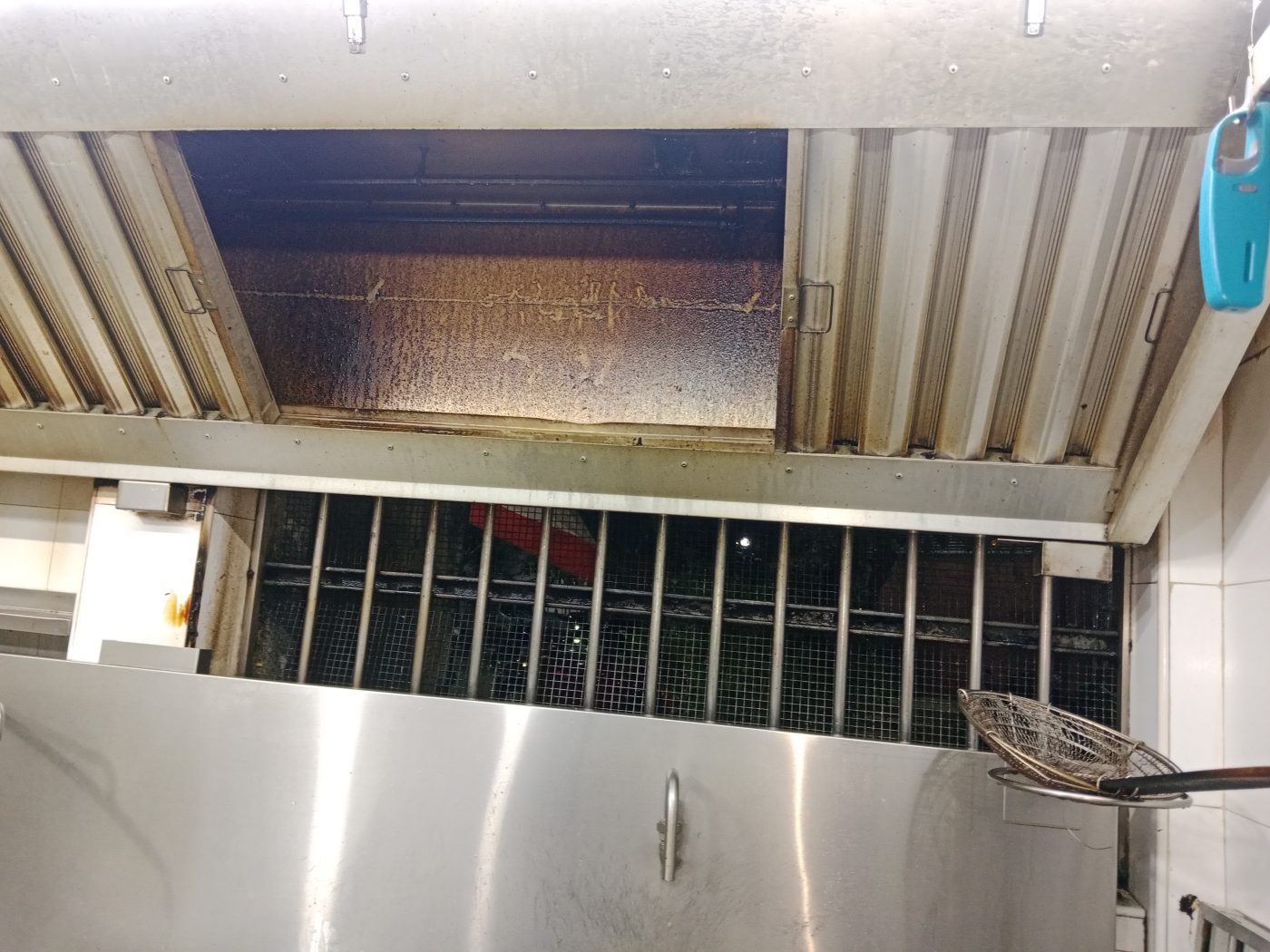
Pictured above: the inside of a hood on one of our projects (Heritage, Yishun), with one filter lifted out so the plenum behind it shows. The rear wall is beaded with droplets and carries a film of grease. That is what vapour from a hot kitchen leaves on cold metal, and a pot of boiling stock puts a great deal of vapour into a hood.
A soup kitchen looks gentler on its exhaust than a wok line. There is no flame licking up the side of a pan, no fryer spitting oil, no charcoal. Big pots sit on burners and bubble for hours. The conclusion many owners reach, quietly, is that a kitchen built around stock, broth and herbal soup is a light user of its exhaust, and that cleaning it can wait.
That conclusion is worth testing before it costs you a drip on the cooking line or a smell in the dining room. This post is about the kitchen in the middle: not a dry, dish-machine kind of steam, and not a dry, baked-on wok kind of grease, but both at once.
Steam is not the whole story when the pot holds stock
We have written separately about the wash-up area, where the air is hot and wet and carries almost no grease. That is why a dish machine wants a condensate canopy rather than a grease hood. A stockpot is not that case.
Stock, bone broth, fatty soups and herbal broths with meat in them carry fat. When the pot is held at a hard rolling boil, the steam leaving the surface carries fine droplets of that fat and oil with it. Skimming, ladling, lifting a lid and a pot that boils over all add to it. So the air entering the hood is wet, hot and greasy at the same time.
That combination behaves differently from the dry, baked-on grease of a wok line, and it is easy to miss because the hood does not look dirty from the floor. What follows is what we would look for in a kitchen like this.
What goes wrong in a stockpot kitchen
- Wet, runny grease instead of a dry crust. Filters, plenum walls and the grease cup collect a thin, watery film of fat. It drips and runs before it hardens, so it finds the lowest point and the nearest joint. The photograph above shows the beading.
- Drips from the hood. When the filters and gutters are overloaded the fat has to go somewhere, and sometimes it is back onto the cooking line. See grease dripping from a kitchen hood onto the cooking line for how to tell the sources apart.
- Condensation inside the duct. Moist air cools as it travels, especially where the duct crosses an air-conditioned ceiling void, and water forms on the inside of the metal. Because it has picked up fat on the way, it weeps out oily and discoloured, and is often taken for a failed joint. Condensation around a kitchen exhaust duct sets out how to tell the cases apart.
- A stale-fat smell. Warm fat vapour that has settled in the hood and the first stretch of duct gives off an odour whenever the line is running. Staff stop noticing it. Customers do not.
- A hot, damp working area. If the hood is not catching the steam, it spreads into the room, and the cooks bear the heat and humidity first.
The exhaust runs longer than the restaurant opens
A pot of stock is often on the burner before the first customer arrives and long after the last one has gone. That matters for two reasons.
The first is that the exhaust has to be running whenever the pots are working, not only during service. A pot simmering under a hood that is switched off sends its vapour into the room and onto the ceiling.
The second is cleaning. The interval on our cleaning frequency page is set by how hard the kitchen works, not by whether there is a flame: most commercial kitchens need cleaning every 1 to 3 months, heavy wok, grill and deep-frying kitchens often monthly, lighter kitchens quarterly. A kitchen that keeps fatty broths going for long hours is not automatically a quarterly kitchen. We inspect the hood, ductwork and fan, look at the cooking volume and the hours, and then recommend an interval, because a soup stall and a bakery are not on the same clock.
What kitchen staff can do about it
- Lids on when nobody is stirring. A covered pot sends far less vapour into the hood than an open one. Take the lid off when the food needs attention, and put it back.
- Bring a pot down from a hard boil to a simmer once it is up to temperature. The harder the boil, the more fat leaves the pot in the steam. Check your own recipe and your cooks' habits, since only the kitchen knows what it needs.
- Keep the pots under the hood. A pot at the edge of the cooking line sends part of its plume past the canopy. A sideways draught from a fan or a door makes that worse, which is the subject of a fan or air-con blowing across the cooking line.
- Skim the fat into a container. Every skim that ends up in a container is fat that does not reach the hood.
- Wash the filters on a short cycle. Wet fat loads filters quickly. The nightly routine is described in the daily routine for kitchen staff.
- Look at the grease cup and gutter each day. If it fills quickly with watery fat, that is information about how fast the system is loading.
- Write down where the hood or the ceiling drips, and when. A drip that follows the long simmer hours points at a different cause from one that follows a busy lunch.
Checking the hood without taking anything apart
With the fan off and the pots cold, lift out one filter, as in the photograph, and look at the plenum behind it with a torch. Compare it with a filter that has just been washed.
- A wet, glossy film on the rear wall and a line of beads along the bottom means fat is passing the filters in volume.
- Streaks running down the walls towards the gutter mean the film is thick enough to flow.
- A stain on the ceiling under the duct run, or a damp patch at a joint, may be fat-laden condensate, not a leak.
- A smell that returns within hours of a wash points at the plenum or the duct, not the filters.
If the plenum is coated, treat the duct beyond it as probably coated too. A filter cannot be judged on its own. What sits behind the baffle filters explains why the plenum is the real measure.
If you are fitting out or replacing a hood for a soup kitchen
Tell the designer what is actually going on the burners: how many pots, how large, whether the stock is held for hours, and whether the wash-up area is nearby. The things to settle early are:
- That the hood over the pots is a grease hood with baffle filters and a gutter, because the vapour carries fat. This is not the same equipment as the condensate canopy over a dish machine.
- That the canopy covers the whole pot station, with room for the plume to arrive underneath it.
- That the duct is laid so liquid cannot pool, with an access panel where grease and condensate collect, so it can be cleaned later without opening a ceiling.
- That the replacement air is planned, because a hood in a kitchen short of make-up air captures less. Make-up air and air balancing covers the arithmetic.
If the same kitchen also runs hotpot or a broth table, table extraction for hotpot and Korean BBQ covers that part. The right size and layout depend on the room and the line, so we survey before quoting.
What to tell your exhaust contractor
- What you cook, how many pots, and how long they stay on the burner each day.
- Whether the burners are gas or electric.
- When the exhaust is switched on and off in relation to the pots.
- Where it drips, smells or sweats, and at what time of day.
- When the hood, duct and fan were last cleaned, and whether you have the report.
- A photograph of the plenum with one filter out, and one of the whole hood from the front.
The short version
- A pot of stock puts steam and fine droplets of fat into the hood together, so it is neither a dish-machine problem nor a wok-line problem.
- The grease it leaves is wet and runny: it drips, finds joints and turns up as odour and condensation.
- No flame does not mean a light kitchen. The cleaning interval follows cooking volume and hours, and starts with an inspection.
- Lids on, a simmer once the pot is hot, pots under the hood, short filter-wash cycles and a daily look at the grease cup all help.
- For a new hood, specify a grease hood with baffle filters, an access panel at the low point and planned replacement air.
If your kitchen runs on stock and broth and you are seeing drips, a smell or a damp ceiling, WhatsApp BC Air on 8989 2833 with what is on the burners and a photo of the plenum behind one filter, and we will tell you what we would check first. Exhaust cleaning is described on the cleaning page, the design side on the commercial kitchen ventilation system page, and our 10-point servicing checklist is a fair test of any contractor's scope, ours included. We clean, repair and maintain the system in-house, with 24/7 standby if something fails mid-service. Scope and pricing follow an inspection.
Related reading: wash-up area steam extraction · condensation around a kitchen exhaust duct · wok and deep-fry grease loading · how often a kitchen exhaust should be cleaned
Questions
Common questions
Does a soup or stockpot kitchen really need a grease hood?
Where the pots hold stock, bone broth or fatty soup, the steam carries fine droplets of fat as well as moisture, so the hood is dealing with grease-laden vapour. A condensate canopy suits the almost grease-free steam of a dish machine. A stockpot line is a different case, and the hood design should be agreed after seeing the line.
Why does my hood drip when we only boil soup?
Steam and fat condense on cold metal and form a thin, runny film instead of a dry crust. When the filters, plenum and grease cup are overloaded, that film runs and drips, sometimes back onto the cooking line. Check the filters, the gutter and the plenum behind them.
How often should the exhaust of a soup kitchen be cleaned?
BC Air publishes that most commercial kitchens need cleaning every 1 to 3 months, with heavy wok, grill and deep-frying kitchens often monthly and lighter kitchens quarterly. A kitchen with fatty broths on the burner for long hours is not automatically a quarterly kitchen. The interval is recommended after an inspection of the hood, duct and fan and the cooking volume and hours.
Can water inside the duct be condensation and not a leak?
Yes. Moist air cools as it travels, especially through an air-conditioned ceiling void, and water forms inside the duct. Because it picks up fat on the way it can look oily and be mistaken for a failed joint. Which one it is decides the fix.
What can kitchen staff do to reduce the load on the hood?
Keep lids on when nobody is stirring, bring a pot down from a hard boil to a simmer once it is up to temperature, keep the pots under the hood, skim fat into a container, wash the filters on a short cycle and check the grease cup each day.