
10 Sep 2026 · Design & Build
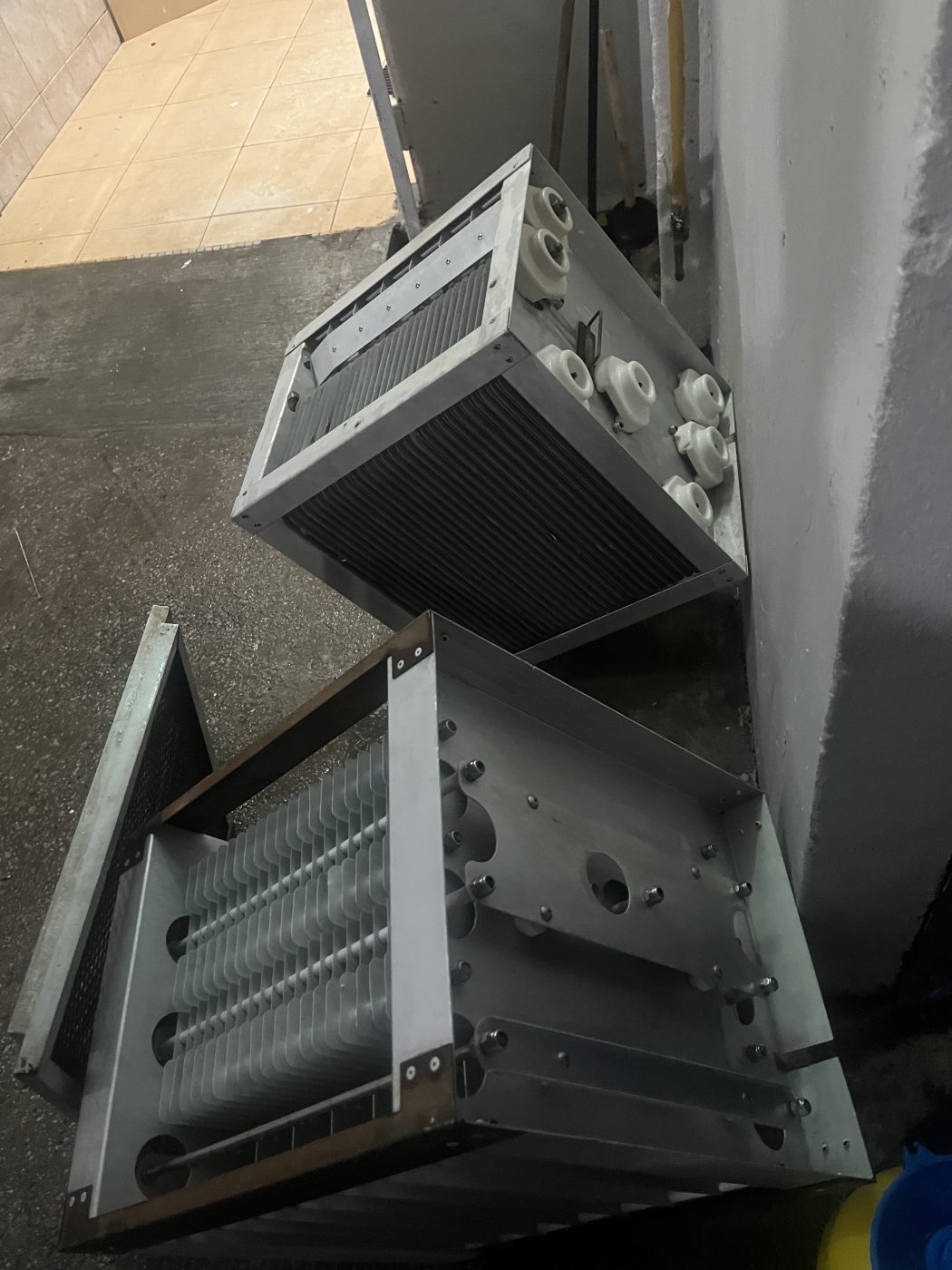
A dish machine produces hot moist air rather than grease-laden vapour, so the equipment that suits it is a condensate canopy with a perimeter gutter and a drain connection, pitched so condensation runs to that drain, rather than a grease hood with baffle filters. The costly failures happen in the ductwork: without deliberate fall, sealed joints, insulation across cooler spaces and an access panel at the low point, condensate collects at whatever point the duct happens to sag.
Every kitchen ventilation conversation in Singapore starts at the cooking line, and it should. That is where the grease is, where the fire risk is, and where the regulators look. But there is a second source of hot, wet air in almost every F&B outlet that gets designed last or not at all — the wash-up area — and it produces a set of problems that look like a building fault rather than a ventilation one.
Dripping ceilings above the dish machine. Paint peeling in a corridor nowhere near the wok line. A ceiling grid that has rusted in eighteen months. Steam rolling out into the service passage every time the machine door lifts. Those are not damp; they are an extraction problem, and they are usually the cheapest thing in the kitchen to have got right at fit-out.
This is the whole point, so it is worth being blunt about it. A cooking hood over a wok range is built to capture grease-laden vapour: baffle filters that force the airflow to change direction so grease drops out, a plenum designed to be cleaned, ductwork specified on the assumption that what passes through it is flammable. Everything about it is designed around grease.
A dish machine produces hot moist air. There is almost no grease in it. Put a grease hood over it and you have bought filters that do nothing useful, in a canopy with no way of dealing with the one thing that actually happens: water condensing on the inside of the metal and running somewhere.
What a wash-up area wants instead is a condensate canopy — stainless, with a gutter around the perimeter and a drain connection, and pitched so that the water that inevitably forms inside runs to that drain rather than down the outside of the hood onto the floor where somebody is standing. It is a simpler thing than a cooking hood. It is also the one most often left out of a fit-out because it does not appear on the cooking equipment schedule.
The failure that costs money is not at the canopy. It is in the duct.
Warm saturated air moving through a duct that runs above a cooler false ceiling, or across an air-conditioned area, will condense on the inside of that duct. The water then runs to the lowest point in the run. If nobody decided where the lowest point was, the lowest point is wherever the duct happens to sag — usually over a ceiling tile, occasionally over the pass, and always somewhere with no access panel.
Three things prevent it, and all three are cheap at design stage and expensive afterwards:
And an access panel at the low point, so that in three years someone can open it rather than cut it.
Add extraction at the wash-up area without adding air to replace it and the kitchen goes further negative. That has consequences that show up somewhere else entirely: the cooking hoods start capturing less, because the air they were designed to pull is being pulled somewhere else; doors get harder to open; and if the outlet is in a mall, the shortfall gets made up by dragging air in from the shopping mall corridor — which is exactly how a neighbour odour complaint starts.
This is why the wash-up canopy is an air balance decision rather than an equipment purchase. Anything you extract has to be replaced deliberately, and the arithmetic is in make-up air and air balancing in a commercial kitchen.
Some dish machines are supplied with condensing or heat-recovery arrangements built into the machine itself, designed to deal with their own vapour at the point it is produced. Where that is the case a separate canopy may be unnecessary, or may need to be smaller than the default. The answer is in the machine's own documentation and the supplier's requirements, not in a rule of thumb — so the sequence is: settle the dish machine, then design the canopy, not the other way round.
It is also worth knowing what your machine does with its drain. A machine dumping hot water into a floor trap in a closed room is adding its own load of vapour to the space independent of the canopy.
The wash-up station is often the hottest, wettest place in a Singapore kitchen, and it is also the position with the highest turnover in most outlets. A working canopy over the machine changes the conditions at that station more than anything else you can do to it, and it does so at a fraction of the cost of a cooking-line intervention. If you are already thinking about conditions on the line, the same reasoning applies here — see reducing kitchen heat for staff comfort.
The best time to deal with this is at fit-out, when the ceiling is open, the drain points are still being set and the equipment schedule can still be argued with. That is the same window in which every other ventilation decision has to be made — see the ventilation timeline from lease to opening, and if you are working from someone else's kitchen, what to check on an existing exhaust system before you take a unit over.
Retrofitting later is not difficult — the canopy is simple and the duct run is usually short — but it means opening a ceiling in a trading outlet, and it means finding a route and a drain that were not reserved. It is the same job at three times the disruption. In a central kitchen the same points apply at larger scale, which we covered in central kitchen and commissary ventilation.
Seeing steam, drips or peeling paint around your wash-up area? WhatsApp us on 8989 2833 — tell us what is in the wash-up area, what you are seeing and whether the cooking hoods have changed, and we will tell you whether it is a canopy problem, a duct problem or an air balance problem. Our commercial kitchen ventilation page sets out how we design and build these systems.
Also worth reading: a stockpot line is the in-between case: steam that carries fat.
We design, clean, repair and maintain commercial kitchen exhaust systems across Singapore — on 24/7 standby.