
04 Sep 2026 · Design & Build
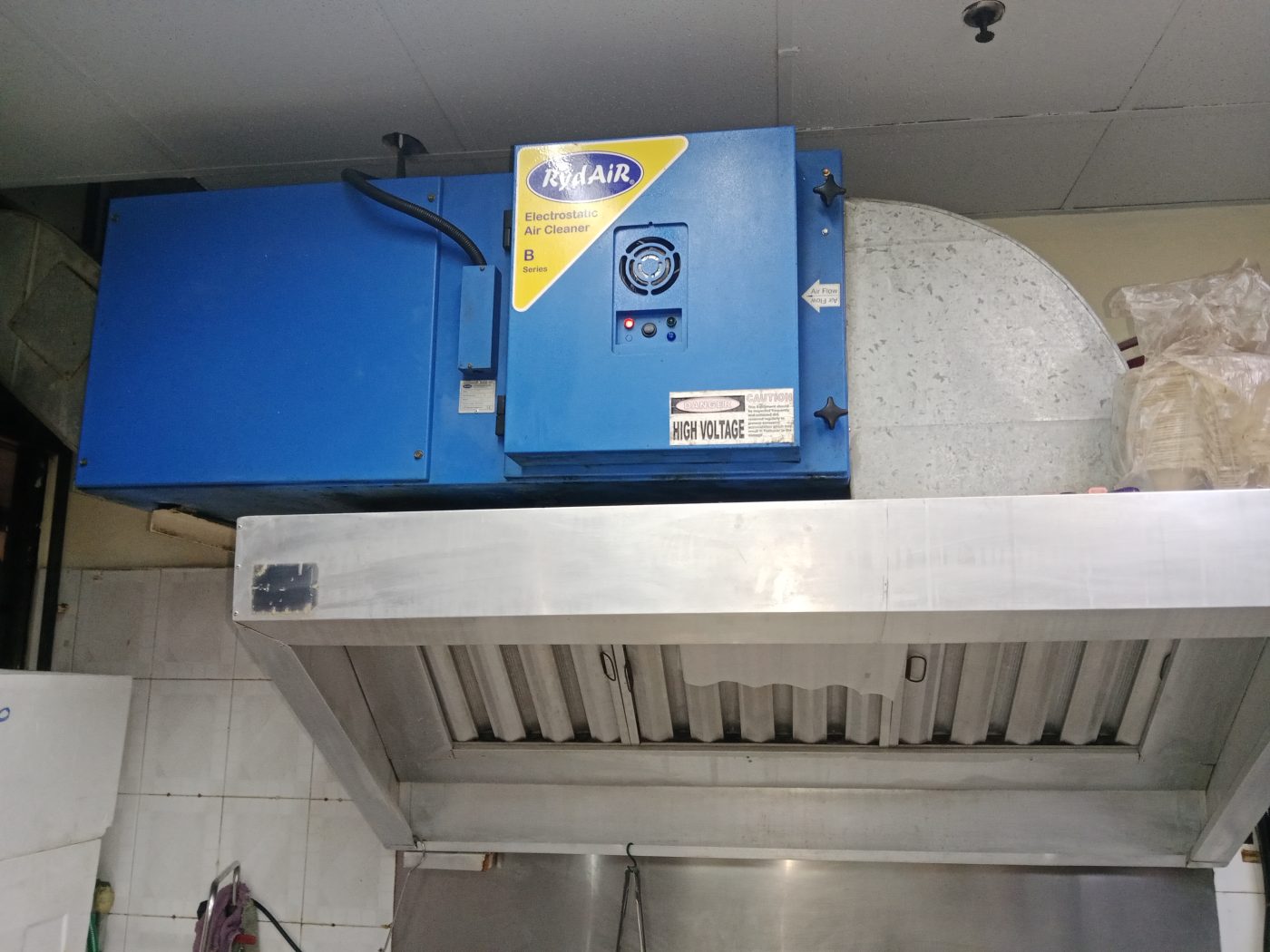
A canteen exhaust is engineered like any commercial kitchen exhaust, but three things around it differ: several stallholders share one system so nobody is contractually responsible for cleaning it, the premises cannot be shut on demand so real work must be planned into a term break or shutdown fixed months in advance, and institutional money moves on a budget cycle so a condition survey has to happen before the budget is set rather than after.
A school canteen, a staff canteen or an institutional food hall is a commercial kitchen by every standard that matters. The equipment is the same, the grease is the same, and the authorities are the same ones. What is different is everything around it — who owns the system, when it can be touched, and where the money comes from — and those three things are what actually decide whether the exhaust in a canteen stays in good order or quietly degrades for a decade.
We see the pattern often enough to describe it. The engineering is rarely the problem. The arrangement is.
This is the first and biggest difference, and it is structural rather than anybody's fault.
In a single-tenant restaurant there is one operator, one hood, one contract, and no ambiguity about whose exhaust it is. A canteen typically has several stallholders under one canopy or one shared duct, an operator or caterer running the space, and an institution that owns the building. Three parties, and the exhaust sits in the gap between them.
The stallholder assumes the canteen operator handles it, because the stallholder's tenancy is short and they did not install any of it. The operator assumes it is part of the building, because the ductwork and fan were there before them. The institution's facilities team assumes it is covered by the catering contract, because catering is what happens in that room. Everyone's assumption is reasonable. The result is a grease duct that is nobody's line item.
The way this surfaces is almost always the same: an inspection, an insurance question, or a fire. At that point somebody has to produce a cleaning record, and there isn't one — not because anybody was negligent, but because the task never had an owner. We have written about the same ownership gap in a different setting in who owns the kitchen exhaust scope in an F&B fit-out, and the fix is identical in principle: name the party, in writing, in the document that outlives the individuals.
What to do about it: put the exhaust cleaning obligation into the stall tenancy or the catering contract explicitly — who arranges it, at what frequency, and who keeps the report — and have the operator maintain one register for the whole canteen rather than each stall keeping its own. One register with dates and reports is the document an inspector, an insurer or an incoming facilities manager can actually use.
The second difference is the calendar, and it is more restrictive than most commercial kitchens.
A restaurant can close on a Monday. A canteen serving a school, a hospital, a dormitory or a workforce cannot simply not serve lunch, and in many of these premises the population has nowhere else to go. That means real work — a proper deep clean of the duct run, a fan replacement, adding access doors, any modification to the ductwork — has to land in a window that is decided by somebody else's calendar and fixed months in advance.
For a school that usually means term breaks. For a staff canteen it may mean a shutdown period. For a facility that genuinely never closes, the approach is the one we described for a kitchen that never closes: the work gets sectioned and done in overnight stages, which takes longer overall and costs more than doing it in one pass.
The practical consequence is that the survey has to happen well before the window, not during it. Finding out in the first week of a term break that a fan needs replacing and the lead time is longer than the break is a genuinely bad position, and it is entirely avoidable by looking a few months earlier.
This one is worth stating plainly because it changes the advice.
Institutions commit money in cycles. If a survey in October finds rectification work, the funds for it may not exist until the next financial year, whatever anybody thinks of the finding. That is not obstruction; it is how the organisation is built.
So the sequencing that works is the reverse of the commercial one. Get the condition survey done before the budget is set, so the number goes into the budget rather than arriving as a surprise against a budget that is already allocated. A report that says what needs doing, what it will cost and what happens if it waits is a document a facilities manager can take into a budget meeting. A quotation received in the middle of a financial year, with no prior warning, usually cannot go anywhere.
Now the engineering part, which is genuinely different from a single-kitchen design.
A canteen line is rarely uniform. A wok stall, a deep-fry stall, a steamed-food stall and a drinks stall may sit side by side under one canopy or share one duct riser. Their grease loading is not remotely comparable — a wok range and a fryer produce a heavy, hot, oily plume, while a drinks stall produces almost nothing. We covered why that plume matters in wok and deep-fry kitchens and grease loading.
Two things follow, and both are common findings.
Extraction sized on an average starves the heavy stall. If a single fan was sized against the canteen as a whole, the wok stall is under-extracted at exactly the moment it matters, which is the lunch rush when every stall is running at once. The symptom is smoke and heat spilling out at the wok stall while the rest of the line looks fine, and it is a design condition rather than a maintenance fault. It does not improve with cleaning.
Grease deposits unevenly along a shared duct. The section serving the wok and fryer end will be significantly worse than the section over the drinks and rice stalls. A cleaning contract priced and scheduled as if the whole run were the same tends to clean everything to the same standard, which is more than the light end needs and less often than the heavy end needs. The better arrangement is a frequency set by the worst section, with the report showing condition section by section rather than as a single verdict.
Where stalls change hands and menus change with them, this drifts. A stall that sold drinks for four years becomes a fried chicken stall, and nothing about the ventilation was reviewed — which is the same failure we described in when a menu change outgrows the kitchen exhaust, except that in a canteen it happens repeatedly and quietly.
Canteens are frequently low buildings, or ground-floor spaces in a larger campus, and the discharge is often at low level near a walkway, a courtyard, a car park or a field.
In a shophouse or a mall the neighbours can go elsewhere. On a campus, the people affected are there every day and have no choice, and complaints reach the institution rather than the operator. Odour and noise are therefore worth thinking about at design stage rather than after the first complaint. We have covered both — odour complaints and the design fixes for them and noise and vibration complaints — and the honest summary is that discharge point and height do most of the work, and filtration is the more expensive remedy once the discharge point is fixed.
Every cubic metre pulled out of the kitchen has to come back in from somewhere. In a canteen with a naturally ventilated dining area, "somewhere" is usually the dining hall — so the extraction pulls air across the diners, past the stalls, and out. When extraction is high and there is no designed replacement air path, the stalls get hot, the servery area gets hot, and it reads to everyone as an air-conditioning problem in a space that was never air-conditioned.
It is worth understanding the balance before spending money on cooling. Make-up air and air balancing covers what the relationship actually is, and reducing kitchen heat for staff comfort covers what helps the people working the line.
The last difference is turnover. Facilities managers rotate, catering contracts change hands every few years, and stallholders come and go. The knowledge about a canteen's exhaust system lives in people who will not be there in three years, unless it is written down.
A canteen exhaust file should be able to answer, on its own, without asking anybody:
That last one is worth checking specifically, because suppression over a canteen wok stall is easy to forget when the stall itself has changed operator twice since it was installed. What a hood fire suppression system does sets out what it is for and what servicing it involves.
If you run or look after a canteen and are not sure where you stand, four things in order:
Find out who is contractually responsible for the exhaust cleaning, and if the honest answer is nobody, fix that in the next tenancy or catering agreement rather than by memo.
Ask for the last cleaning report, and read whether any section was recorded as inaccessible. That single sentence is the one an inspector will find.
Work out your real shutdown window for the coming year, and put a survey ahead of it rather than inside it.
Look at the heaviest stall at lunchtime, when everything is running. If smoke is escaping the canopy there while the rest of the line is fine, that is a balance or capacity question and cleaning will not solve it.
BC Air is a Singapore commercial kitchen ventilation contractor working on hoods, ductwork, fans, cleaning and fire suppression. What a compliant system looks like is set out on the commercial kitchen ventilation page, and what a proper clean covers is on the kitchen exhaust cleaning page.
Looking after a canteen and not sure what condition the exhaust is in? WhatsApp us on 8989 2833 — tell us how many stalls share the system, what the heaviest one cooks, and when the premises can actually be shut, and we will tell you what a survey would need to look at.
We design, clean, repair and maintain commercial kitchen exhaust systems across Singapore — on 24/7 standby.