
08 Nov 2026 · Troubleshooting
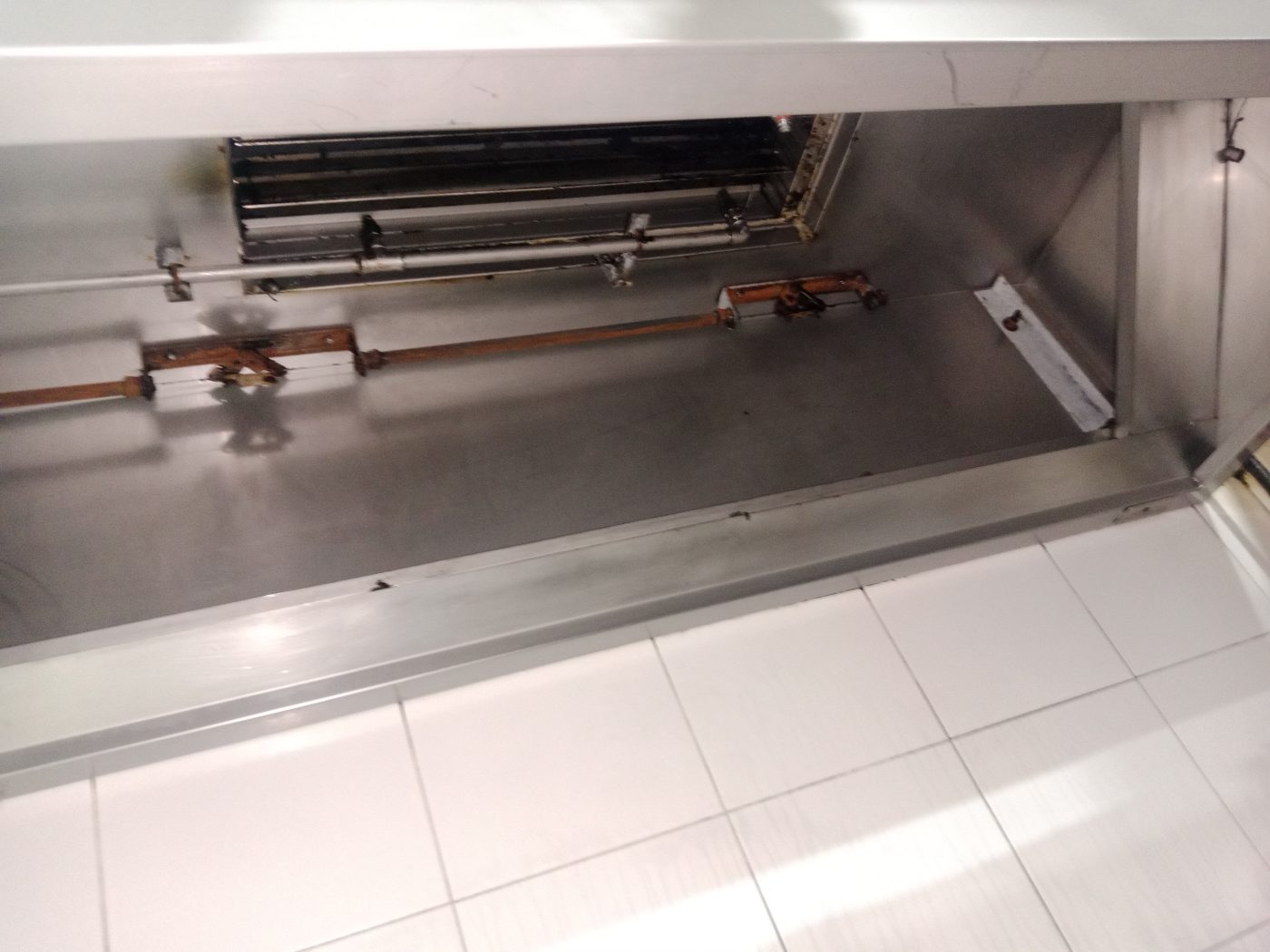
A stale grease smell at the hood in the morning, with the fan off, comes from grease on surfaces (unwashed or damp filters, a full grease cup, a greasy hood face), grease behind the filters in the plenum and duct, or air travelling back through the duct from outside, a shared riser or the room. Check the filters and grease cup first, then ask when the duct was last cleaned (most commercial kitchens need it every one to three months), and rule out drains and bins.
Pictured above: looking up into the underside of a hood on one of BC Air’s projects (Yishun). This is a photo from our own work, reused here because the opening at the top of a hood is where the kitchen air, the duct and the building meet when the fan is switched off.
You unlock the kitchen at eight. Nobody has cooked for ten hours. The fan has been off all night. And the moment you walk in, the air at the hood smells of old fried oil, a sour, stale smell that was not there when you locked up. By the time the first wok is hot it seems to fade, and by lunch nobody mentions it. Then the next morning it is back.
This is a different complaint from the smell that reaches the dining area while the exhaust is running, which we cover in cooking smell in the dining area with the exhaust running. Here the kitchen is closed and the fan is off. There is no cooking to blame. That makes it easier to work out, because with everything stopped there are only a handful of places a smell can come from. This post goes through them in the order we would check.
While the fan runs, air is pulled through the hood, along the duct and out at the discharge point, and it carries smell with it. Switch the fan off and that moving column of air stops. What is left is a long, still passage that is open at the hood end into your kitchen, open at the far end to the outdoors, and, if the duct runs above the ceiling, in contact with the ceiling void along the way.
Two things follow. Anything that smells inside that passage now has time to leak back into the room at the hood, because nothing is pulling it the other way. And the room itself, with the air-conditioning off or on its night setting, can slowly draw air through the hood opening. So the morning smell has one of two kinds of source: something on a surface that is giving off smell, or air that is travelling back through the system. The checks below separate the two.
The most common source is the cheapest to fix. Filters that went back into the hood damp, or were left in unwashed after service, sit overnight above a grease cup that has not been emptied. Warm, fresh grease smells like cooking. Grease that has sat for ten hours and gone cold smells stale and sour, and in a humid kitchen it smells stronger.
If a proper wash of the filters, an emptied cup and a wipe of the hood face clear the smell for a few days, you have found at least part of the answer. If it is back by the next morning, keep reading.
Past the filters there is a space behind the bank (the plenum) and then the duct itself. Nobody in the kitchen can wash those. Grease that has built up there is warmed every service and then cools overnight, and it gives off smell the whole time. With the fan running, the air stream carries that smell away. With the fan off, some of it drifts back towards the hood opening, which is the only low point it can reach.
That is why a stale smell that appears specifically when the fan is off is one of the early signs that the system behind the filters is overdue. The same grease is also fuel, which is why the clean exists. We describe what is sitting behind the filter bank in behind the baffle filters.
Most Singapore commercial kitchens need the system cleaned every one to three months, with heavy wok, grill and deep-frying kitchens at the monthly end. We inspect the system and the cooking volume before recommending an interval for a particular kitchen. So the practical question is simple and you can answer it today: when was the duct and plenum last cleaned, and do you have the report? If it has been more than a few months, or nobody can say, treat the smell as a reason to book a survey rather than a thing to live with. Signs your hood is overdue a deep clean lists what else usually shows up beside it.
The second kind of source is air travelling the wrong way. With the fan off, the duct is a passage between your kitchen and whatever is at the other end. Depending on the building, that can be an open discharge on a roof or a wall, or a shared riser that serves other units.
Humid night air matters too: a cold duct section can sweat, and damp grease smells stronger than dry. If the ceiling under the duct is stained, see duct condensation. We do not assume what a particular building has at its discharge or whether the duct has any way of closing off the path when the fan is off. That is something we look at on a survey, with the drawings or the duct itself in front of us. What you can do is note whether the smell tracks the weather or the air-conditioning schedule, because that is exactly the evidence that tells us which way the air is moving.
A quiet, closed kitchen lets other smells show up. Before spending on the exhaust, rule out:
A quick way to tell the difference: stand at the hood and then at the floor drain and then at the bin, and smell each. A stale oil smell strongest at the hood points to the exhaust. A sour, drain-like smell strongest at the floor points elsewhere.
This is a rough pointer, not a measurement. Do not leave the fan running all night to chase the smell: it moves the smell without removing its source. Do not spray deodoriser into the hood or duct: it adds a second smell and a coating that is harder to clean.
A description that includes the pattern gets to the cause faster than “it smells”. Before you call, write down:
That lets the first visit go straight to the likely source. We survey the kitchen and quote from what is there. We do not give a price over the phone for something we have not seen.
Keep the morning smell with your filter-wash and cleaning records: the kitchen exhaust logbook shows what to write down.
If the system behind the filters is the problem, the work is a professional duct and hood clean, described on our kitchen exhaust cleaning page. Regular upkeep sits on the maintenance page.
WhatsApp BC Air on 8989 2833 with the location, what you cook, when the smell appears and where it is strongest, when the filters and the duct were last cleaned, and anything that changed recently. We are on 24/7 standby, and scope and pricing follow an inspection.
Related reading: cooking smell in the dining area · behind the baffle filters · fan on after the last order
We design, clean, repair and maintain commercial kitchen exhaust systems across Singapore — on 24/7 standby.