
29 Jun 2026 · Cleaning & Compliance
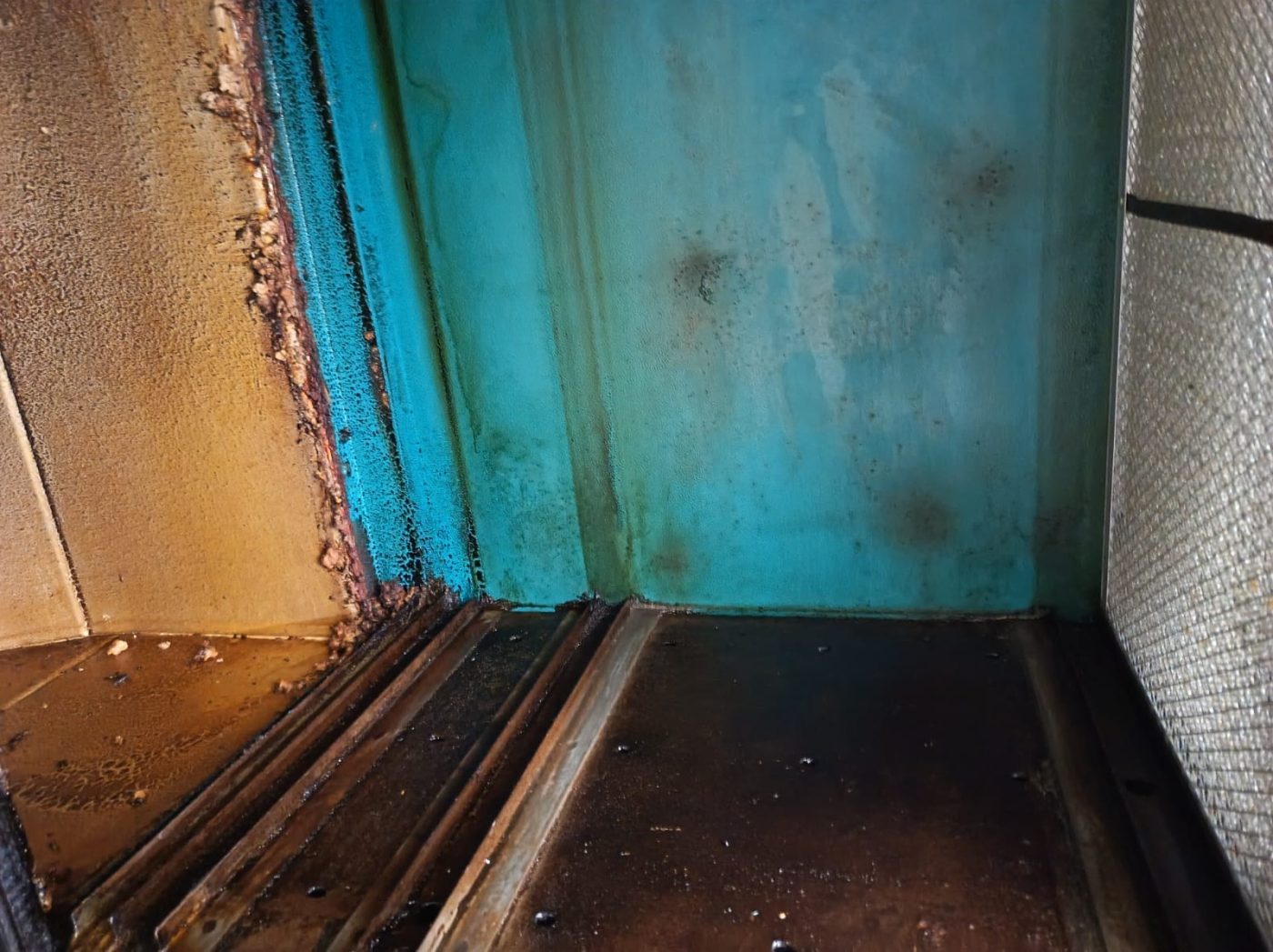
Grease traps catch fats and oils from your sinks and drains — that's a plumbing concern. Grease in your ductwork is an exhaust ventilation problem, and a serious fire risk. We deal with ductwork grease daily, and the two issues need completely different solutions, different schedules, and different specialists.
A grease trap — sometimes called a grease interceptor — sits in your drainage system. Its job is to intercept fats, oils, and grease (FOG) before they enter the public sewer network. When your kitchen staff rinse pans, wash dishes, or drain fryers, that greasy wastewater flows through the trap, cools down, and the solidified grease floats to the top where it's retained.
In Singapore, grease traps for food establishments are typically a requirement under PUB regulations, and their cleaning and maintenance falls under your plumbing and drainage obligations. This is handled by licensed plumbers or drainage contractors — not by us. We always tell clients that clearly, because mixing up the two can lead to the wrong contractor being called and the real problem going unaddressed.
A neglected grease trap will cause blocked drains, foul odours, and potential regulatory issues with PUB. Unpleasant and costly — but not, in itself, a fire hazard.
When your kitchen produces heat, smoke, steam, and cooking vapours, your exhaust hood captures all of that and draws it up through your canopy filters, into a network of ductwork, through your exhaust fan, and out of the building. The problem is that those cooking vapours carry fine grease particles. As the air moves through the duct, that grease cools and deposits itself on every internal surface — the duct walls, the fan blades, the plenum chambers, the bends and joints.
Over time, this builds into a thick, flammable coating. On a busy kitchen running deep-frying or wok cooking, we've opened ducts and found grease accumulation measured in centimetres, not millimetres. That grease is fuel. If a flare-up at the hob pushes a flame far enough — or if a grease fire starts in the canopy — that duct becomes a chimney lined with accelerant. A fire that should have been contained to the hob can travel the full length of the ductwork and reach concealed ceiling spaces or adjacent premises.
This is why NEA and SCDF have requirements around kitchen exhaust maintenance, and why we take this work seriously. We always confirm exact current requirements with the relevant authority before quoting, because the specifics can depend on your kitchen type, cooking load, and premises classification.
There's no single answer that fits every kitchen, and anyone who gives you a flat "once a year" without understanding your operation is guessing. In our experience, cleaning frequency depends on:
We assess the actual grease load when we first inspect a system, and we recommend a cleaning schedule based on what we find — not a generic interval. For heavy cooking operations, quarterly cleaning is common. For lighter operations, semi-annual may be sufficient. We document everything so you have a proper service record for compliance purposes.
This is where we see a lot of corners being cut in the market. A proper exhaust ductwork clean isn't wiping the visible parts of the canopy and calling it done. When we carry out a full clean, we:
Because we fabricate and stock our own components — including MV fans, motors, and control panels — if we spot a fan that's on its way out during a clean, we can advise on replacement immediately rather than waiting on a separate supplier.
Indirectly, yes. If your grease trap is overflowing or your drainage is backing up, kitchen staff may be less diligent about managing cooking residues, and the overall hygiene discipline in the kitchen tends to slip. A kitchen that's struggling with drainage grease often has canopy filters that aren't being swapped or cleaned on schedule either, which accelerates ductwork grease build-up.
We're not drainage contractors, but when we arrive at a kitchen and notice a grease trap issue, we'll flag it to the operator. It's part of looking at the whole picture. Good kitchen ventilation doesn't exist in isolation — it's connected to how the kitchen runs day to day.
Keep the two maintenance streams separate, assign clear responsibility for each, and make sure neither gets deferred. For your ductwork and exhaust system specifically:
No — these are completely separate services. Grease trap cleaning is a plumbing and drainage job; it deals with wastewater FOG in your drainage system. Kitchen exhaust cleaning deals with grease deposited inside your canopy, ductwork, and exhaust fans from cooking vapours. We handle the exhaust side. You'll need a licensed drainage contractor for your grease trap.
Honestly, you usually can't tell just by looking at the outside of the duct. Reduced extraction performance, persistent cooking odours in the kitchen or neighbouring spaces, and visible grease staining around duct joints are all warning signs. The only reliable way to know is to have the duct opened and inspected internally. We do this as part of our assessment before quoting any cleaning job.
For a thorough clean, yes — the system needs to be offline. We typically schedule work outside operating hours, including overnight and early morning slots, to minimise disruption. Our team runs a 24/7 standby operation, so scheduling around your kitchen's hours is something we do routinely.
NEA and SCDF both have requirements that affect commercial kitchen exhaust systems — covering everything from fire suppression provisions to ventilation standards and maintenance obligations. The exact requirements depend on your premises type and cooking activity. We always confirm the specific applicable requirements with the relevant authority before we quote, so you get accurate guidance rather than a generic answer.
Absolutely. A grease-coated duct has a reduced effective cross-section, which increases resistance and makes your exhaust fan work harder for less airflow. Your kitchen becomes hotter, stuffier, and harder to work in. The fan itself wears faster. We've seen kitchens where cleaning the ductwork and fan made a noticeable difference to the working environment within the first shift after the job.
If you're unsure whether your ductwork is due for a clean, or you want to separate your exhaust maintenance from your drainage maintenance properly, get in touch with us for an assessment. We're available around the clock — our 24/7 standby means you don't have to wait for a working week to sort a problem that's keeping your kitchen from running safely.
]]>We design, clean, repair and maintain commercial kitchen exhaust systems across Singapore — on 24/7 standby.