
22 Oct 2026 · Troubleshooting
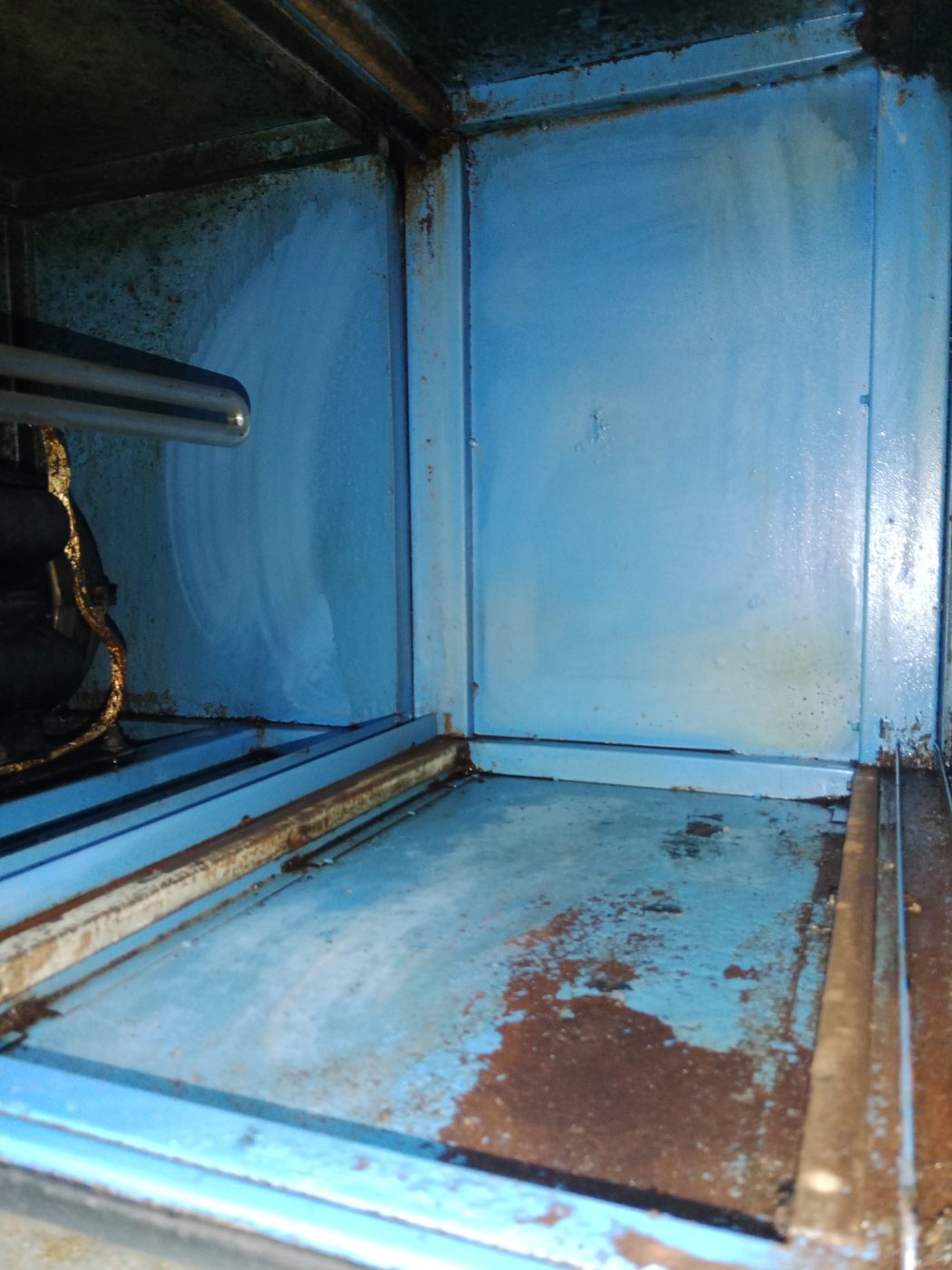
A cooking smell in the dining area is carried by air, so find which way the air moves at each opening between kitchen and dining room. The five usual routes are the kitchen pushing air out, a hood that does not capture everything, a leaking duct or access panel in the ceiling void, a discharge point near an air intake, and smells that do not come from the cooking line, such as bins or dry drains. A tissue held at the kitchen door during service shows which way the air is moving.
Pictured above: the inside of a metal exhaust section on one of our projects (Tian Xin, Adelphi), with grease residue and surface rust along the base. Every seam, joint and access panel along a duct run is a place where kitchen air can leave before it reaches the fan.
The fan is running. The hood is on. The kitchen is not smoky. And yet a customer at table six can tell what the kitchen has been cooking, and the front-of-house manager has stopped believing that the exhaust is doing its job.
This is a different complaint from the one in a kitchen that is still smoky with the exhaust running. There the problem is visible in the kitchen. Here the kitchen can look fine and the smell is arriving somewhere else: the dining area, the corridor, the lift lobby, or the neighbour’s unit. The fix depends entirely on which route the smell is taking, so this post is about finding the route first.
Cooking smell does not drift into a dining room by accident. It is carried by air, and air moves from higher pressure to lower pressure through whatever openings exist. So the useful question is not “is the exhaust strong enough?” but “which way is the air going at the kitchen door, and at every other opening between the kitchen and the dining area?”
There are five usual routes. They are listed here in the order we would check them, from the cheapest test to the most involved.
A kitchen should sit slightly lower in pressure than the dining room, so that air flows from the dining room into the kitchen and carries the smell towards the hood, not away from it. When that relationship flips, every opening becomes an outlet for kitchen air: the pass, the serving hatch, the swing door, the gap under the door.
It flips more often than people expect. Common reasons:
The full explanation of why supply and extract must be balanced, and what balancing involves, is in make-up air and air balancing in a commercial kitchen. For this problem, the one thing to take from it is that the kitchen should be marginally negative relative to the dining room, never positive.
With the kitchen running at its normal service load, open the kitchen door by a hand’s width and hold a thin strip of tissue or a lit incense stick in the gap. Do it at the door, at the pass and at any serving hatch.
It is a crude test and it is not a measurement, but it answers the direction question in half a minute and it tells you whether the next step is a pressure survey or a different check altogether. Do it during a busy service as well as a quiet one: the answer can change with the number of burners lit and the doors being opened.
If some of the plume escapes the hood, it spreads into the kitchen and is then moved by whatever air currents there are. Some of that always finds the kitchen door. The kitchen looks acceptable to the cooks, who stand close to the hood, and the smell still reaches the front.
Signs the hood is the weak link: the front edge of the hood is stained or yellowed, the ceiling around it is discoloured, there is a film of grease on surfaces within arm’s reach, and the smell is strongest when a particular appliance is on. Check that the baffle filters are all present and seated and that no gap has opened at the edge, because a missing filter or a loose one changes how the hood captures. We cover what sits behind the filters in behind the baffle filters.
If a new appliance has been added under an existing hood, the hood may simply be too small for it. We go through that in adding cooking equipment under an existing hood.
This one is easy to miss, because everything in the kitchen looks right. The duct leaves the hood, runs through the ceiling void above the dining area or corridor, and carries hot, smelly, grease-laden air all the way to the discharge point. If a joint, seam or access panel along that run is leaking, the smell leaks into the ceiling void and from there into the room below, through light fittings, ceiling tile gaps, air-conditioning grilles and anywhere else the void connects.
Clues that point to the duct:
Access panels are a particular suspect, because they are opened for every cleaning and then closed again. A panel that is closed but not properly sealed will leak every day until someone looks at it. Duct access panels explains where they should be and what to check when they are refitted.
If the exhaust discharges near an air intake, the smell can be pulled straight back into the building. The intake might belong to your own air-conditioning, to the landlord’s system or to the unit next door. The kitchen exhaust is working correctly in that case, and the smell still ends up in the dining area because the air is simply being recirculated.
Look at where the duct terminates and what is nearby: fresh-air intakes, air-conditioning units, open windows, a neighbouring unit’s intake. The smell often returns on a particular wind direction or at a particular time of day, which is itself a clue. Where the discharge point goes is a design decision, and where the duct terminates sets out how to think about it. A discharge-side fix is a design and permission question, not a cleaning one, so it needs a survey before anyone quotes.
Sometimes the exhaust is blamed for a smell it has nothing to do with. Before spending money on the exhaust, rule out:
If the smell is a stale, sour or drain smell and not a fried, grilled or burnt one, look here first.
The more specific the description, the faster the right check happens. Before you call, write down:
That description lets the first visit go straight to the likely route, instead of starting with a fan quote that may not touch the problem. A survey with measured readings, not a guess, is how we separate a pressure problem from a leak, and a leak from a discharge problem. Pricing is quoted after the survey, and we do not quote from a price list.
The instinct is to ask for more extract. It rarely helps in this situation, and it can make things worse. More extract in a kitchen that is already short of replacement air deepens the starvation and drags air in from worse places. More extract through a leaking duct leaks more, because the duct runs at a higher pressure. Only where the hood genuinely does not capture, and the fan genuinely cannot move enough air, does a bigger fan solve it, and that should be established by measurement first.
If the dining room smells of the kitchen while the exhaust is running, WhatsApp BC Air on 8989 2833 with where the smell is strongest, what you cook and what changed recently, and we will say which check we would do first. The whole system is described on the commercial kitchen ventilation system page, routine upkeep on the maintenance page and duct and hood cleaning on the cleaning page. We design, fabricate, install, clean and maintain the system in-house, with 24/7 standby if something fails mid-service.
Related reading: make-up air and air balancing · exhaust running but still smoky · duct access panels · ventilation for open and show kitchens
We design, clean, repair and maintain commercial kitchen exhaust systems across Singapore — on 24/7 standby.