
12 Nov 2026 · Maintenance
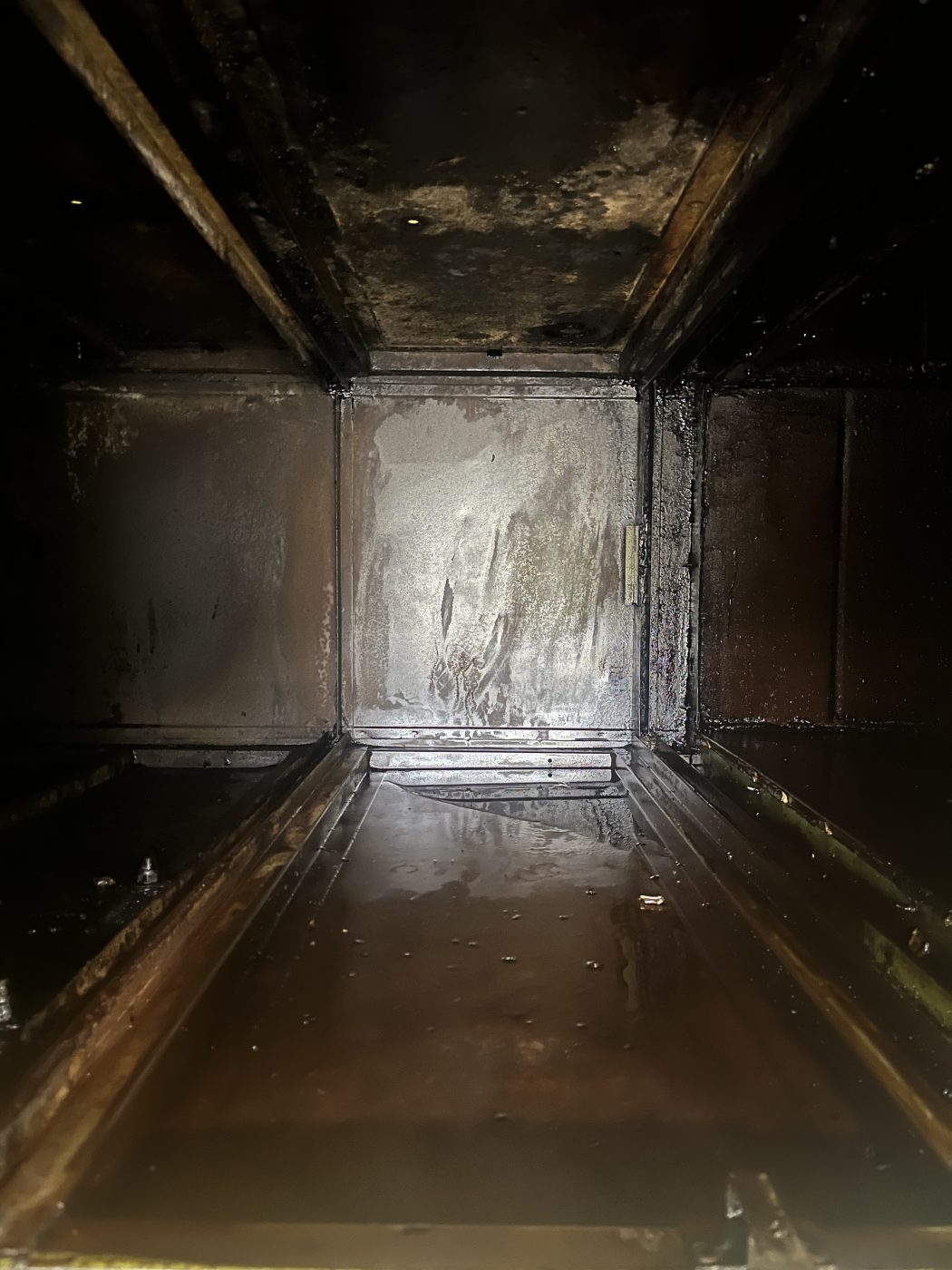
A kitchen exhaust that has not been cleaned for years carries a baked, hard layer of grease, so the first clean is heavier than a scheduled one. The bulk is scraped out first, then a degreaser is applied with time to work, then the surface is flushed and inspected. It can take a longer window or a follow-up visit, it often uncovers corrosion, fan faults or sections that cannot be opened, and it should end with dated before-and-after photographs and a report naming anything not cleaned.
Pictured above: the inside of a kitchen exhaust duct at one of BC Air’s cleaning and maintenance projects in Chai Chee, with a film of grease on the walls and ceiling of the section and liquid grease lying along its floor. It is reused here because it is what “the duct” looks like from the inside, and it is the part of the system that no one in the kitchen ever sees.
You have taken over a unit, or the contractor has changed, or you have just realised that nobody can say when the exhaust was last cleaned. The honest answer might be “years”. The question that follows is what the first clean will be like, because it will not be like the ones on a schedule. It will take longer, it may be done in more than one step, and it is the visit most likely to find something.
This post is about that first clean: what is different, what to settle before the crew arrives, and what you should have in your hands afterwards. It gives no prices. What it costs depends on the system and what is found, and we quote after an inspection.
Grease does not just pile up in a kitchen exhaust, it bakes. Each cooking session hardens the layer underneath. What starts as a soft, wipeable film turns, over months, into a hard, lacquer-like coating bonded to the metal. In a neglected system the deposit can be several millimetres thick, and in the worst ones centimetres. The same system on a regular schedule never gets that far, because the film is removed while it is still soft.
That is why a system with a long gap behind it cannot be treated as a normal clean with a bit more effort. A degreaser sprayed over a thick baked deposit does not get through it. It can leave a surface that looks clean while a hard layer is still sitting underneath. The right first step is to remove the bulk, and only then to bring in the chemistry. We explain the two methods and why a badly loaded system needs both in chemical degreasing versus manual scraping.
A fair quote for a backlogged system is not a number given over the phone. Here is what to ask, and what a straight answer sounds like.
The sequence that gives the best result on a heavily soiled system is the same one every time, and it is worth knowing so you can tell whether it is being followed:
Older systems also have thin or corroded panels that have to be handled with care. If the crew treats the duct like a pipe to be hosed, ask them to slow down.
Three things tend to come to light, and none of them is the cleaner’s fault.
One more item belongs on the same visit. The grease we remove also fouls the fire suppression nozzles and coats the fusible links over the cooking line, and a greased-over link may not release at the temperature it was rated for. We can service the suppression system on the same visit as the clean, so one team sees the whole cooking line. See fire suppression maintenance. Nobody should be moving or covering a nozzle to make the cleaning easier.
On a first clean the before-and-after photographs are worth more than on any later one. They are dated proof of the condition you inherited and of what was done about it. Every clean here comes with before-and-after photographs and a service record you can show NEA, SCDF, your landlord or your auditor. If you took over the unit recently, those photographs and the record are what separate “it was like that when we arrived” from “nobody checked”. Our post on taking over an F&B unit covers what to look at before you sign.
Ask for the report to name anything that was not cleaned and why. A section named on this report that is still named on the next one is a section that has been accumulating through two cleans.
The kitchen should not be cooking on a system that has only been cleaned, it should be cooking on one that has been checked. Before the first burner is lit, run the opening check from kitchen exhaust cleaning night: filters seated and the right way round, the fan running without a new noise or vibration, and the hood actually pulling smoke and heat. If a motor, fan or drive was changed, confirm the airflow before service.
The first clean fixes the backlog. What keeps it fixed is the interval. Published guidance is that most commercial kitchens need the whole system cleaned every one to three months, with heavy wok, grill and deep-frying kitchens often monthly and lighter kitchens quarterly. NFPA-96 is the framework the industry works to, and both NEA and SCDF expect the system to be kept clean, safe and documented. We do not apply a fixed rule: after the first clean we know what your kitchen produces, and we recommend an interval from that. A maintenance program puts it on a schedule with a record after each visit. The reasoning is in how often a kitchen exhaust must be cleaned.
WhatsApp BC Air on 8989 2833 with the location, what you cook and for how many hours, the last clean if you know it, whether the duct has access doors, and what you are seeing. A photo of the hood interior or an opened access panel helps. We are on 24/7 standby, and scope and pricing follow an inspection. Our kitchen exhaust cleaning covers the hood, the filters, the accessible duct and the fan.
Related reading: signs your hood is overdue for a deep clean · reopening after a long closure · how often a kitchen exhaust must be cleaned
We design, clean, repair and maintain commercial kitchen exhaust systems across Singapore — on 24/7 standby.