
16 Nov 2026 · Design & Build
An air cleaner for a kitchen exhaust is not one product. An electrostatic precipitator (ESP) collects fine grease aerosol, the haze you can see at the discharge. Activated carbon takes out the gas-phase cooking smell. Germicidal UV treats the air stream along the duct and reduces grease build-up between cleans. Name the complaint first (haze, smell or build-up), then match the equipment, keep the stages in the right order, and get the cleaning or change schedule in writing. None of them replaces grease filters, duct cleaning, good capture or a sensible discharge point.
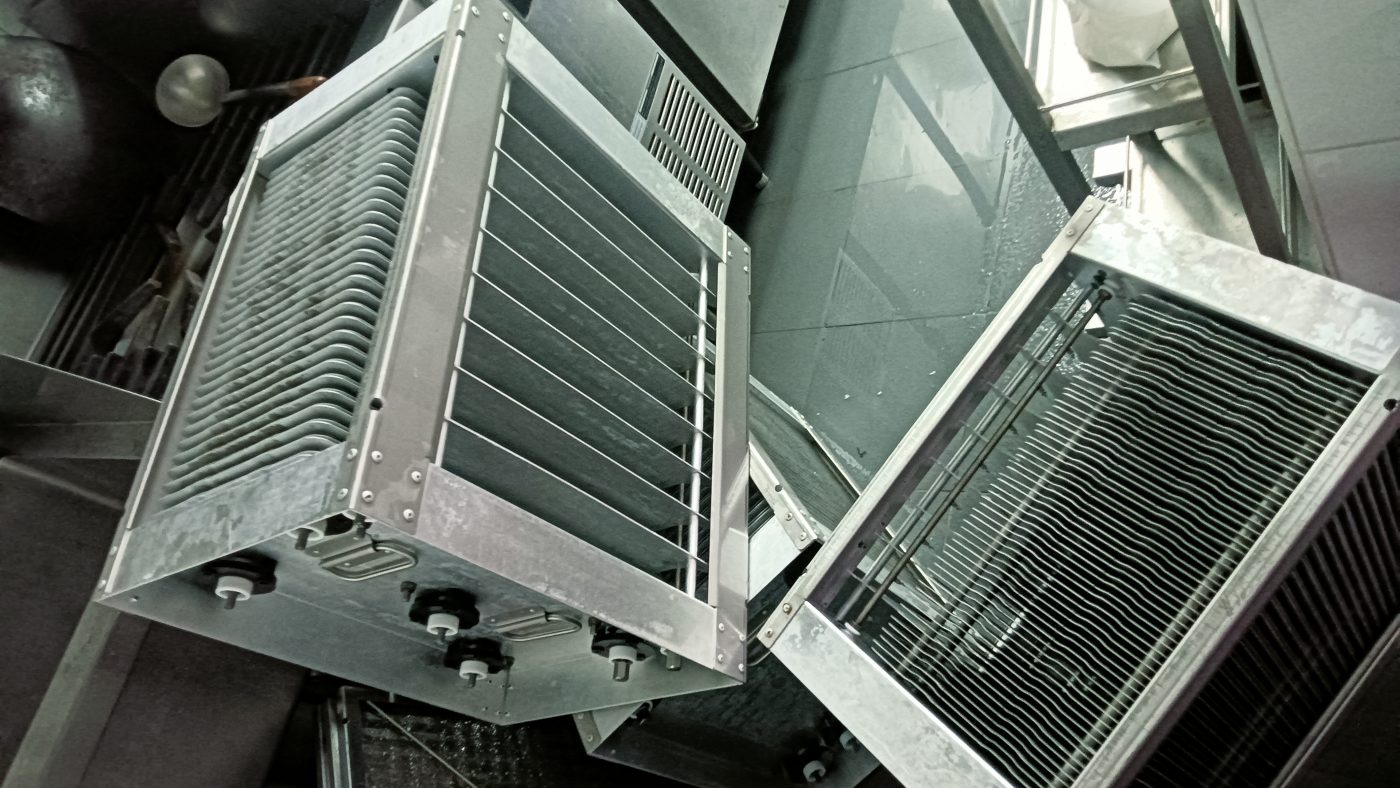
Pictured above: two electrostatic cells taken out of their housing in a kitchen exhaust, on one of BC Air’s projects (VivoCity). Reused here because it shows the part most people mean when they say “air cleaner”, and how much metal there is to keep clean.
Someone has complained about the kitchen. A neighbour, the mall’s technical team, the landlord, or the people at the back tables. The advice that comes back is usually the same: “you need an air cleaner on the exhaust.” Then you start asking around and hear three different things: an ESP, a UV system, a carbon bank.
They are not three brands of the same thing. Each one is aimed at a different complaint, and buying the wrong one is the most common way an owner spends real money and still gets the same call a month later. This post is for the person who has to decide, or who has to check that the right thing was proposed. It gives no price, because a price depends on the system it goes into, and we quote after seeing it.
Write the complaint in one sentence before you talk to anyone. It will be one of these, and the equipment follows from it.
If you cannot tell which of these you have, say that to whoever you ask. A good adviser will want to see the discharge point and hear what is being complained about before naming equipment.
Grease leaves a wok or fryer as an aerosol, droplets small enough to stay in the air. The baffle filters in the hood catch the larger ones. The finest fraction goes straight through, and that is the haze you see and the film that settles on whatever is downwind. An ESP charges those fine particles and collects them on plates, so the grease stays in the unit instead of leaving the building. We go through it in full in when you need an electrostatic precipitator.
What it does not do is remove smell. Cooking odour is largely gas-phase and passes through the collector plates. A kitchen that fits an ESP because of an odour complaint will often find the haze gone and the complaint unchanged.
And it is not fit-and-forget. The cells fill with exactly what they were fitted to catch. As they load, collection drops and the haze comes back, and a heavily loaded cell can start to arc: a snapping noise, a unit that keeps tripping. The cells have to come out and be cleaned on a schedule set by how hard the kitchen cooks.
Activated carbon takes the gas out by adsorption. It is the stage that deals with cooking smell once the grease stages have done their part. Two things to know. It holds a finite amount, so it is a consumable, not a fitting you install once. And it gives no warning when it is full: the airflow does not change, the fan does not change note, and the first sign is a complaint. We cover that in carbon banks and why the smell comes back.
Carbon is also not a grease filter. Grease and moisture that reach it coat the surface the gas needed, and it is finished long before its time.
A germicidal UV unit holds UV-C lamps mounted in the plenum or duct run, typically downstream of the grease filters. The light breaks down some of the fine grease aerosol that slipped past the filters, acts on the odour compounds, and reduces microbial growth in a hot, humid duct. It is sized to the actual airflow, because a bank sized for a small stall will not do the job in a banquet kitchen: the air spends too little time near the lamps. The full explanation is in germicidal UV systems in kitchen exhaust.
Two things catch people out. Lamps lose output gradually, so a lamp that looks lit may be delivering only a fraction of its original dose, and replacement has to follow a schedule, not a visible failure. And grease on the lamp sleeve shields the lamp from the very aerosol it is meant to treat, so the sleeves and reflectors need cleaning too. UV also does not replace grease filters or duct cleaning.
These stages are a train, and each one protects the next. Roughly, from the hood outwards: baffle filters catch the larger grease; the ESP collects the fine aerosol; UV, where it is used, sits ahead of the carbon in some configurations; carbon takes the gas last. Swap the order, or leave out a stage that the one behind it depends on, and the last stage is ruined early. The usual victim is the carbon, loaded with grease it was never meant to meet.
The same logic runs backwards. Every treatment stage inherits the problems upstream of it. If the hood is not capturing, the baffle filters are overdue, the plenum is coated or the make-up air was never planned, the air cleaner is working on air that was never going to reach it properly. Our post on make-up air and air balancing is the one to read if the system moves less air than it was designed to.
We would rather say this than sell equipment that does not help. A standalone industrial canteen with a clean roof-level discharge and nobody downwind is usually well served by proper filters, correct duct velocity and a disciplined cleaning schedule. An air cleaner is capital equipment with a maintenance commitment attached, and fitting one where the discharge point does not call for it is money that would do more good on the cleaning interval.
It also often comes down to where the air leaves the building. The height and direction of the discharge frequently matter more than anything fitted inside the duct, and a new carbon bank on a discharge that points at a neighbour’s window is a short-term fix. See where the duct terminates and how exhaust design fixes neighbour odour complaints.
In a mall or shared-shaft unit, air treatment is often set by the tenancy handbook, and fit-out drawings may not be approved without it. Podium units under residential floors, mixed-use buildings and shophouse units with a discharge close to the next unit’s windows are the other common cases. Check the handbook and the fit-out conditions before you assume, and equally before you assume not. Our post on mall F&B units, shared risers and landlord rules sets out what to look for.
Do not open an ESP or UV housing yourself while the system is running, and do not go onto a roof or into a ceiling void to take photographs.
There is no flat figure. It depends on the airflow, the size and number of units, the access available and what is found upstream, so we quote after we have seen the details. We would rather tell you the equipment is not what your problem needs than sell you a unit.
The short version:
If you are weighing up air treatment and want it looked at, WhatsApp BC Air on 8989 2833 with the details above. We are on 24/7 standby. The wider picture of how the hood, duct, fan, make-up air and air treatment fit together is on our commercial kitchen ventilation systems page, and the upkeep side is on kitchen exhaust maintenance and kitchen exhaust cleaning.
Related reading: electrostatic precipitators · germicidal UV systems · carbon banks · neighbour odour complaints
Also worth reading: an ESP that is snapping or tripping: what usually causes it and what to check before you call.
We design, clean, repair and maintain commercial kitchen exhaust systems across Singapore — on 24/7 standby.