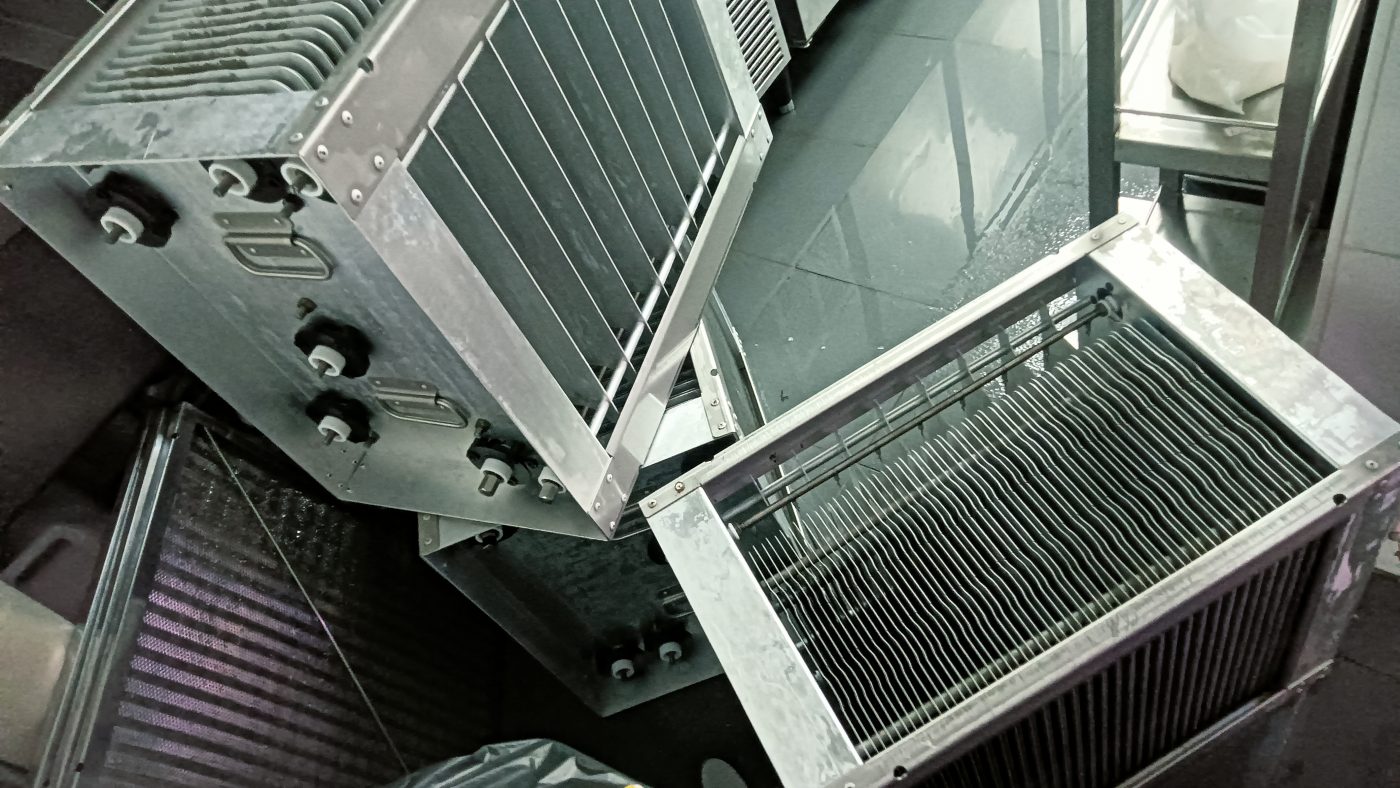
Pictured above: electrostatic cells taken out of a kitchen exhaust for cleaning, on one of BC Air’s projects (VivoCity). Reused here because it shows the part this post is about: a stack of thin plates that has to be clean and dry to work.
The kitchen has an electrostatic precipitator (ESP) on the exhaust, fitted because the discharge point is close to neighbours or the mall asked for one. For a while nobody thinks about it. Then someone hears a snapping or crackling from the unit, the indicator light goes out, the unit keeps tripping, or the haze at the discharge comes back and the unit looks fine from the outside.
This post is for the owner or kitchen manager who has to decide what to do in the first hour. It covers what usually causes an ESP to snap or trip, what you can safely look at without opening anything, what to tell the technician, and what to ask for afterwards. It gives no price: a price depends on the unit and what is found, and we quote after seeing it.
What an ESP is doing when it works, in one paragraph
An ESP charges the fine grease particles in the exhaust air and then collects them on plates held at the opposite polarity, so the grease stays in the unit and the air carries on. That only works while the plates are clean and the gap between them is held. Every common fault below is a version of the same thing: something is bridging that gap, or something is stopping the unit from switching on at all.
Why it snaps: the usual causes
A snapping or crackling sound is the unit arcing, meaning a spark is jumping across the gap. The power supply usually responds by cutting out, which is the “tripping”. In a kitchen the causes are not mysterious, and we rank them roughly in the order we meet them.
- The cells are loaded with grease. This is the most common one. The cells fill with exactly what they were fitted to catch. As the film thickens the gap narrows, the field is less even, and the unit starts to arc. A loaded cell is also the place in the whole system where grease and high voltage sit next to each other, which is why we do not treat it as a nuisance fault.
- The cells were washed and are not dry. A cell that goes back in with water trapped between the plates can trip the unit straight away or after a few minutes of running. It is the classic “it worked before the clean and tripped after it” story.
- Something is bent or touching. A plate knocked out of line when the cell was carried, or when it was pressed against a sink edge, can narrow the gap in one spot. The unit then arcs at that spot every time.
- The pre-filter is missing or has been replaced with something it was not designed for. The upstream filters protect the cells from the coarse grease. Without them the cells load far faster than anyone planned. Foil, pads and homemade liners on the filters upstream make this worse, which we cover in foil pads and liners on hood filters.
- Steam or water is reaching the unit. A kitchen with heavy steam, a leaking duct joint upstream, or rain getting in at the discharge can wet the cells while the kitchen is running.
- A cell is seated wrongly. A cell put back the wrong way round or not pushed fully home can leave a gap where there should be a contact, or leave the door interlock open so the unit will not start.
- The fault is in the electrical side. A failed ionising part, a failed power supply or damaged wiring. These show up as a unit that trips even with clean, dry, correctly fitted cells, and they are for a qualified technician, not for the kitchen to chase.
We have not seen your unit, so treat that list as an order of questions, not a diagnosis.
What you can safely check from the outside
None of these needs a tool or an open panel. They take about ten minutes and give the technician a head start.
- When were the cells last taken out and cleaned, and by whom? Find the date. If nobody can say, that is already a finding.
- Did the trouble start straight after a clean, a filter change or a repair? A start right after a clean points at wet or misfitted cells. A slow build-up over weeks points at loading.
- Is the pre-filter bank in front of the unit complete and the right type? The same check as on the hood, and for the same reason: a gap sends grease straight through. If a filter is bent or missing, see replacing a damaged baffle filter.
- Is the unit’s indicator showing a fault, and does it come back when it is reset? Write down what it shows and how soon it trips again. A trip in seconds and a trip after an hour are different clues.
- Is there any water, steam or dripping near the housing? Look at the outside of the housing and the duct around it.
- Is there a burning smell, visible smoke or heat from the unit? If so, treat it as an emergency, not a nuisance. Switch the unit off at its isolator if you can do that without opening anything, and if there is any sign of fire follow the kitchen’s fire procedure first.
What not to do
- Do not open the housing or pull cells while the unit is live. It is a high-voltage unit full of grease. Isolate it first and let the technician say when it is safe to open.
- Do not keep pressing reset. A unit that arcs again as soon as it is reset is telling you something. Repeated resets over a loaded or wet cell are how a nuisance fault becomes a damaged part.
- Do not bypass the unit because the neighbour or the mall is still waiting for it to work. Whether the kitchen can keep trading while the unit is out of service is a decision for you and the technician, together with whoever required the unit, not something to improvise at the board.
- Do not wash the cells with a pressure jet or bend them straight. Thin plates dent. A dented plate is a new arcing point.
- Do not put them back damp. If the cells have been washed, they need to be fully dry before the unit is switched on.
What to tell the technician when you call
Send these on WhatsApp before anyone comes. They save a site visit spent asking questions.
- The location, the make or model if it is on the unit, and a photo of the unit’s front or its indicator.
- When the cells were last cleaned, and whether the trouble started right after.
- What the noise is (a crackle, a regular snap, a hum) and how long after switch-on it starts.
- Whether the pre-filters are all in place.
- Whether anything changed: a new fryer or wok station, a repaired duct joint, a roof or ceiling job nearby, a heavy rainstorm.
- Whether there is a tenancy or neighbour requirement that the unit must be running, and any date attached to it.
What you should get back
A visit to an ESP is only worth having if you leave with something written down. Ask for:
- the condition the cells were found in (loaded, damp, bent), with photographs;
- what was cleaned, repaired or replaced, and what was not touched;
- whether the unit was running properly when the technician left, and how that was confirmed;
- how often the cells should come out for cleaning in your kitchen, and who is booked to do it;
- anything upstream that is making the unit work harder, such as missing pre-filters or a leaking joint.
That last point is the one that stops the call coming back. An ESP that keeps tripping is very often a symptom of something upstream, not a unit that is faulty on its own.
Where an ESP sits in the bigger picture
An ESP deals with the fine grease haze. It does not remove cooking smell, and it does not replace the hood filters or the duct clean behind them. We explain what it does and does not do, and when a kitchen actually needs one, in when a kitchen exhaust needs an electrostatic precipitator, and how it sits with carbon and UV in ESP, UV or carbon: matching the air cleaner to the complaint. If the complaint is smell and not haze, the stage that matters is the one in when to change a carbon bank.
Getting it looked at
We design, fabricate, install, clean, repair and maintain the whole exhaust system in-house, including air treatment, and we are on 24/7 standby. If your ESP is snapping, tripping or letting haze through, WhatsApp BC Air on 8989 2833 with the points above. We quote after seeing the system, and we would rather tell you what it needs than sell you a part. The wider picture of how the hood, duct, fan, make-up air and air treatment fit together is on our commercial kitchen ventilation systems page, and the upkeep side is on kitchen exhaust maintenance and kitchen exhaust cleaning.
The short version:
- Snapping is arcing. The usual causes, in order: loaded cells, cells put back wet, bent plates, missing pre-filters, then an electrical fault.
- Check when the cells were last cleaned, whether the trouble began after a clean, and whether the pre-filters are complete. Do not open the unit while it is live.
- Do not keep resetting it, do not bypass it on your own, and do not put cells back damp.
- Leave with the condition found, what was done and a cleaning interval for your kitchen, in writing.
Related reading: electrostatic precipitators · ESP, UV or carbon · neighbour odour complaints · where the duct terminates
Questions
Common questions
Why is the ESP on my kitchen exhaust snapping or crackling?
A snapping or crackling sound is the unit arcing: a spark is jumping across the gap between the plates. In a kitchen the usual cause is cells loaded with grease. Other common causes are cells put back while still damp, a bent plate, missing pre-filters upstream, and an electrical fault. Isolate the unit and have a technician look at it.
Why did the ESP start tripping right after it was cleaned?
The most common reason is that the cells went back in before they were fully dry, or that a plate was bent while the cell was carried or washed. A misfitted cell can also leave the door interlock open so the unit will not start. Tell the technician that the trouble began straight after the clean.
Can I keep pressing reset until it stays on?
No. A unit that arcs again as soon as it is reset is telling you something, and repeated resets over a loaded or wet cell can turn a nuisance fault into a damaged part. Write down what the indicator shows and how soon it trips, then call.
Is it safe to open the ESP and look at the cells myself?
Not while it is live. It is a high-voltage unit full of grease. Isolate it first and let the technician confirm when it is safe to open. If there is a burning smell, smoke or heat from the unit, treat it as an emergency and follow the kitchen fire procedure first.
What should I get in writing after an ESP visit?
The condition the cells were found in with photographs, what was cleaned, repaired or replaced, whether the unit was running properly when the technician left and how that was confirmed, how often the cells should come out for cleaning in your kitchen and who is booked to do it, and anything upstream that makes the unit work harder.
How much does it cost to have an ESP looked at?
There is no fixed price. It depends on the unit, its access and what is found, so BC Air quotes after seeing it. Send the location, the make or model if known, when the cells were last cleaned and what the noise or indicator shows on WhatsApp.