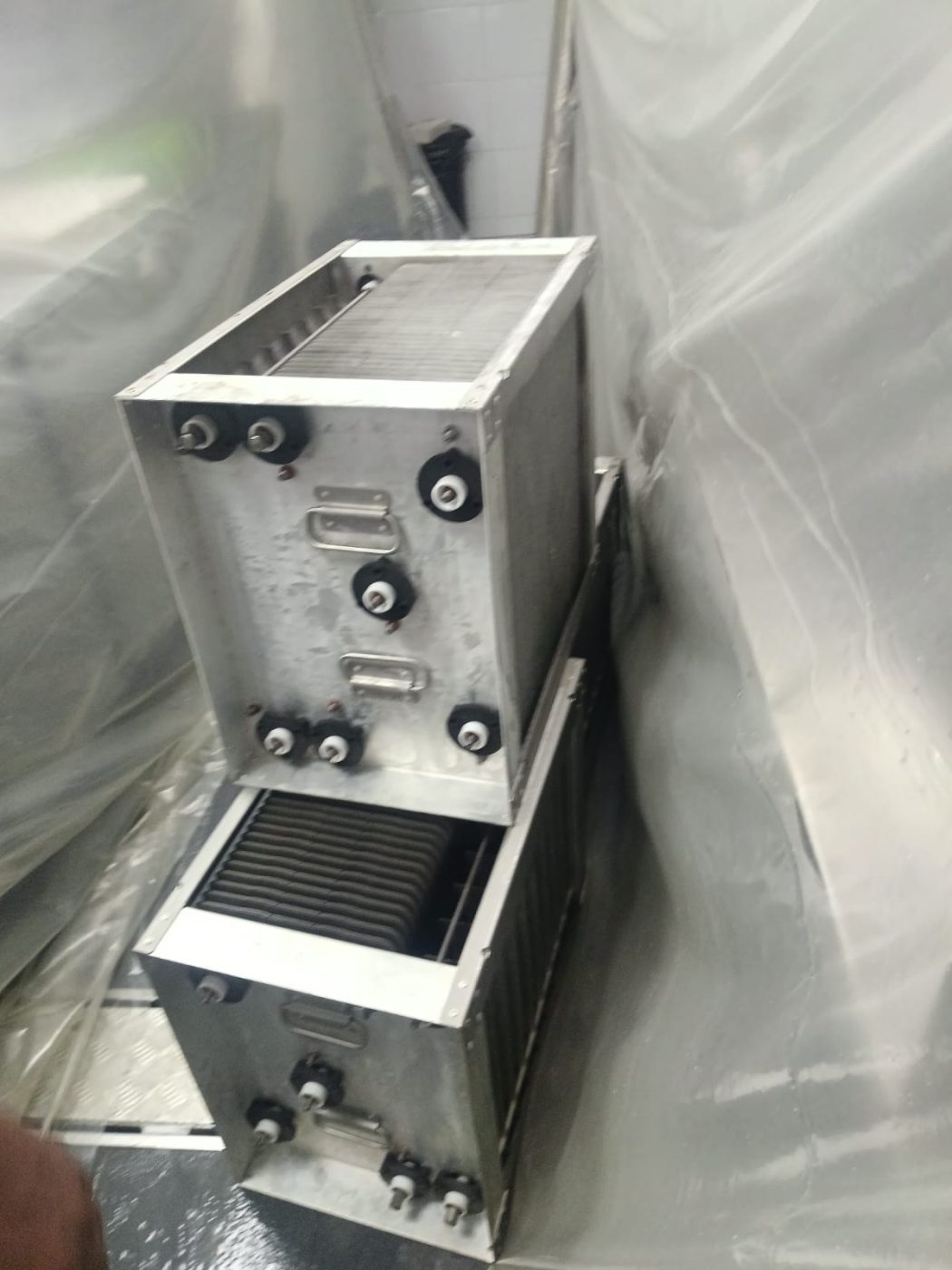
Pictured above: two electrostatic cells taken out of a kitchen exhaust for cleaning, on one of BC Air’s projects (Gokoku, VivoCity). They are not carbon banks. They are reused here because they sit in the same treatment train, just upstream of the carbon, and they show how much equipment a smell has to get past before it leaves the building.
The complaint stopped after the carbon bank went in. For a few months nobody said anything. Then a neighbour mentions it, or the landlord’s manager walks past the back lane at lunch, or the dining room starts to smell of last night’s wok. Nothing has visibly broken. The fan runs. The hood captures. The carbon bank is still sitting in its housing.
Often the cause is simple: the carbon is full. This post explains what a carbon bank actually does, why it gives no warning when it is finished, what shortens its life, how to tell a spent bank from a different problem, and what to send us when you want it looked at. It does not give a price or a change interval, because both depend on the kitchen, and we set them after we see it.
What a carbon bank does, and what it does not
Cooking smell is largely gas-phase: volatile compounds that are not particles. Baffle filters in the hood catch the larger grease droplets, and an electrostatic precipitator collects the fine grease aerosol, but the gas passes through both. Activated carbon is the stage that takes it out. The gas sticks to the very large surface inside the carbon, which is why it is called adsorption, and the air leaving the bank is less smelly than the air going in.
Two limits follow from that, and both explain the complaints we get.
- Carbon holds a finite amount. Once its surface is covered it cannot take any more, and the smell goes straight through. A carbon bank is a consumable, like a filter, not a fitting you install once.
- Carbon is not a grease filter. It is placed after the grease stages for a reason. Grease and moisture that reach it coat the surface the gas needed, and the bank is finished long before its time.
We covered the first stage in electrostatic precipitators in kitchen exhaust: the ESP handles what people can see, carbon handles what they can smell. This post is about the second half.
Why it gives no warning
A filter that clogs shows itself. The airflow drops, the hood stops capturing, the fan changes note. A spent carbon bank does none of that. Air still passes through it, the fan is not working any harder, and every gauge reads the same. The only thing that changes is the smell, and the people who notice it first are not in your kitchen. They are the neighbours, the other tenants and the customers at the front.
That is why a carbon bank is looked after by a schedule and a record, not by waiting for a symptom. If the only instrument you have is a complaint, you will always be changing it late.
What shortens its life
The change interval is not a number on a box. It follows from four things in your kitchen.
- What you cook, and for how many hours. A wok and deep-fry line puts far more into the air than a sandwich counter, and a kitchen that runs all day loads the carbon all day. The same logic as the cleaning interval applies: it is set from the cooking, not from the calendar.
- How clean the stages upstream are. Loaded baffle filters, a grease-coated plenum or electrostatic cells that have not been cleaned let grease through to the carbon. No odour control system performs well sitting downstream of a grease-blocked duct.
- Moisture. Steam from the line, or condensation in the duct, wets the carbon, and wet carbon takes up less. A duct that sweats is a carbon problem as well as a water problem, which we went through in water at the kitchen exhaust duct when it has not rained.
- A menu change. A kitchen that adds a strong-smelling dish or a second wok is asking the same bank to do more than it was sized for. If that sounds familiar, when a menu change outgrows your kitchen exhaust is the one to read first.
Is it the carbon, or is it something else?
A returning smell is not always a spent bank. Work through these before anyone orders anything.
- When did it come back, compared with the last change? If the complaint returned a long time after the bank went in, spent carbon is the likely cause. If it returned within weeks, look for grease or water reaching the carbon, or a bank that was never sized for the cooking.
- Where is the smell strongest? At the discharge point, or in the dining room? Smell in the dining room points to air being pulled the wrong way, not to the carbon. We looked at that in make-up air and air balancing.
- Is the air going through the bank, or around it? A frame that does not seal, a panel left off or a gap at the edge sends the air around the carbon. A bank that looks full and does nothing may not have been in the path.
- Where does the air leave the building? Where and how high the exhaust discharges often matters more than anything inside the duct. A fresh bank on a discharge that points at a neighbour’s window is a short-term fix. Where your kitchen exhaust actually discharges and how exhaust design fixes neighbour odour complaints explain that side.
If you are not sure, do not guess and do not order carbon first. Changing a bank that was not the problem costs money and tells you nothing.
What changing a bank should involve
It is more than swapping the panels. A proper visit should leave you with answers to these.
- The upstream stages looked at first. Baffle filters, the plenum and the electrostatic cells checked and cleaned, so the new carbon is not loaded on day one.
- The housing and seals checked so the air goes through the carbon and not around it.
- The old carbon looked at, not just binned. Is it wet? Is it coated with grease? What it looks like tells you which of the four causes above is at work.
- The date written down, with what was replaced and when the next change is due, in the report you keep for your files. Without a date nobody can say how old the bank is when the next complaint arrives.
- The same-day airflow check, so you know the new bank has not changed the resistance the fan was sized for.
This sits inside a maintenance programme, which already covers baffle filters, carbon banks and UV lamps as consumables, with a documented report after every visit. Our kitchen exhaust maintenance programmes page sets out what is included. We stock carbon banks and UV components in-house, so a change does not wait on an order.
What to do this week
- Find out when the carbon bank was last changed. If nobody knows, treat it as spent until someone looks.
- Ask your cleaning contractor whether the electrostatic cells and filters upstream of the carbon are on the cleaning schedule, and where that is written.
- Note where and when the smell is noticed, and what was being cooked. Five lines of notes save a visit.
- Do not open the housing yourself while the system is running, and do not climb into a ceiling void or onto a roof to look.
What to send us
A short message is enough to start:
- The kind of kitchen, what you cook and how many hours a day the line runs.
- When the carbon bank was last changed, or that you do not know.
- Where the smell is noticed: the dining room, the back lane, a neighbour or the building management.
- Photos of the carbon housing from outside, the discharge point if it can be seen safely, and any cleaning report.
What it costs
There is no flat figure for a carbon bank or for a change. It depends on the size of the bank, how many there are and what is found upstream of them, so we quote after seeing the system. We would rather tell you the carbon is not the problem than sell you a new bank.
The short version
A carbon bank takes out the gas-phase cooking smell that grease filters and electrostatic cells cannot, and it has no alarm. It works until it is full, grease and moisture from upstream shorten its life, and the first sign of a spent bank is a complaint. Look after the stages upstream, write the change date down, and check the discharge point before assuming the carbon is the cause.
If the smell has come back and you want to know why, WhatsApp BC Air on 8989 2833 with the details above and we are on standby 24/7.
Related reading: electrostatic precipitators in kitchen exhaust · neighbour odour complaints · where the exhaust discharges
Questions
Common questions
What does a carbon bank do in a kitchen exhaust?
It adsorbs the gas-phase cooking odour that baffle filters and electrostatic cells cannot catch. The odour compounds stick to the large surface inside the activated carbon, so the air leaving the bank smells less than the air entering it.
Why does the cooking smell come back after the carbon bank was installed?
The most common reason is that the carbon is full. It holds a finite amount, it gives no warning when it is spent, and the first sign is the smell. Grease or moisture reaching the carbon from upstream shortens its life, and a discharge point that points at a neighbour can also keep the complaint alive, so the bank should be checked before it is blamed.
How often should a kitchen exhaust carbon bank be changed?
There is no single interval. It depends on what the kitchen cooks, how many hours the line runs, how clean the filters and cells upstream are and whether the carbon gets wet. BC Air sets the interval after seeing the system and writes the change date into the report.
Can a carbon bank replace an electrostatic precipitator or baffle filters?
No. Carbon deals with odour, not grease. It sits after the grease stages, and grease reaching it coats the surface and ruins it quickly. The baffle filters, the plenum and any electrostatic cells still have to be cleaned on schedule.
How much does it cost to change a carbon bank?
There is no fixed price. It depends on the size and number of banks and what is found upstream. BC Air quotes after seeing the system: send the details on WhatsApp and we will tell you what is involved.