
02 Aug 2026 · Cleaning & Compliance
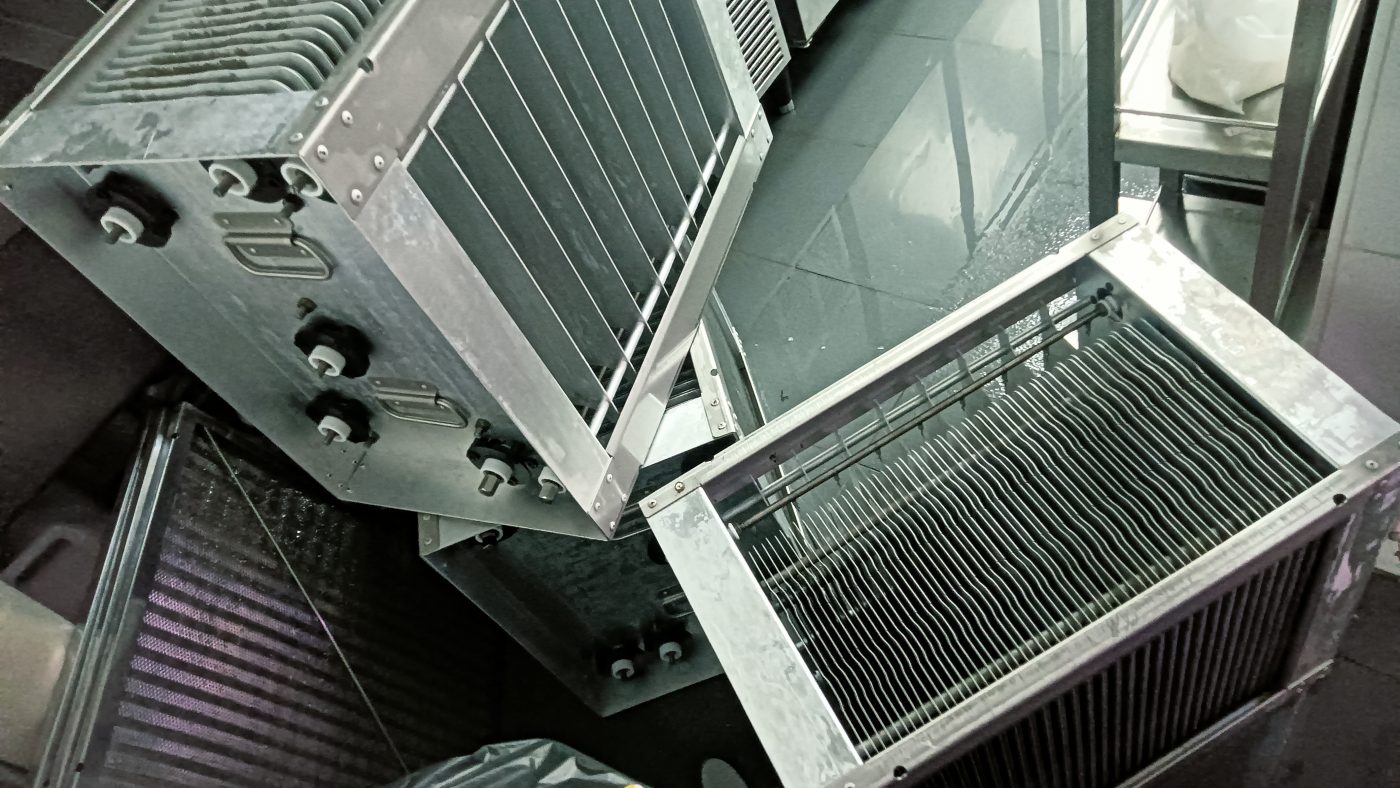
Germicidal UV systems installed inside kitchen exhaust ducts emit high-intensity ultraviolet light that photo-oxidises grease aerosols, destroys odour-causing compounds and kills airborne bacteria — reducing grease build-up between cleans, improving air quality and supporting NEA and SCDF compliance in Singapore commercial kitchens.
When kitchen owners ask us about germicidal UV systems, they usually have one concern in mind — smell. That's fair. Odour complaints from neighbours or tenants are one of the most common reasons a client calls us. But once we sit down and explain what UV does inside an exhaust duct, most people realise there are three strong reasons to install one: odour control, grease load reduction and hygiene. Here's what we know from designing, installing and maintaining these systems in Singapore commercial kitchens every day.
A germicidal UV unit houses high-intensity UV-C lamps — the short-wave, high-energy band of ultraviolet light — mounted inside the exhaust plenum or duct run, typically downstream of the grease filters. As the exhaust air stream passes the lamps, several things happen simultaneously.
We always specify the lamp intensity and the number of units based on the actual airflow volume of the system. A UV bank sized for a hawker stall will not perform adequately in a hotel banquet kitchen — the dwell time drops and the system simply cannot do its job.
No — and we'll always be straight with you on this. A germicidal UV system is not a substitute for properly maintained grease filters or periodic duct cleaning. What it does is reduce the rate at which grease accumulates between cleaning cycles, and it manages odour and bacteria continuously in a way that mechanical filtration alone cannot.
In practical terms, on kitchens where we've installed UV systems we often see the duct interior staying noticeably cleaner between scheduled cleans. That matters for two reasons: it reduces fire risk (grease is the fuel in a duct fire) and it can, depending on usage, allow cleaning intervals to be adjusted sensibly. We always carry out an assessment before recommending any change to a client's cleaning schedule — we won't tell you to clean less often without evidence that it's safe to do so.
SCDF has clear requirements around grease duct fire risk. NEA has its own standards on exhaust discharge quality and odour nuisance. We always confirm the exact applicable requirements with the relevant authority before quoting on any UV or exhaust project.
In our experience, the strongest candidates are:
We fabricate our own UV carbon banks and germicidal UV assemblies in-house. That means we're not waiting on a third-party supplier's lead time or adapting a generic unit to your duct — we build to the actual dimensions and airflow of your system.
The sizing process starts with your exhaust volume in cubic metres per hour, the duct cross-section, and the cooking load profile — how many burners, what type of cooking, how many hours a day. From those inputs we calculate the required UV dose and determine how many lamps and at what spacing they need to be positioned. We also account for lamp ageing: UV-C output degrades over time, so we build in a replacement schedule from day one and include it in your maintenance plan.
Installation is done by our own technicians. We don't sub-contract. After installation, we test lamp output, confirm airflow is not compromised, and walk the kitchen team through the basic indicator checks they can do themselves between our visits.
UV-C lamps don't fail dramatically — they gradually lose output. A lamp that looks lit may be delivering only a fraction of its original dose. That's why lamp replacement on a defined schedule, not just on visible failure, is essential. We track this for every system we maintain.
Beyond lamp replacement, we clean the lamp sleeves and reflectors during scheduled visits. Grease coating on a lamp sleeve is effectively a shield against the very aerosols the system is meant to treat. A dirty UV system is close to a useless one.
We carry our own stock of compatible lamps, ballasts and control components, so a maintenance visit doesn't get delayed waiting for parts. Our 24/7 standby team can also respond if a lamp failure is flagged outside normal hours — because a kitchen running a full dinner service without a functioning UV system in an odour-sensitive location can't always wait until Monday morning.
It will significantly reduce it in most kitchens, but "completely eliminate" depends on the cooking type, exhaust volume, and how the system is sized and maintained. We've seen UV systems make a dramatic difference in mixed-use developments where odour complaints were a recurring problem. What we won't do is promise complete elimination without first assessing your specific setup — that wouldn't be honest, and it wouldn't serve you well.
UV-C lamps in a properly installed exhaust duct system are enclosed within the ductwork, so staff are not exposed to the UV light during normal operation. The lamps are not in the cooking or food preparation space. We install systems with safety interlocks so lamps shut off if an access panel is opened, and we brief your team on the correct procedure for any inspection work. Handled correctly, these systems present no risk to staff.
A well-sized UV system generates ozone within the duct, and that ozone is part of the photo-oxidation process. In a correctly designed installation, the ozone is consumed in the reaction with grease and VOCs before it reaches the discharge point. We monitor ozone levels as part of our commissioning process. An over-specified or poorly installed system can produce excess ozone — which is exactly why correct sizing matters and why we don't just bolt in the largest unit available.
It varies by lamp type and operating hours, but as a general guide most UV-C lamps in continuous kitchen exhaust service need replacement annually, sometimes more frequently in very high-usage kitchens. We assess this during every maintenance visit and track output against the original specification. We'll tell you when a lamp needs changing — we won't recommend replacement before it's necessary, and we won't let it run past the point where it's still doing its job.
Yes, and this is actually the most common scenario for us. Most clients who enquire about UV already have an exhaust system in place — they're adding UV to address an odour issue or to improve overall compliance. We assess the existing ductwork, identify the best installation point for the UV bank, and fabricate the assembly to fit. As long as there is adequate duct access and the system has sufficient airflow, retrofitting is straightforward.
If you're dealing with odour complaints, a high grease load, or you simply want to understand whether a germicidal UV system makes sense for your kitchen, get in touch with us for a no-obligation assessment. Our team is available 24/7, and we'll give you a straight answer based on what we actually see on-site — not a standard sales pitch.
Also worth reading: when a commercial kitchen actually needs an electrostatic precipitator — and why an ESP is not an odour fix.
We design, clean, repair and maintain commercial kitchen exhaust systems across Singapore — on 24/7 standby.