
12 Aug 2026 · Design & Build
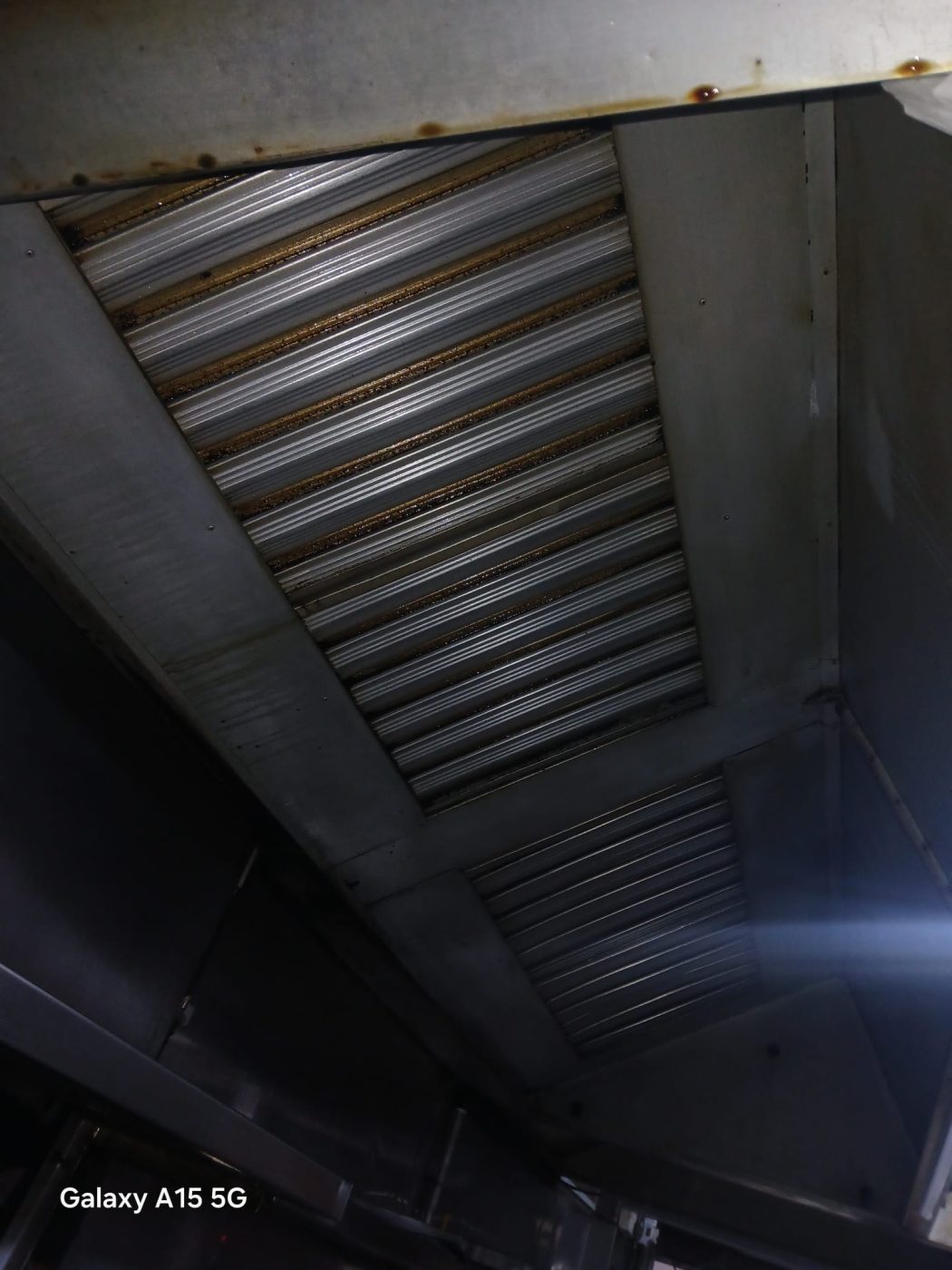
An electrostatic precipitator removes the fine grease aerosol that passes straight through hood baffle filters, by charging the particles and collecting them on oppositely charged plates. It is normally required where the exhaust discharges into a shared mall shaft, a mixed-use podium or close to neighbouring windows, rather than at a clear roof level. An ESP removes particles, not odour — gas-phase cooking smells need activated carbon and a properly located discharge point — and its performance falls away steeply if the collector cells are not cleaned on a schedule set by cooking volume.
Most kitchen exhaust problems are about getting air out of the kitchen. This one is about what that air is allowed to look like when it leaves the building.
If your kitchen discharges at roof level, on an industrial site, away from anyone, filters and a well-cleaned duct will usually do. If it discharges into a shared mall shaft, at a podium level with apartments above, into a courtyard, or anywhere a neighbouring tenant's windows are, then what comes out of the fan becomes somebody else's problem — and the fix is air treatment, not a bigger fan.
An electrostatic precipitator, always shortened to ESP, is the usual answer to the visible half of that problem.
Grease leaves a wok or a fryer as an aerosol — droplets small enough to stay suspended in the air stream. Baffle filters in the hood catch the larger ones by making the air change direction sharply, but the finest fraction goes straight through. That fraction is what you see as a haze at the discharge point, and what settles on the roof, the parapet, the neighbour's aircon condenser and the car park below.
An ESP works in two stages. In the first the air passes through an ionising section where the fine particles pick up an electrical charge. In the second the charged particles pass between collector plates held at the opposite polarity, and they stick to the plates instead of leaving the building. Air passes through; the grease does not.
Because it works electrostatically rather than by physically straining the air, an ESP does this without adding the resistance that a filter dense enough to catch the same particles would add. That matters: a fan sized for a system is sized for a particular resistance, and adding a heavy filter bank to an existing system is a good way to lose the capture you already had.
In our experience the answer is decided by the discharge point and the neighbours, not by the menu.
Conversely, a standalone industrial canteen with a clean roof-level discharge and no one downwind is usually well served by proper filters, correct duct velocity and a disciplined cleaning schedule. An ESP is real capital equipment with a real maintenance commitment, and installing one where the discharge point does not require it is money that would do more good spent on the cleaning interval.
An ESP is not an appliance you install and forget. It is a component that has to be cleaned on a schedule, and its performance falls off steeply when it is not.
The collector cells fill with exactly what they were installed to catch. As they load up, three things happen in order: collection efficiency drops, so the haze reappears at the discharge point; the pressure drop across the unit rises; and eventually the loaded cells begin to arc, which shows up as a snapping noise, nuisance tripping of the unit, and — on a heavily loaded cell — a genuine ignition risk in the one place in the system where grease meets high voltage.
So the honest way to buy an ESP is to buy it together with the schedule that keeps it working. That means cells taken out and cleaned at an interval set by how hard the kitchen actually cooks, the pre-filters upstream kept in service, and the whole duct still cleaned properly — because an ESP does not remove the need to clean the ductwork behind it. We set out what a proper clean covers in what a kitchen exhaust cleaning service should include, and why the interval is set by cooking volume rather than the calendar in how often a commercial kitchen exhaust needs cleaning.
This is the single most common misunderstanding we meet, and it causes real disappointment after real money has been spent.
An ESP removes particles. Cooking odour is largely gas-phase — volatile compounds that are not particles and pass through the collector plates untouched. A kitchen that installs an ESP because a neighbour complained about smell will often find the visible haze gone and the complaint unchanged.
Odour is dealt with further along the treatment train: activated carbon to adsorb the gas-phase compounds, ultraviolet treatment ahead of it in some configurations, and — before any of that — the discharge point itself, because where and how high the air is released frequently matters more than what is fitted inside the duct. We go through that whole argument in what to do about neighbour odour complaints, and the UV half of it in germicidal UV systems in kitchen exhaust.
The right way to think about it: the ESP handles what people can see, carbon handles what they can smell, and the hood and duct design handle whether either of them gets the chance to work.
An ESP is sized for an air volume and for a velocity range through the cells. Both come from the system it sits in, which means an ESP inherits every problem upstream of it.
If the kitchen has no deliberate make-up air path, the whole system moves less air than it was designed to and the numbers the ESP was selected against were never real — that argument is set out in make-up air and air balancing. If a variable speed drive turns the fan down at prep hours, the velocity through the cells changes with it, and the control strategy has to account for that rather than being set by whoever last adjusted the panel. And if the hood is not capturing at the source, the ESP simply never sees the grease that ended up on the ceiling instead.
Air treatment is the last stage of a system, and it can only be as good as the stages ahead of it.
We supply and install cylindrical honeycomb electrostatic air cleaners, ESP hoods, ducted UV-C emitters and carbon banks, and we design, fabricate, install, clean, repair and maintain the whole system in-house — hood, ductwork, fan, make-up air, controls and air treatment together. All work complies with NEA, SCDF, BCA and bizSAFE standards, and we run a 24/7 standby service, so a tripping ESP on a Saturday night is a call rather than a closed kitchen.
We would rather tell you an ESP is not what your problem needs than sell you one. If the discharge point requires it, we will size it against the system that is actually there, put the access to service it into the design, and price the cleaning schedule with it so it is not a surprise a year later. The full picture of how the parts fit together is on our commercial kitchen ventilation systems page, and the end-to-end route from concept to commissioning on design and build.
Tell us where the kitchen is, what you cook, how many hoods you run, and what is being complained about — visible deposits, smell, or a unit that keeps tripping. We will tell you which of the three you actually have.
WhatsApp 8989 2833 for an air treatment assessment →
Also worth reading: baffle vs mesh hood filters — what each type does, and how the wrong one ends up in the frame.
Related: an ESP in a recirculating hood is doing a different job from one at the end of a duct — see going induction or all-electric: what changes in your kitchen exhaust.
We design, clean, repair and maintain commercial kitchen exhaust systems across Singapore — on 24/7 standby.