
09 Oct 2026 · Maintenance
To replace a damaged baffle filter, measure the filter face (width and height), its thickness and the opening it slides into, mark which edge is the bottom and the gutter side, and photograph it with a tape in the shot. Order the same type as the rest of the bank, not a cheaper mesh panel that merely fits, and until it arrives use a spare set rather than covering the opening.
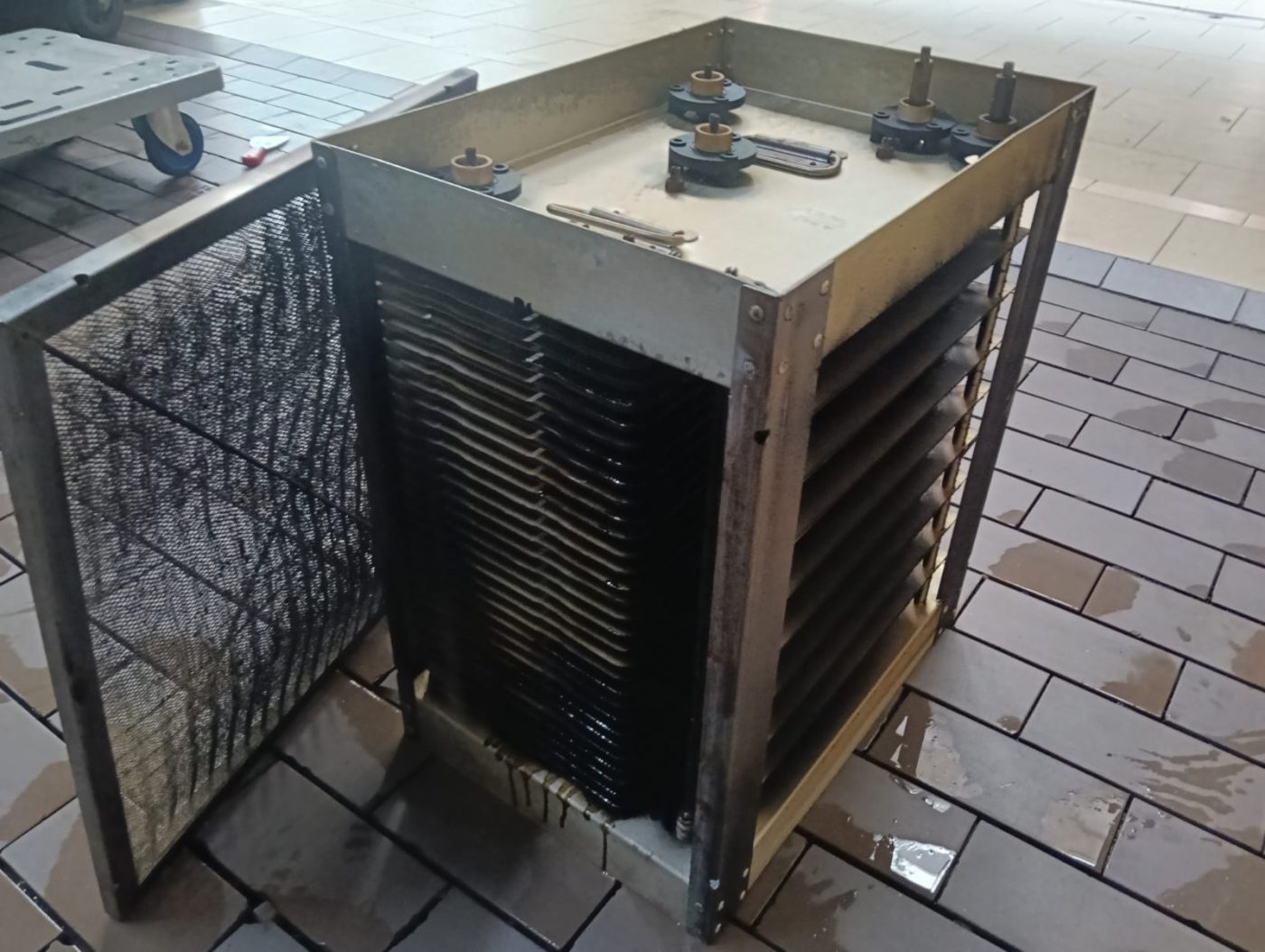
Pictured above: a removed mesh pre-filter panel beside the electrostatic unit it protects, both coated in grease, on one of BC Air’s jobs. It is not a baffle filter. It is reused here because it shows what every kitchen filter is: a framed, removable panel with its own dimensions that has to be matched exactly when one needs replacing.
It happens at the sink. A baffle filter slips, gets dropped on the floor, or is levered out of a tight frame with a screwdriver, and now one panel in the bank is bent. Or a filter walked off after a cleaning night and nobody can say where it went. The kitchen opens in a few hours. Someone has to order a replacement, and the person who has to order it usually has never measured one.
This is a practical guide to that moment: what to check on the damaged filter, what to measure, what to photograph and send, and what to do about the gap in the meantime. It is written for the operator or kitchen manager, not the engineer. It does not give a price, because the right filter depends on the hood it sits in, and we quote after seeing the details.
Not every dent means a new filter, and not every clean-looking filter is a good one. A baffle filter works by making the air change direction sharply, two or three times, in a short distance, so that grease droplets hit the metal and run down into the grease gutter. That only works while the channels keep their shape. So the test is about geometry, not about looks.
A filter that has been dropped, or bent from being levered out, no longer holds its channel geometry and no longer turns the air the way it should. If yours fails any of the four checks above, treat it as out of service, not as a filter with a cosmetic mark. Ask whoever services it whether a bent-back filter is worth keeping; a filter that has been bent and straightened again may not turn the air the way it did when new.
The most common wrong order is a filter that is nearly the right size. In a hood designed for baffles, a panel that is a little small drops into the runners and looks fine from the floor, but leaves a gap that lets air, and the grease in it, bypass the bank entirely. So measure, and measure the opening as well as the filter.
If you do not trust the numbers, do not guess. Measure twice, and photograph the tape against the filter. Then compare your numbers with a neighbouring filter that is still good: panels in a bank are often the same size, and if the damaged one measures differently from its neighbours, find out why before you order.
A contractor can narrow the answer quickly from a handful of pictures, and a vague message turns into a day of questions. Send these:
Add one line on what the kitchen cooks and how many hours the line runs. A wok and deep-fry line loads a bank much faster than a bakery, and that informs how soon the rest of the filters should be looked at too.
Whatever is ordered must be the same type as the rest of the bank. A mesh panel will often fit the runners of a hood built for baffles, and it is often cheaper, which is exactly how mismatched banks happen. Mesh holds the grease it captures instead of draining it, so it gets steadily more restrictive. A different type of filter also changes the resistance across the hood, and the fan and duct were sized around the original. Our comparison of baffle against mesh hood filters explains where each belongs.
If the filter in your hood is not a plain baffle, say so when you send the details. Do not assume a replacement of a different design is a like-for-like swap.
This is the part that matters most tonight. A missing or unseated filter is not a cosmetic problem: it is a straight, unobstructed path into the plenum behind the bank, for the whole of a service. We covered where that grease goes in what sits behind the baffle filters. So until the replacement arrives:
If there is no spare and no replacement before service, the honest answer may be to hold the appliance under that position, or that part of the line, until the filter is in. That is a business decision, and it is better made on purpose than by default.
When one filter is damaged, the others have usually been handled the same way. While the bank is open, take a minute to look at all of them: any with a bent corner, a frame that no longer sits square, a gutter edge crushed. And look at what is behind the empty slot. A damaged filter that has been sitting at a poor angle may have let grease through for weeks, so the plenum behind it can be worse than the rest. Our guide to a fault found during an exhaust clean is a good way to decide what to do now and what to book.
Replacing consumables such as baffle filters is part of our maintenance programmes, alongside the chemical clean, the mechanical checks and the documented report after each visit. If you are not on a programme, send us the details above and we will tell you what is involved.
We do not give a figure over the phone for a filter, or for anything else, without seeing the system. We survey the kitchen and quote from what is there. Send the measurements and photos below and we will tell you what is involved.
A damaged baffle filter is replaced when its channels, frame or gutter edge no longer hold their shape. Measure the filter face, the thickness and the opening it sits in, mark which edge is the bottom, and photograph the lot with a tape in the shot. Order the same type as the rest of the bank, never a cheaper panel that merely fits. Until it arrives, use a spare set, never cover the opening with something improvised, and tell whoever is ordering that the hood is cooking with a gap.
If a filter needs replacing and you want to be sure the new one is right, WhatsApp BC Air on 8989 2833 with the measurements and photos and we are on standby 24/7.
Related reading: baffle against mesh hood filters · behind the baffle filters · the daily routine for kitchen staff
We design, clean, repair and maintain commercial kitchen exhaust systems across Singapore — on 24/7 standby.