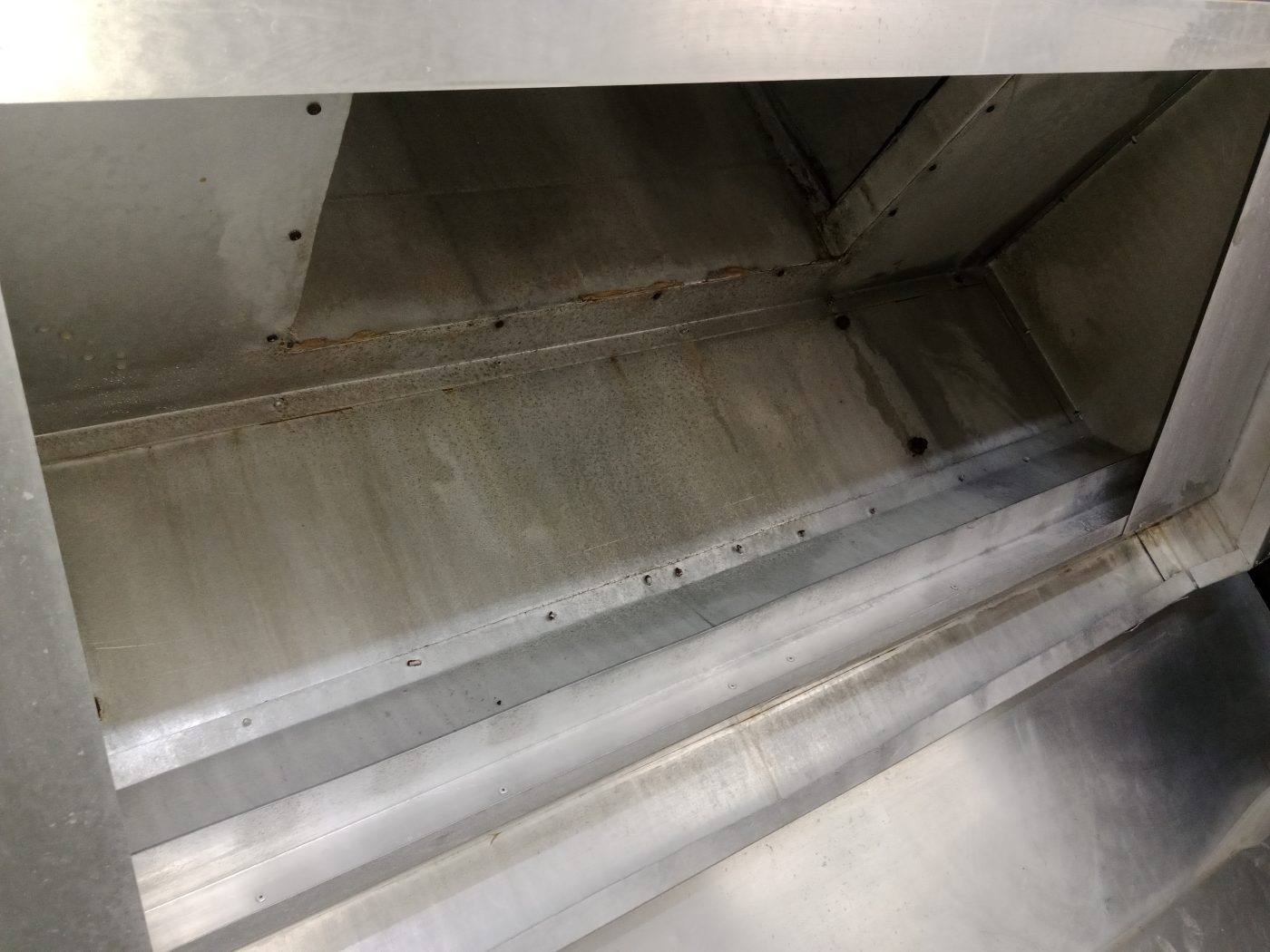
Pictured above: the inside of a kitchen hood at one of our projects (Tony Cafe, Adelphi), with the filters out. The channel along the lower edge is where grease drains to when the filters do their job, and it is the first place spilt oil ends up on a fryer clean-out day. It is not a fryer. It is reused here because it shows the part of the hood that takes the consequences.
Most of the time a fryer is a steady load on the hood. Once a week, or whenever the oil is due, it stops being steady. The oil is drained, filtered or topped up, the vat is cleaned out, the surrounding surfaces get wiped, and a lot of this happens quickly, between services, by whoever is available. The hood has to cope with all of it and nobody plans for that.
The complaints that follow are familiar. The hood smokes more than usual while the oil heats back up. A fresh film of oil shows on the front of the hood and on the filters. Something drips from the canopy edge the next morning. The kitchen smells of hot oil for hours. We do not run your fryers and we are not going to tell you how to manage your oil. This post is about the exhaust side: what an oil change or clean-out day does to the hood, what is worth doing on the day, and what to look at afterwards.
Why the day is harder on the hood than a normal service
A fryer sends fine grease droplets up into the hood all day. That is normal, and it is what the baffle filters, the grease channel and the cleaning schedule are for. A clean-out day changes three things at once.
- Oil is being moved, not just heated. Hot oil poured, drained or carried between containers gives off vapour and splashes. Some of it lands on the floor and the front of the hood, and some is drawn up into the filters as a heavy, wet load rather than the usual fine mist.
- The line is often half-working. One fryer is down while the rest of the line keeps cooking, so the plume under the hood is different from the one the hood was set up for. Capture can be weaker at the end where the fryer normally sits.
- People are in a hurry and in the way. Pans, bins and filter trays get parked under or beside the hood, a door is propped open for the oil container, and a pedestal fan comes out to cool the person doing the job. Each of these affects how the hood captures. We have written about a fan blowing across the cooking line and about a hood that runs but still leaves the kitchen smoky.
Oil that has been in use for a long time also tends to smoke earlier and more heavily when it is heated, so the stretch just before an oil change is often the smokiest part of the cycle. If the hood looks worst the day before the change, that is a clue about the oil, not necessarily about the fan.
What to do on the day
- Keep the exhaust fan running throughout. Not just while the fryer is hot. Hot oil gives off vapour well after the cooking stops, which is the same reason we say to leave the fan on after the last order. Do the clean-out with the fan on and the make-up air path clear, and switch the fan off only when the work is finished and the oil has cooled.
- Do not pull the filters for a wash while an open fryer is hot underneath. A hood with empty filter frames over a vat of hot oil is exactly what we describe in the daily staff routine: a straight path for grease into the plenum and the duct. Wash the filters before or after the oil work, with a clean set ready to go back, so there is never a moment when the line is running with gaps.
- Keep the area under and in front of the hood clear. No stacked trays, bins or oil containers pushed up under the canopy. Anything under there changes where the air goes, and an oil container left under a hot hood is a fire load.
- Do not use the hood as a drain. Spilt oil and used oil do not go into the grease channel, the grease cup or the hood's drain point. Those are for what the filters catch in normal service. Fryer and dish wastewater belongs on the grease trap side of the kitchen, which is a separate system, as we explain in grease trap against grease ductwork.
- Wipe the oil film off the hood front and the filter faces before cooking again. A wet, oily filter face is a heavy load on its first night and can start dripping within hours. If oil has been splashed onto the filters, take those filters out and wash them, then refit them the right way round, with the drain edge down towards the grease gutter.
- Wait before you switch the fryer back on. A fryer heated up while the hood front is still wet with oil gives you the smoke and the drips in one go.
What to look at the next morning
Do this with the system off and the cooking cold, the same way as the checks in our guide to grease dripping from the hood.
- The grease cup and gutter. Is there more in there than on a normal day, and is it a heavy fresh load? Empty it before it overflows.
- The filters, all of them. In place, drain edge down, no gap at either end, no bent frame from being levered out in a hurry.
- The front and underside of the canopy edge. A bead of grease forming on the lower edge is the start of a drip.
- The floor and the wall behind the fryer. Oil walked across the floor can end up on the access panel and the base of the duct.
- The air. On the first busy service after the change, watch the plume from the cook's position. If smoke now rolls out of the front of the hood at the fryer when it did not before, tell whoever services the system, because something moved.
When it is not just oil day
If the hood struggles on oil day and also on an ordinary busy night, the clean-out is only showing you a problem that is already there. The usual causes are the ones we list elsewhere: a hood that has gone longer than it should without a clean (most commercial kitchens need the exhaust cleaned every 1 to 3 months, with heavy wok, grill and deep-frying kitchens often monthly and lighter kitchens quarterly, and the interval is set after we inspect the system), filters that are loaded or damaged, or a fryer that has been replaced with a bigger one or moved to the open end of the line.
That last point matters for more than smoke. Fire suppression nozzles are aimed at specific appliances in specific positions. If a fryer has been swapped, added or moved, ask whoever services the suppression system to check that the nozzles still sit over what they were set up to protect, and that the gas shut-off arrangement still matches the line. We cover that in gas and fire suppression interlocks and adding cooking equipment to an existing hood, and the case of a kitchen built around a fryer and griddle is in small kitchens with a fryer and griddle.
Getting it looked at
If the hood smokes, drips or struggles on oil change day, or on any other day, WhatsApp BC Air on 8989 2833 with the number of fryers, what else is under the hood, the hours the line runs, what happens on oil change day, and a photograph of the hood front and the filters. We will tell you what a first visit would need to check. We run a 24/7 standby line. We give no price in a post: it depends on the kitchen and is quoted after we see it. For the cleaning side, see our kitchen exhaust cleaning page.
The short version
- Oil change and clean-out day puts a wetter, heavier load on the hood than a normal service, usually while the line is half-working.
- Keep the fan on throughout, never run the line with filters out over hot oil, and keep the space under the hood clear.
- The grease channel and cup are not a drain for spilt or used oil.
- Wipe the oil film off the hood front, wash any oily filters, and refit them drain edge down.
- If a fryer has been replaced or moved, have the suppression nozzles and gas shut-off checked against the new position.
Related reading: what a kitchen team does daily to keep the deep clean cheaper · grease dripping from the hood · how long to leave the fan on after the last order · a fryer and griddle in a small kitchen
Questions
Common questions
Should the exhaust fan stay on while the fryer oil is being changed?
Yes. Hot oil keeps giving off vapour while it is being drained or moved and for a while after. Keep the fan running and the make-up air path clear, and switch it off only when the work is done and the oil has cooled.
Can I take the baffle filters out to wash them during an oil change?
Not while an open fryer is hot underneath. Empty filter frames over hot oil give grease a straight path into the plenum and duct. Wash them before or after the oil work and have a clean set ready to refit, drain edge down.
Can used or spilt fryer oil go into the hood's grease channel or cup?
No. The channel and cup are for what the filters catch in normal service, not a drain for spilt or used oil. Fryer and dish wastewater belongs on the grease trap side of the kitchen.
Why does my hood drip the morning after a fryer clean-out?
Usually oil that was splashed onto the filter faces or the canopy edge, a full grease cup or gutter, or a filter refitted wrongly. Check those with the system off and the cooking cold, then ask for a survey if it keeps happening.
I replaced or moved a fryer. Does the fire suppression need checking?
Ask. Suppression nozzles are aimed at specific appliances in specific positions, so a fryer that has been swapped, added or moved can end up outside the protection it was set up for. Have the nozzles and the gas shut-off checked against the new line.