
18 Oct 2026 · Design & Build
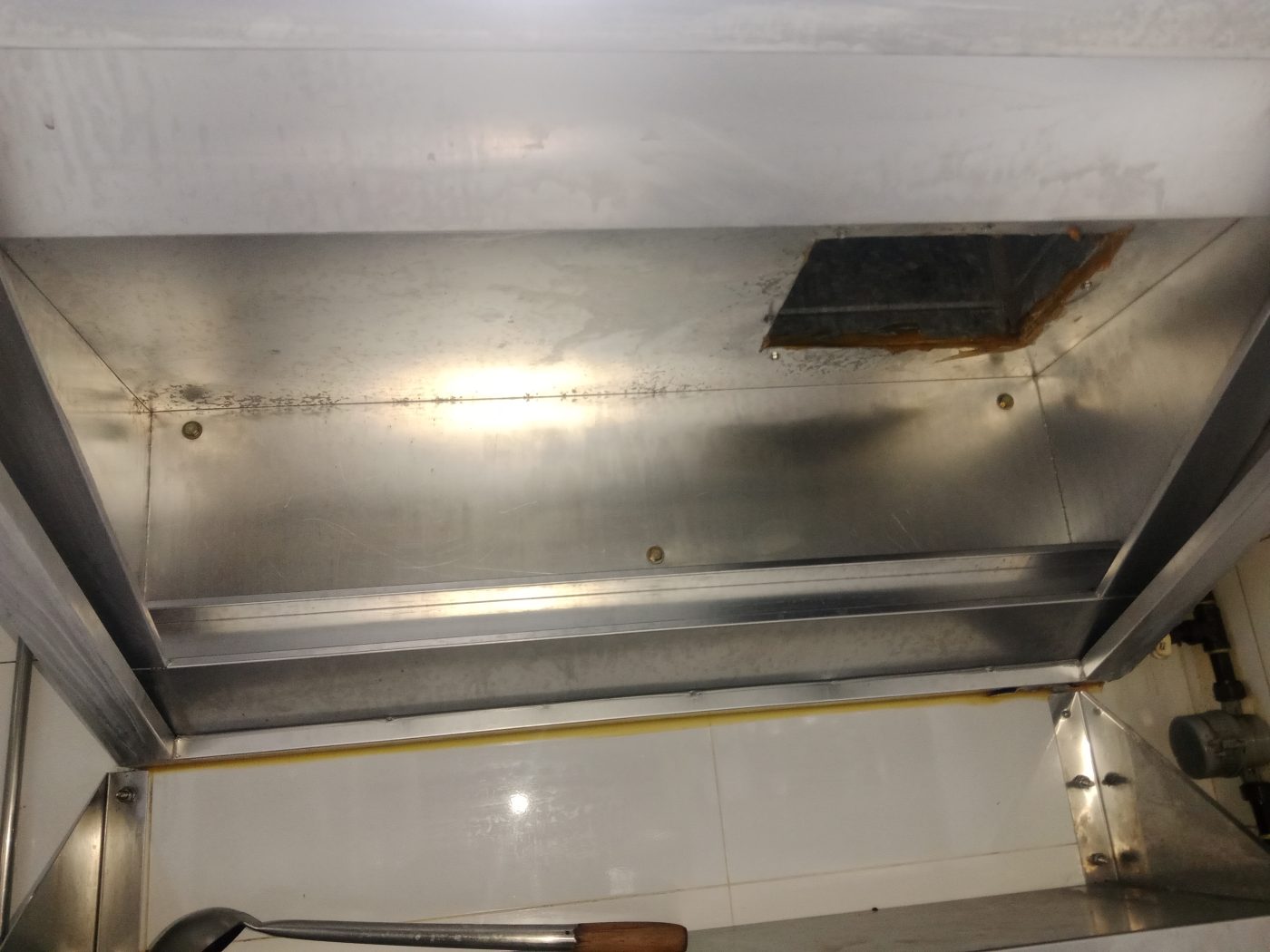
The kitchen exhaust a café needs depends on its equipment, not the word café. Coffee machines and steamers add heat and steam; a fryer or griddle adds grease, which needs a hood that reaches over it, a cleanable duct, a planned replacement air path and a fire-suppression check.
Pictured above: the inside of a hood canopy at a coffeeshop kitchen on one of our cleaning jobs (Heritage, Yishun). It is a small cooking line, and it has the same parts as a big one: a canopy, filters, an opening into the duct. A café kitchen is built from the same parts, and they work in the same way.
"Café" tells us almost nothing about the exhaust a kitchen needs. Two cafés on the same street can be very different. One makes coffee, plates cakes from a chiller and toasts a few sandwiches. The other runs an all-day brunch with eggs on a flat-top, fries in a fryer and bacon on the griddle. They have the same word on the signboard and a different kitchen behind it.
What decides the exhaust is the list of equipment, and what each appliance puts into the air. This post sorts a small café's usual equipment by that, and then sets out what to settle before you order a fryer or sign a lease.
The third group is the one that changes everything. A café with only the first two can be a lighter job. A café that adds one fryer has stopped being a light kitchen, whatever the menu card says.
A fryer holds a large volume of hot oil, and everything that goes into it sends grease up into the hood. Fries, chicken, tempura, anything battered. The grease does not care that the shop sells pastries as well.
That has three consequences, and none of them depends on the size of the shop.
Eggs, bacon, burgers, pancakes. A flat-top spreads fat and moisture over a large surface, and the vapour and splatter go straight up. It is a lower and wider load than a fryer, but it is a grease load all the same, and it runs for long stretches at a brunch service. Treat it as a cooking line, not a warming plate.
Many café units are fitted out with induction or electric equipment. That can genuinely mean less heat in the room and no combustion gases. It does not take the grease out of the air, because grease comes from the food, not the flame. We went through what changes and what does not in induction and all-electric kitchen exhaust, including why a recirculating hood is a conversation to have with the landlord and the relevant authorities before the layout is built around one.
A café is usually an air-conditioned room with a kitchen at one end. Every cubic metre the exhaust fan removes has to be replaced from somewhere. If nobody has planned where, the kitchen takes it from the dining room and from the front door, which is how a café ends up with cold customers, a warm kitchen and a door that is hard to push. That is a make-up air question, set out in make-up air and air balancing, and it is much easier to settle on a drawing than after the shop is open.
On our cleaning frequency page we set out the NFPA-96 framework that the industry works to. Inspection intervals run from monthly for solid-fuel cooking down to annually for low-volume operations: seasonal, day camps, places of worship. A café that fries or griddles all day is not described by that last line. In practice most Singapore F&B kitchens fall in the monthly-to-quarterly range, and we set your interval after inspecting the hood, duct and fan against what you actually cook and for how many hours.
Two things to ask whoever cleans it. First, that the scope covers the plenum, the duct and the fan, not just the filters in a sink. Second, for dated before-and-after photographs, which every clean we do includes, and which are what you show a landlord or an auditor. Our 10-point servicing checklist is there to check any contractor's scope against, ours included.
The common route is slow. The café opens with toasties and cold dishes, sells well, and a fryer is added for fries, then fried chicken. The hood and fan were chosen for the first menu. We wrote about the point where that stops working in when a menu change outgrows the exhaust, and about what to check when you bolt a new appliance onto an existing line in adding equipment to an existing hood.
If there is any chance the menu will grow, say so at the start. It is cheaper to design for the fryer you might buy than to rebuild around the fryer you did.
Many cafés open in a shop or office unit that has no hood, no duct and no route out of the building. That is its own set of questions, and they come before the equipment list: where the air goes out, whether the duct can reach it, and what the landlord allows. They are set out in turning a retail or office unit into an F&B kitchen.
We do not publish a price for exhaust design and build, because a meaningful figure depends on the cooking line, the duct route and the discharge point. We survey, then quote against a scope. Cleaning is quoted after we have seen the system.
Opening a café, or adding a fryer or griddle to one that is already trading? WhatsApp BC Air on 8989 2833 with your location and the equipment you have in mind, and we will tell you what the exhaust needs before you commit. How we design and build systems is on the design and build page, suppression on the fire suppression page, and cleaning on the exhaust cleaning page. Scope and pricing follow a site survey.
Related reading: when a menu change outgrows the exhaust · adding equipment to an existing hood · turning a retail or office unit into an F&B kitchen
We design, clean, repair and maintain commercial kitchen exhaust systems across Singapore — on 24/7 standby.