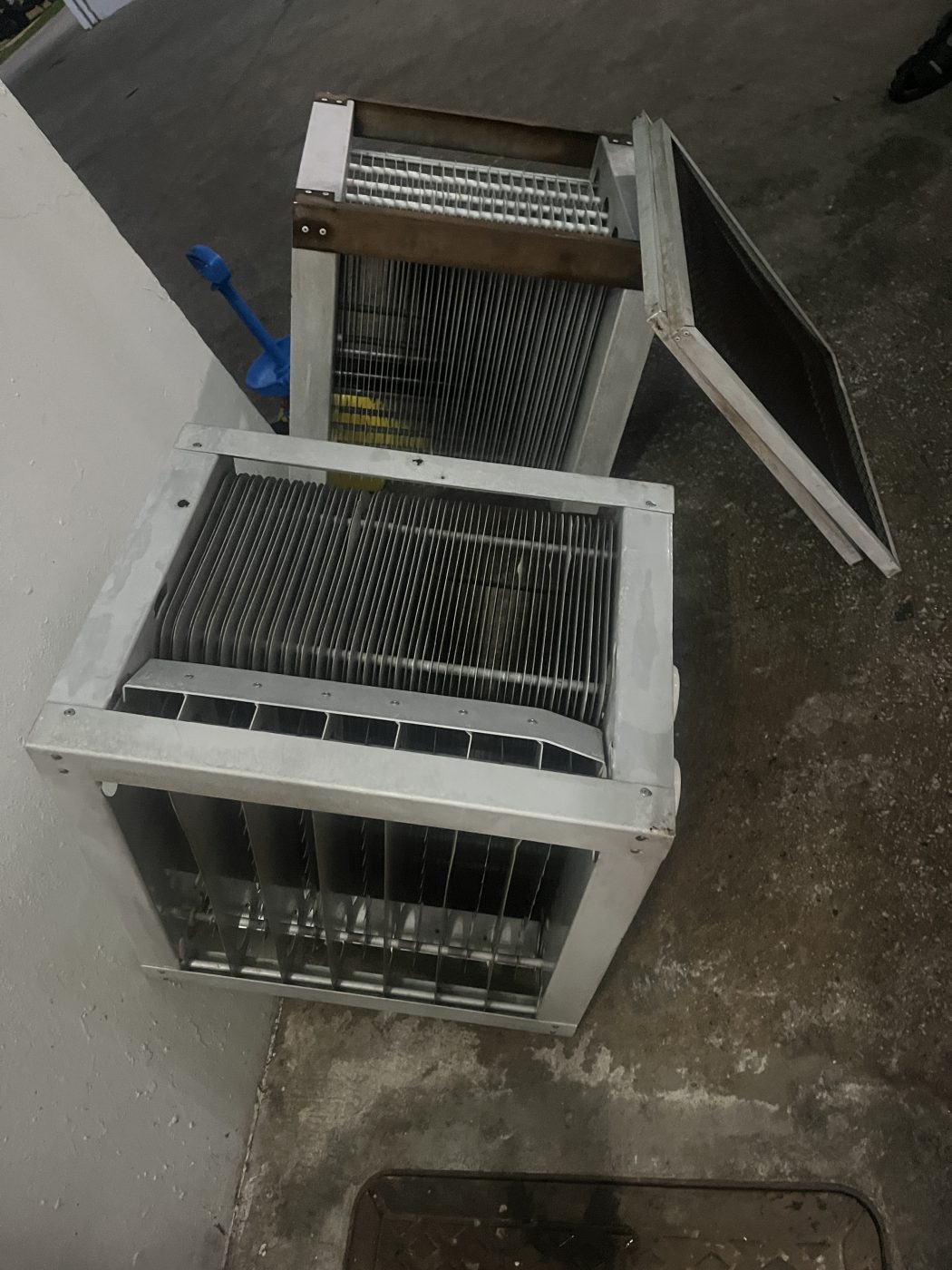
Pictured above: two electrostatic cells taken out of a kitchen exhaust for cleaning, on one of our projects (Khan Saab, Chai Chee). They are not a hood and not a carbon bank. They are reused here because they sit on the fine-aerosol side of the system, the part of the air that is not a smell and not a visible plume, and that is exactly the part chilli-heavy cooking makes people complain about.
The complaint usually does not sound like a ventilation complaint. The cook says his eyes are stinging. Someone on the line keeps coughing when the sambal goes into the wok. The dining room smells fine, the hood looks clean, the fan is roaring, and still every time a batch of chilli hits hot oil the whole line turns its face away.
The instinct is to blame the smell and go shopping for odour control. In most kitchens that is the wrong end of the system to start at. This post explains why chilli, sambal and spice-heavy cooking feel so much worse than their grease load would suggest, how to tell which link in the exhaust is letting it through, what you can check yourself today, and what to send us when you want it looked at. It gives no price and no fixed interval, because both depend on the kitchen and are set after we see it.
Why spice-heavy cooking feels worse than it looks
Chilli, dried spice paste, sambal and curry bases are fried, not just heated. Most of the work happens in hot oil, at the wok, on the griddle or in the tempering pan, and the oil is what carries the sting into the air. What leaves the pan is a mix of oil vapour, a fine oil mist and steam, and the part of it that irritates eyes and throats rides along in the mist and the vapour.
Three things follow from that, and each one explains a complaint we hear.
- It reaches the cook first. The cook stands closest to the plume. If the hood does not capture it at the pan, the first people to breathe it are the people working under the hood, not the neighbours.
- It does not behave like a heavy grease droplet. Baffle filters catch larger droplets by making the air turn sharply, and the finest fraction goes straight through. We went through why in what sits behind the baffle filters. A fine mist that gets past the filters is not stopped by them and has to be carried away by the air.
- It is a capture problem before it is an odour problem. A smell you notice in the dining room or the back lane is the end of the story. A sting at the wok is the start of it. Odour treatment downstream, such as the stage in our post on carbon banks, does nothing for a cook whose eyes are streaming at the hood, because the air never reaches it.
Work out where it stings
The single most useful question is where people notice it. Write down the answer before anyone calls anyone, because it points at a different link in the chain each time.
- At the cooking station, on the cook. The hood is not holding the plume. Look at capture: the overhang and height of the hood over that wok, anything blowing across the line, the fan running slower than it should, or a kitchen starved of replacement air.
- Across the whole kitchen, at the back of the line and at the pass. The plume is escaping the hood and spreading, or the room is under negative pressure and air is being dragged in the wrong way. Make-up air is the usual suspect.
- In the dining room or the shopfront. Smell or sting is coming back in, either from a capture problem that is spilling forward or from the discharge point returning air to a place it can re-enter. Our post on cooking smell in the dining area while the exhaust is running goes through where it comes from.
- Outside, at a neighbour, in the back lane or on the roof. This is the discharge and treatment end. Where the duct terminates, and what stages sit before it, decide this, and we covered it in where your kitchen exhaust actually discharges.
If your answer is number 1, spend nothing on odour treatment yet. That is the commonest mistake: a staff-sting problem treated as a neighbour-smell problem.
Six checks you can make today
None of these needs a tool or a ladder, and none involves opening anything. Do them with the line running and the kitchen as bad as it gets.
- The open-door test. With the kitchen at its worst, open the back door or a window. If the air clears noticeably within a minute or two, the extraction is probably fine and the kitchen is starving for replacement air. That points at make-up air, which our post on a running exhaust that is still smoky covers in full.
- Stand where the cook stands and watch the plume. Does it rise into the canopy, or does it roll out from under the front edge and past the cook's face? A plume that escapes at the front is a capture problem at that station.
- Look for anything blowing across the line. A pedestal fan aimed at a hot cook, a split unit blowing across the pass, a propped door making a through-draught. A rising plume is fragile, and a modest side current tips it out from under the hood. We covered this in a fan or air-con blowing across the cooking line.
- Find out what the fan is set to. If the fan runs on a variable speed drive, ask whoever commissioned it what speed it is set to during service, and whether anyone has turned it down to save energy or quieten it. Ask for the answer in writing. A fan that has been slowed down can run with a perfectly clean hood and still leave the cook in the plume.
- Check the date of the last clean, and what it covered. The published pattern is that most commercial kitchens need cleaning every 1 to 3 months, with heavy wok, grill and deep-frying kitchens often monthly and lighter kitchens quarterly, set after inspecting the system. A loaded baffle bank, plenum or duct restricts the air that is supposed to be carrying the mist away. Ask your report whether the fan and the filters were included.
- Look at the make-up air grilles. Our servicing checklist lists make-up air grilles cleaned and checked as one of its ten items, because exhaust only works when replacement air can get in. A blocked grille makes the whole system weaker.
The menu changed, the hood did not
A common pattern behind this kind of complaint is not a failure. It is a kitchen that was ventilated for one menu and is now cooking another. A line that was designed around light frying and steaming gets a sambal wok, a mala pot, a curry station with a long tempering step, and nobody revisits the hood. The same thing happens when equipment moves or a new burner goes in.
That is the situation covered in when a menu change outgrows your kitchen exhaust, and it is worth asking the same question here: has the cooking under this hood changed since the system was sized? If it has, the survey has to look at the cooking line as it is now, not at the drawing.
What not to do
- Do not turn the fan up and walk away. A faster fan in a kitchen without enough replacement air mostly makes the doors harder to open and the plume less stable.
- Do not order carbon, or an electrostatic unit, as a first move. Those are treatment stages for the air that has already left the hood. They suit a discharge problem and they depend on clean stages upstream. Our post on electrostatic precipitators explains when one is actually needed.
- Do not skip the clean because the hood looks clean from the floor. What matters sits behind the filters, in the plenum, duct and fan.
What to send us
You do not need a diagnosis. A few facts and photographs let us narrow it before anyone visits.
- Where it stings: the cook, the whole kitchen, the dining room, outside.
- What is being cooked when it is worst, and how many hours the line runs.
- A photograph of the hood from the front and of the cooking line under it.
- Anything blowing across the line, and where the make-up air comes in.
- The date and the report of the last exhaust clean.
- Whether the menu or the equipment has changed since the kitchen was set up.
We do not give a figure over the phone for a ventilation fix, or for anything else, without seeing the system. We survey the kitchen and quote from what is there.
Getting it looked at
WhatsApp BC Air on 8989 2833 with where it stings, what is being cooked and a photograph of the hood, and we will tell you what a first visit would need to check. We run a 24/7 standby line. For the cleaning side, see our kitchen exhaust cleaning page, and for balancing and airflow work see ventilation, CFD and air balancing.
The short version
- A sting at the wok is a capture problem first. A smell at the neighbour is a discharge problem. Work out which you have before buying anything.
- Spice and chilli cooking is fried in hot oil, and the mist and vapour that carry the irritant get past baffle filters, so the hood has to hold the plume.
- Try the open-door test, watch the plume from the cook's position, look for cross-draughts and ask what speed the fan is set to.
- Check the date and scope of the last clean, and whether the fan and filters were included.
- If the menu has changed since the hood was sized, say so before the survey.
Related reading: the exhaust is running but the kitchen is still smoky · a fan blowing across the cooking line · carbon banks and the smell that comes back · make-up air and air balancing
Questions
Common questions
Why do chilli and sambal make the kitchen so much worse than other cooking?
They are fried in hot oil, and the oil vapour and fine mist carry the irritant into the air. Baffle filters catch larger droplets and the finest fraction passes through, so the hood has to hold the plume at the pan. If it does not, the cook is the first person to breathe it.
Will a carbon filter stop my staff coughing at the wok?
Probably not. Carbon is an odour stage for air that has already left the hood, and it depends on clean stages upstream. A sting at the cooking station points first at capture, airflow and make-up air, so check those before buying odour treatment.
What is the open-door test for a smoky or stinging kitchen?
With the kitchen at its worst, open the back door or a window. If the air clears within a minute or two, the extraction is probably fine and the kitchen is starving for replacement air, which points at make-up air rather than the fan.
How often should the kitchen exhaust be cleaned for a heavy wok or spice kitchen?
BC Air publishes that most commercial kitchens need cleaning every 1 to 3 months, with heavy wok, grill and deep-frying kitchens often monthly and lighter kitchens quarterly. The interval is set after inspecting the system and the cooking volume.
Does BC Air publish a price for fixing this?
No fixed figure is published. Scope and pricing follow a survey of your kitchen, because the cause could sit in capture, airflow, make-up air, cleaning or the discharge.