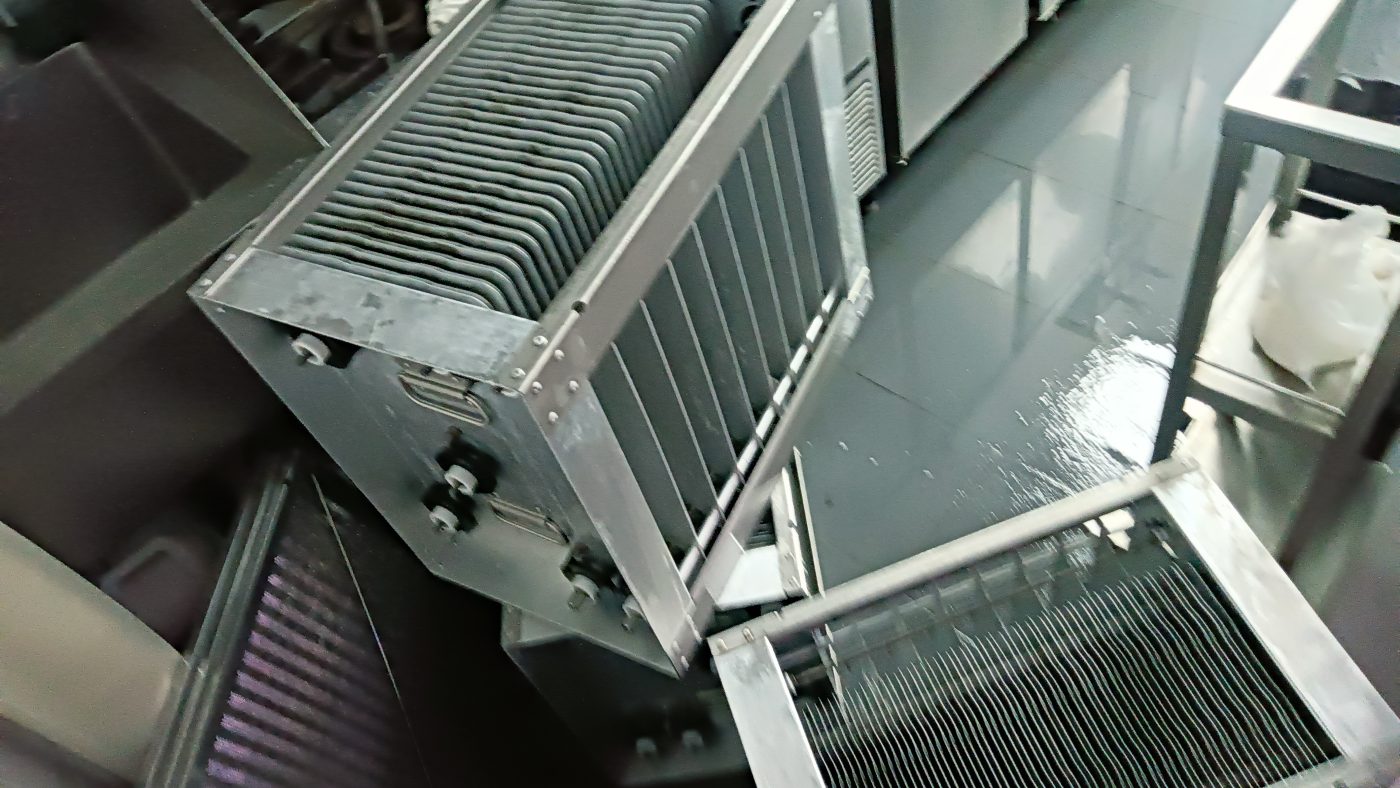
Pictured above: filter units lifted out of an exhaust system and set on the floor during one of BC Air’s projects (a Japanese restaurant at VivoCity). It was not a teppanyaki counter. We use it here because every iron-plate counter depends on the same part: the filters that stand between the plate and the duct.
You are planning a teppanyaki or iron-plate counter, or you have taken over one, and the hood over the plate is about to become the most visible piece of equipment in the room. Guests sit a metre or so from it. They can see the plate, the chef and the hood face. If the hood does not capture, they smell it and they see it, long before any inspector does. So the question is not only “does it pass”. It is whether the counter can run a full evening with guests sitting at it and still smell of food rather than of grease and smoke.
This post is for the owner or operations manager who is being asked to sign off a counter design, or who is dealing with one that already smokes. It covers what an iron-plate counter does to the air, what to settle before the plate is bought, and what the cleaning routine looks like when the cooking is done in front of the customer.
Why a plate counter is its own problem
A wok line throws grease up with the flame. A plate does something quieter. A large flat surface is held hot, oil and butter go onto it, food is seared, sauces hit the metal, and the plate gives off grease vapour and smoke across its whole area, continuously, for as long as it is hot. Three things follow from that.
- The source is wide and low. The hood has to capture over the whole plate, not over one burner. Whatever edge of the plate is not covered by the hood is where the smoke gets away.
- The guests are part of the layout. In a back-of-house kitchen a weak hood is a staff problem. At a counter the weak spot is at someone’s face. Open and show kitchens have this in common, and we cover the general version in ventilation for open-concept and show kitchens.
- The load is steady, not a spike. A plate that runs for the whole service puts grease into the filters and the duct at a steady rate. That is what decides how often the system needs cleaning, not the menu on paper.
The table-side version of the same issue, with extraction at every table, is in hotpot and Korean BBQ table extraction. A teppanyaki counter sits between a normal kitchen and that: a small number of heat sources, but in the dining room.
Five things to settle before the plate is ordered
These are cheaper to answer on paper than after the counter is built. Put them to whoever designs and supplies the counter, and write the answers down.
- How big is the plate, and does the hood cover all of it? Ask for the plate size and the hood size on the same drawing. A hood that is the right width but sits back from the guest side leaves the front edge uncovered.
- Where does the replacement air come from? Extraction only works if air can come in. A counter that extracts strongly in a room with no supply air pulls from the door gaps and from the air conditioning. Our make-up air and air balancing post covers the symptoms. A supply grille pointed across the counter can also push smoke away from the hood and towards the guests.
- Who owns the filters and the grease collection? Baffle filters have to come out to be cleaned and go back the right way round, and a counter chef is not usually thinking about that at the end of a service. Agree who pulls them, who washes them and who checks them. The light test for washed baffle filters is a simple check for whoever does it.
- What does the suppression system cover? A suppression system is positioned around the appliances that were there when it was commissioned. If the plate is bigger than the one it was designed around, or has been moved, the nozzles may no longer point where the hazard now is. See adding cooking equipment to an existing hood.
- How will the duct be reached for cleaning? A neat counter with a boxed-in hood is also a counter where the access panels end up behind a fixed panel. Have the panel positions shown on the drawing.
The gas, the plate and the interlock
Where the plate is gas-fired, the gas supply, the hood fan and the suppression system should be tied together so that a discharge cuts the fuel, and so the plate cannot be lit with the fan off. That wiring is the one nobody tests until it matters; we describe what to test in the wiring nobody tests. An electric plate changes the fuel question, not the grease question: the surface still gives off grease vapour, and the hood and the cleaning interval still matter.
What the first month tells you
A new counter is worth watching closely for the first few weeks, because that is when you learn what the design really does. Keep a short note, in your exhaust logbook, of the following.
- Does smoke drift past the hood edge at the guest side during the busiest hour, and which seats smell it?
- Do the filters look greasy by the end of one service? That tells you the load, and the washing routine should match it.
- Does the front door pull shut or whistle when the fan is at full speed? That points to replacement air, not the hood.
- Is there a smell at the counter after the plate is switched off? Grease on the filters, the hood face or the plenum behind the filters is the usual place to look.
Photographs on the same phone, taken at the same time each week, make a change easy to see.
Cleaning when the kitchen is the dining room
Our published guidance is that most commercial kitchens need the whole exhaust system cleaned every one to three months, and that heavy wok, grill and deep-frying kitchens often need monthly attention. We do not set an interval for a plate counter from a menu. We set it after inspecting the system and seeing what actually builds up, because a counter that runs hard every night can need more than one that runs lightly. The method behind that is in how often a commercial kitchen exhaust must be cleaned.
Two practical points about a counter specifically:
- The hood face is part of the room. Guests see it. A greasy hood face is the first thing a guest notices, so wiping the visible stainless is a daily job, but it is not a substitute for cleaning the plenum and the duct behind it.
- Book the clean for after the last guest. We routinely schedule cleaning overnight or in closed periods so the counter is ready when you open, and every clean comes with before-and-after photographs for NEA, SCDF, your landlord or your auditor.
Taking over an existing counter
If you are taking over a unit that already has an iron-plate counter, do not assume the previous design was right. Ask for the last cleaning record, look at the hood from the guest side while the plate is hot, count the filters against the slots, and find out who last serviced the suppression system. A counter that was fitted for a smaller plate is a very common reason for a hood that never quite captures. If anything looks wrong, a site survey comes first, and the scope and the price follow it.
WhatsApp BC Air on 8989 2833 with the location, the plate size and fuel, and what you see at the counter. A photo of the hood from the guest side helps. We are on 24/7 standby, and scope and pricing follow an inspection.
The short version
- An iron plate gives off grease vapour across its whole surface for as long as it is hot, and the guests sit right next to it.
- Settle the plate size against the hood, the replacement air, the filter routine, the suppression coverage and the duct access before the plate is ordered.
- Watch the first month and write down what you see.
- Clean the whole system on an interval set after inspection, not from the menu alone.
- Taking over a counter: check the hood from the guest side, the last clean and the suppression record.
Related reading: open-concept and show kitchens · table extraction · commercial kitchen ventilation systems
Questions
Common questions
Does a teppanyaki counter need a different exhaust from a normal kitchen?
It needs the same parts (hood, filters, duct, fan and replacement air), but the layout is less forgiving. A hot plate gives off grease vapour across its whole surface and the guests sit next to the hood, so a weak edge or a bad supply-air draught shows up at a guest's seat, not just in the back of house.
What should the hood cover on an iron-plate counter?
The whole plate. Ask for the plate size and the hood size on the same drawing and check that the guest-side edge is covered, because a hood that sits back from the front of the plate lets smoke escape toward the seats.
How often should the exhaust of a teppanyaki counter be cleaned?
BC Air's published guidance is that most commercial kitchens need the whole exhaust system cleaned every one to three months, and heavy wok, grill and deep-frying kitchens often monthly. For a plate counter the interval is set after inspecting the system and seeing what builds up, not from the menu alone.
Does the fire suppression system cover a new or larger plate?
Not automatically. A suppression system is positioned around the appliances present when it was commissioned, so a larger or moved plate should be checked against where the nozzles point.
The counter smells of grease after the plate is switched off. Where should I look?
Start with the baffle filters, the grease cup and the hood face, then ask when the plenum behind the filters and the duct were last cleaned. Also note whether the front door pulls shut or whistles, which points to replacement air rather than the hood.