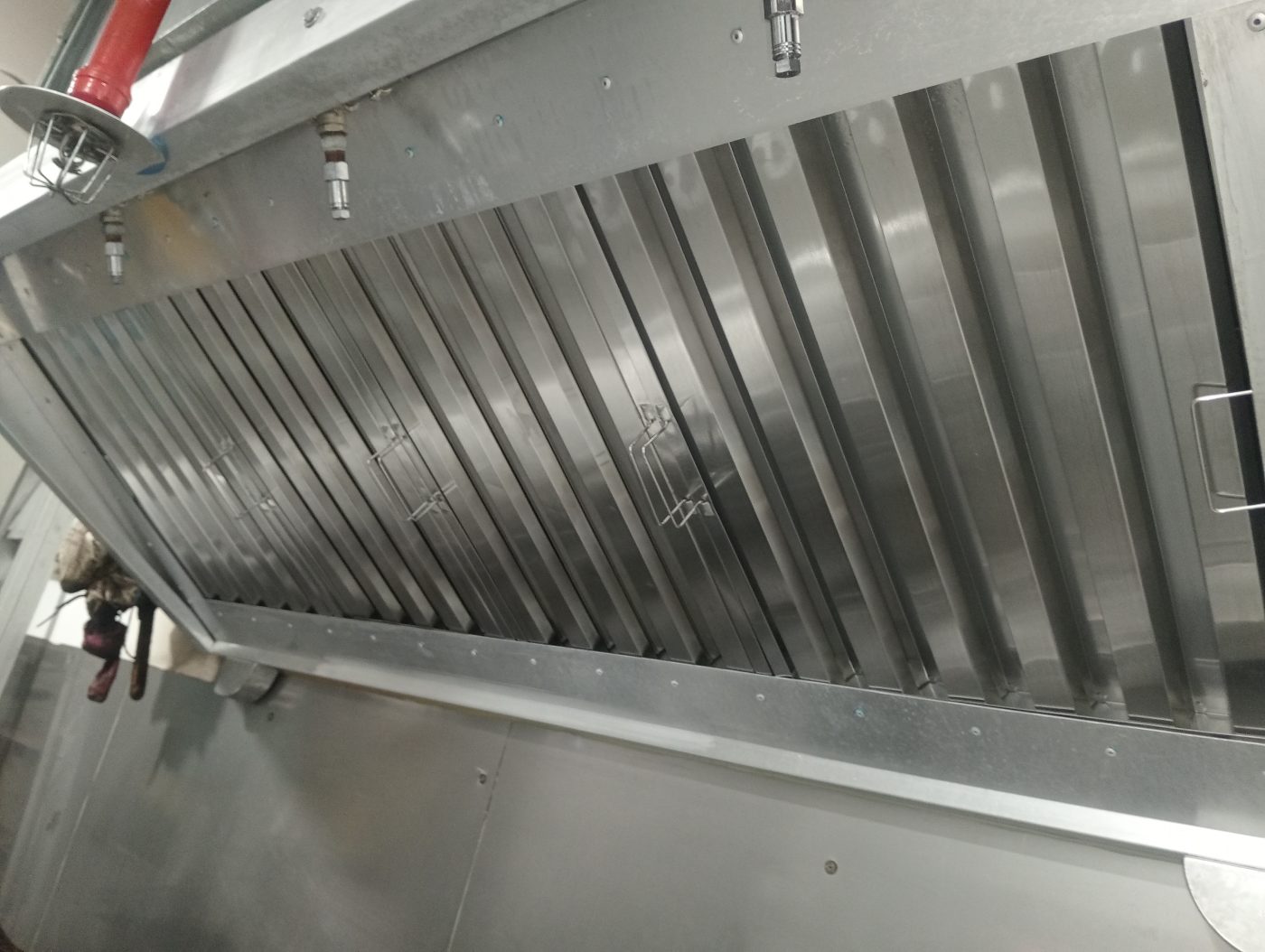
Pictured above: a new hood we installed for a steakhouse at Capitol (Stirling Steaks), with the baffle filter bank and the suppression nozzles above it in view. It is a new installation, not a cleaning job. It is here because it shows the filter bank and the suppression nozzles this post keeps coming back to.
It usually starts with a good concept and a signed lease. The menu is built around the grill, the char-broiler has been chosen, sometimes ordered, and then someone asks the landlord's contractor, or the fit-out firm, whether the exhaust is "sorted", and the answer is a quick yes that nobody has checked against the grill.
A char-broiler is the appliance most likely to make that yes wrong. This post is for the operator or fit-out manager who is about to order one, or about to put one under an existing hood. It covers what the grill asks of the exhaust, six things to settle before the purchase order, what a grill line does to the cleaning interval, and what to send us so we can look at it. It gives no prices. Every kitchen is different, and we quote after a survey.
The short answer
Do not treat a char-broiler as one more appliance to slide under the hood. List every appliance on the line and where each will stand, check that the grill sits properly under the hood with the overhang the hood was designed with, keep every baffle filter in place with no gaps, have the suppression nozzles aimed at the grill where it will actually stand, check that make-up air is enough for the extract, and bring the cleaning interval forward to match a heavy grill line. Do all of that before ordering, because it is far cheaper than doing it after the grill has arrived.
What a char-broiler asks of the exhaust
Three things set a grill apart from a griddle or a fryer under the same hood.
- A strong, fast plume. High-heat equipment such as char-broilers and wok ranges throws a large, fast-moving plume upward. We cover this in how we size a hood to the cooking line: a line of char-grills and a line of steamers need very different hoods of the same length. If the grill is hotter than whatever was under the hood before, the extract question is real.
- Fat onto a live heat source. Meat fat drips onto hot surfaces, which is what produces flare-ups and smoke. The kitchen sees the flames; the hood has to deal with what comes off them, a mix of smoke, grease vapour and droplets.
- High grease loading. Grilling, like wok frying and deep frying, is high grease-load cooking. It needs properly rated baffle filters, adequate drain gutters and, in many cases, further filtration downstream. See grease loading in wok and deep-fry kitchens.
One distinction before going on. This post is about gas and electric char-broilers and salamanders. If the grill is charcoal or wood-fired, the question changes, because embers and solid-fuel smoke come into it. We cover that separately in charcoal, tandoor and wood-fired kitchens.
Six things to settle before you order the grill
- The full appliance list, and where each one stands. The hood is sized from the list of everything that will be under it: wok burners, char-grills, fryers, griddles, ovens, steamers, and any salamander above. Write the list, with the grill's position on a simple sketch of the line.
- Position and overhang. Even if the fan is generous, capture depends on the plume being under the part of the hood designed to catch it. A grill pushed to the end of the run so that it sits half outside the canopy is not captured, whatever the fan is rated at. Ask where the edge of the hood falls in relation to the front and sides of the grill. Our post on adding equipment to an existing hood goes through this.
- The filters: all present, all baffle, no gaps. A baffle filter forces the air to change direction sharply, so grease droplets strike the blades and drain into the channel. It also breaks up a flame front, so a flare-up is far less likely to travel through the bank into the plenum and the duct. Mesh holds the grease it catches instead of draining it. A gap in the bank is a straight, unobstructed path into the plenum, which is why a filter bank with a missing panel is urgent, not cosmetic. If one is damaged, what to measure when replacing a baffle filter sets out what to send.
- Suppression aimed at the grill, where it will actually stand. A hood suppression system is built around the cooking line, with nozzles aimed at specific appliances in specific positions. It is not a general blanket over the whole line. Add a grill, move one along the line or swap it for a different type, and the nozzle that was aimed at the old appliance may be protecting an empty space. Any change to the line is a reason to have the suppression design reviewed, and a char-broiler is a flare-up appliance, so raise it early. How the suppression system ties to the gas and the fan is in hood, fan, gas and suppression interlocks.
- Make-up air. If the answer to a heavier line is a higher extract rate, the replacement air has to rise with it. If it does not, the kitchen goes more negative than it was designed to be. Doors become hard to open, air drags in from the dining room, and capture at the hood gets worse, not better. See make-up air and air balancing. In a mall or shared building, the riser and the extract allocated to your unit may be fixed by the landlord, and that limit sits above anything you do inside the kitchen.
- The cleaning interval. Decide it on the menu, not the calendar. More on that below.
What the grill does to the cleaning interval
The NFPA-96 table we publish on our cleaning frequency page puts charbroiling in the high-volume band, with a quarterly inspection interval. The same page says that heavy wok, grill and deep-frying kitchens often need monthly cleaning, and that most commercial kitchens need cleaning every one to three months. Solid-fuel cooking is on a monthly interval. The standard adds that the system is cleaned whenever grease is found to have built up to an unsafe level.
So a steakhouse that opens with a quarterly clean booked because that is what the previous tenant did may already be on the wrong clock. We do not apply a fixed rule: we inspect the hood, ducting and fan and look at your actual cooking volume and hours before recommending a schedule.
When the clean happens, it should cover the whole system, not the visible stainless: the hood inside and out, the filters taken out and chemically cleaned, the plenum behind them, the accessible duct, and the fan. Our kitchen exhaust servicing checklist lists the ten points, and it is published so that you can hold any contractor's scope against it, including ours. Because the same grease fouls suppression nozzles and coats fusible links, suppression servicing can be carried out on the same visit. See fire suppression maintenance.
What the kitchen team can do every day
Between cleans, the filters are the part your own team handles. A baffle filter is designed to be taken out and washed. Two habits matter on a grill line:
- Put them back the right way round, and put them all back. A baffle installed backwards drains into the hood interior instead of the channel, and a filter left out after washing is an open path for flame and grease. Our daily routine for kitchen staff sets out the nightly steps.
- Report a flare-up, even a small one. A flare that staff put out in seconds is not a clearance to cook. What to do in the first hour and what to check next morning is in the grease flare-up post.
Questions to put to whoever is quoting the exhaust
- Was the hood sized from a written list of my appliances, including the grill, and can I see the list?
- Where does the grill sit in relation to the edge of the canopy?
- Are the filters all baffle, all the same type, and fitted with no gaps?
- Will the suppression nozzles be aimed at the grill where it will stand, and who signs that off?
- Is the make-up air matched to the extract, and what limits does the landlord or building set?
- What cleaning interval do you recommend for this menu, and what will I get on paper after each clean?
If an answer is "it should be fine", ask what it was measured against. See comparing kitchen ventilation quotations.
What we do, and what to send us
We design, build, clean, repair and maintain kitchen exhaust systems in-house, and the same team that installs a hood services it afterwards. Our commercial kitchen ventilation system page sets out how a system is designed from the cooking line, our design and build page covers a new hood and duct, and our fire suppression page explains how suppression is built around the appliances. We are on 24/7 standby.
If you are planning a grill line, or about to put a char-broiler under an existing hood, WhatsApp BC Air on 8989 2833 with the unit's location, the list of appliances and where each will stand (a phone photo of a sketch is fine), whether the unit already has a hood and duct, whether there is a suppression system over the line, and the date and scope of the last clean. We will tell you what needs to change before you order. We give no price in a post: the quotation follows a survey of the actual kitchen.
The short version
- A char-broiler throws a strong plume and puts fat onto a live heat source. It is not just another appliance under the hood.
- List every appliance and the grill's position before ordering, and check it sits properly under the hood with the right overhang.
- Keep every baffle filter in place. A gap is an open path into the plenum.
- Suppression nozzles are aimed at specific appliances: any change to the line is a reason to review them.
- More extract needs matching make-up air, and the landlord may limit both.
- Grill, wok and deep-fry kitchens often need monthly cleaning, so set the interval by the menu.
Related reading: adding equipment to an existing hood · wok and deep-fry grease loading · charcoal and wood-fired kitchens
Questions
Common questions
Can I put a char-broiler under an existing kitchen hood?
Sometimes, but not automatically. The hood was sized for a specific list of appliances in specific positions, and a char-broiler throws a strong, fast-moving plume. Check that the grill sits properly under the hood with the overhang the hood was designed with, that make-up air matches the extract, and that the suppression nozzles are aimed at the grill where it will stand. Do this before ordering, not after delivery.
Does a char-broiler need a different fire suppression setup?
A hood suppression system is built around the cooking line, with nozzles aimed at specific appliances in specific positions. Adding, moving or swapping an appliance is a reason to have the suppression design reviewed, and a char-broiler is a flare-up appliance, so raise it early.
How often should a steakhouse kitchen exhaust be cleaned?
Most commercial kitchens need cleaning every one to three months, and heavy wok, grill and deep-frying kitchens often need monthly cleaning. The NFPA-96 table on our cleaning frequency page puts charbroiling in the high-volume, quarterly inspection band. We inspect the system and your cooking volume before recommending an interval.
Why does it matter if one baffle filter is missing above the grill?
A gap in the filter bank is a straight, unobstructed path for grease and flame into the plenum behind it. Baffle filters make the air change direction so grease drains out and a flare is less likely to travel into the duct. A missing panel is urgent, not cosmetic.
Is this the same for a charcoal or wood-fired grill?
No. This post is about gas and electric char-broilers and salamanders. Charcoal and wood-fired cooking brings embers and solid-fuel smoke into the exhaust, which changes the design and the cleaning interval; we cover it in a separate post.