
21 Nov 2026 · Design & Build
A baffle filter bank is designed around the hood's exhaust airflow, not just its length: the number and size of filters should follow the airflow from the hood sizing so each filter works in its intended range. Then keep every filter the same size, make sure one fits your wash-up sink and can be lifted down safely, choose a material that takes daily washing and your degreaser, check the drain direction, full-length gutter and a reachable grease cup, keep filters clear of the suppression pipework, and ask for a spare set at handover.
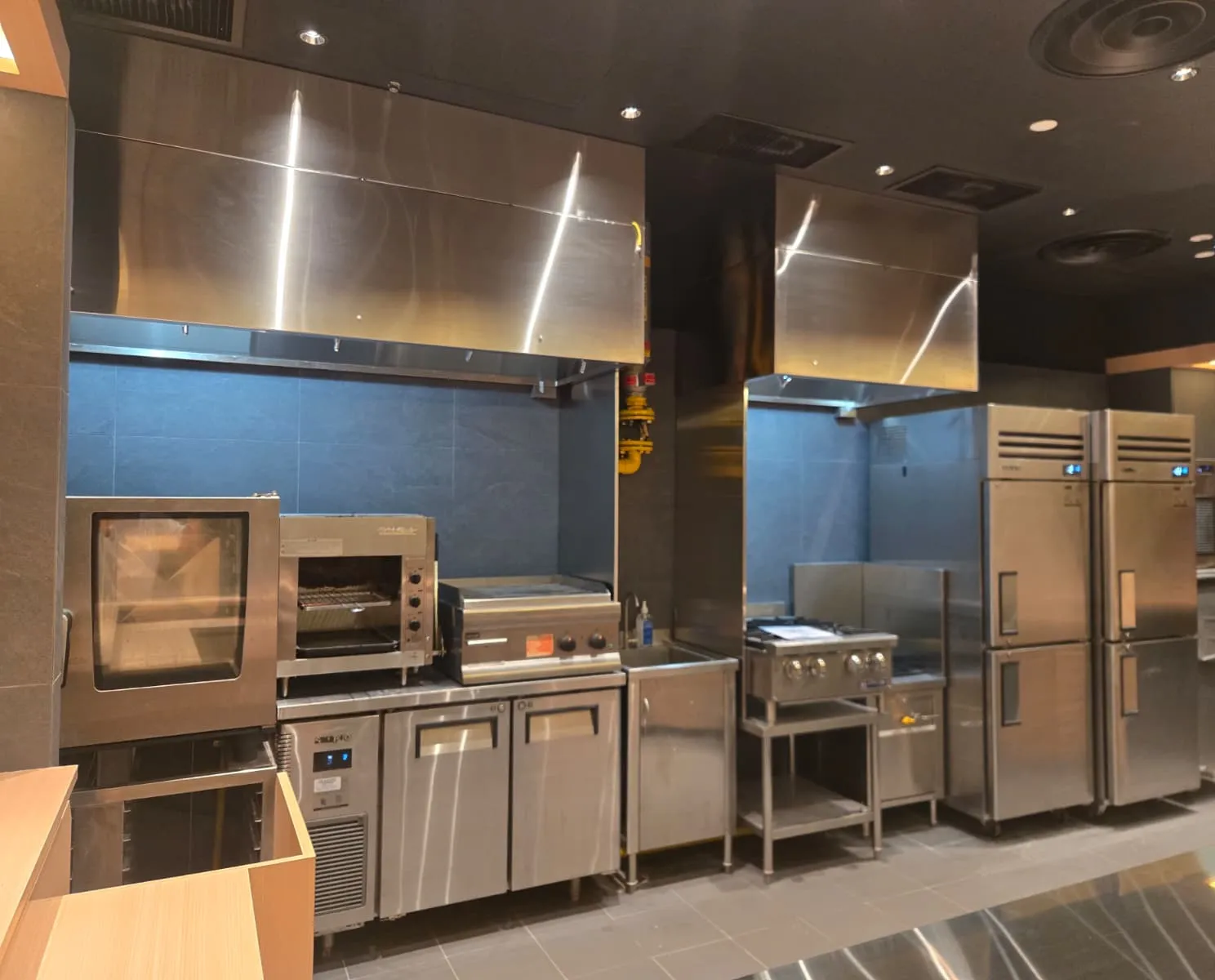
Pictured above: two new stainless hoods over the cooking line at an F&B outlet fit-out, from BC Air’s Live Jobs page. The baffle filters sit inside the canopies and cannot be seen from this angle. This is the stage at which the filter bank should already be settled, because once the hood is fabricated and hung, most of the decisions below are fixed.
Most people only think about baffle filters when one is dirty, bent or missing. By then the important choices have been made for them: how many filters the hood takes, how big and heavy each one is, what they are made of, which way they drain and where the grease goes. Those choices are made when the hood is drawn and fabricated, usually by people who will never wash a filter.
This post is for the owner, the operations person or the fit-out manager who is about to approve a new hood, or a rebuilt one, and wants the filter bank to work for the kitchen as well as on paper. It covers the six things worth settling before fabrication and the questions to ask whoever is drawing it. It gives no price: a hood is quoted after we have seen the layout and the cooking line.
A baffle filter bank is designed around the hood’s exhaust airflow, not just its length. The number and size of filters should follow the airflow figure from the hood sizing, so that each filter works in the range it was made for. After that, the practical points decide whether the bank keeps working: every filter the same size so any one fits any slot, a size and weight your crew can lift down and wash in the sink you actually have, a material that stands up to daily washing and your degreaser, a clear drain direction into a gutter and a grease cup that can be reached, and a spare set at handover. Settle these on the drawing, because changing them after fabrication means changing the hood.
A baffle filter is a frame of interlocking metal blades that make the air change direction sharply as it passes through. Grease droplets are heavier than the air carrying them, so they strike the blades, run down the channels and drain into the hood’s grease gutter. The same tight turns give flame no straight path through the bank. How the blades work, and why a baffle is not the same as a mesh panel, is covered in our baffle versus mesh comparison.
The exhaust airflow for a hood is worked out from the cooking line under it: which appliances, where they stand and how hard they cook. We explain that process in how we size a kitchen exhaust hood for your cooking line. The filter bank is then chosen so that the air passing through each filter is within the range that filter is made for.
Get that wrong in either direction and the filters stop doing their job:
So the question to ask is simple: what airflow is this hood designed for, and how was the number of filters chosen against it? If the answer is “we filled the length of the hood”, the bank has not really been designed. This matters even more on a hood built to capture at a lower exhaust volume, such as the energy-saving low-velocity hoods on our products page, because the filter bank has to match the lower airflow, not the airflow of a conventional hood of the same length.
Where the hood allows it, every filter in the bank should be the same size. It sounds like a small thing. In practice it means any filter fits any slot, a spare set is one size to order, and nobody has to remember which odd panel goes at the end. Odd-sized end filters are the ones that get lost, put back in the wrong place, or replaced with a cheaper panel that “nearly fits”, which is how gaps and mismatched banks start. If the hood length means one position has to differ, mark it on the drawing and on the filter itself.
Baffle filters are built to come out and be washed as routine, and in a busy Singapore kitchen that generally means nightly. Our own servicing checklist is clear that filters are taken out and chemically cleaned, never cleaned in place. That only happens if the filter can be lifted down safely and fits where it is going to be washed.
The filter is washed far more often than any other part of the system, usually with a strong degreaser. Stainless steel is what commercial kitchens commonly specify for that reason: it takes daily washing and alkaline degreasers without breaking down. Lighter metals are easier to handle but softer, so they dent and bend more easily, and some degreasers attack aluminium. Whatever the drawing says, ask two things: what the filters are made of, and whether the degreaser your crew or your cleaning contractor uses is suitable for that material. Our own BC Air Chemical Series is used as part of our cleaning and maintenance work, so on our own jobs we know what the filters will be washed with.
A baffle filter drains in one direction, so the bank is set at an angle that sends grease down the blades into a gutter along the bottom of the filters and then into a grease cup. On the drawing, check:
Behind the filters is the plenum, and in many commercial hoods that is also where the fire suppression pipework and nozzles sit. When the hood is drawn, check that every filter can come out and go back without knocking or bending suppression pipework, and that nobody has to reach past a nozzle to get a filter out. The suppression design has to cover the cooking line as it will actually stand. Our fire suppression systems page explains how we install it as part of the same project when you ask for it.
One set in the hood and one set washed and drying is what makes a nightly wash realistic. It also means a bent or lost filter does not leave the hood cooking with a hole in the bank while a replacement is made. If a spare set is not in the quotation, ask for it to be priced, and keep it with the handover documents. What else to ask for at handover is in new kitchen exhaust handover: the readings and documents to ask for. If you ever do need to replace one, what to measure and send for a damaged baffle filter shows how to order the right one.
We design and build kitchen exhaust systems in-house, and the hoods are fabricated in our own workshop, so the filter bank is decided by the same team that sizes the hood, the duct and the fan. Replacing consumables such as baffle filters is also part of our maintenance programmes. The design side is on our design and build page.
If you are about to approve a hood, or rebuild one, WhatsApp BC Air on 8989 2833 with the location, what will be cooked under the hood, its approximate length, whether it is a new fit-out or an existing kitchen, and when you need it ready. A kitchen layout or a photo of the existing hood helps. We are on 24/7 standby, and we quote after seeing the layout and the cooking line.
Related reading: baffle versus mesh hood filters · the light test for a washed baffle filter · how we size a hood for the cooking line · behind the baffle filters
We design, clean, repair and maintain commercial kitchen exhaust systems across Singapore — on 24/7 standby.