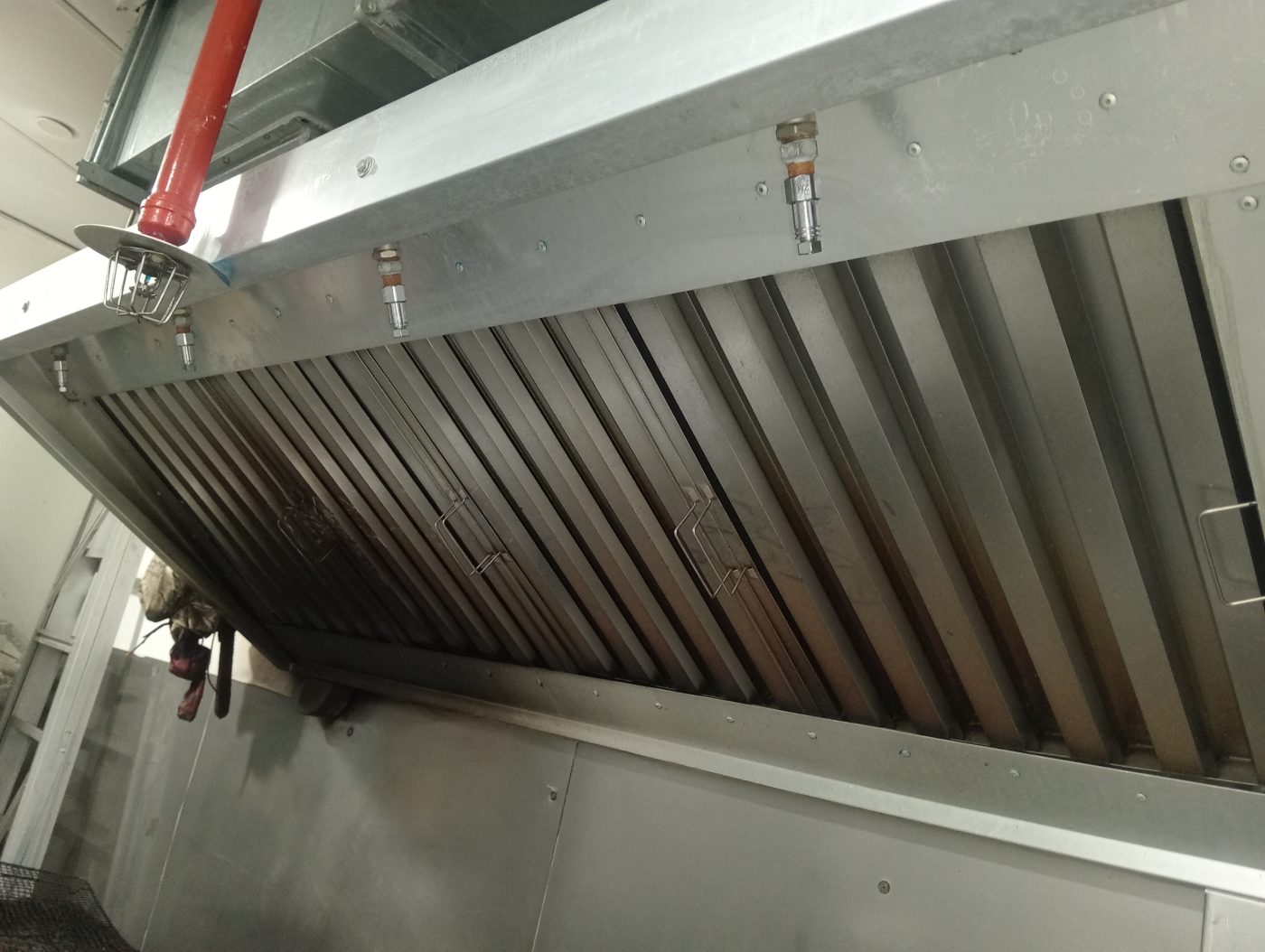
Pictured above: a hood on one of our projects (Stirling Steaks, Capitol), with its baffle filters, the suppression nozzles along the top edge and a sprinkler head beside them. All of it sits at ceiling-trade height, which is exactly why it gets bumped when the trades arrive.
The outlet is due for a refresh. New floor, a repainted back-of-house, perhaps a new ceiling over the dining area, and a tighter schedule than anyone would like. The interior contractor has a quote and a start date. The kitchen exhaust is not on the quote, because nobody thinks of it as part of the renovation. It is just there, humming over the cooking line.
That is the gap this post is about. A renovation does not have to touch the exhaust to damage it. Ladders, boards, grinders, paint and a lot of well-meant tidying all pass within arm’s reach of the hood, the duct, the fan and the controls. The damage is rarely dramatic. It is a filter that goes missing, a panel that gets boarded over, a grille that gets painted shut. You find out on the first busy night.
This is written for the owner or operator who is about to refurbish a kitchen that is trading, or will trade again soon, and wants to brief the other trades properly. If you are fitting out a bare unit, who owns the kitchen exhaust scope in a fit-out is the better starting point. If the outlet has already been shut for a long time, the checks for reopening after a long closure cover the restart. This post is the one before both: what to protect, and what to tell people, before the works begin.
Why the exhaust is exposed during works
A commercial kitchen exhaust system is several parts working as one: the hood and its filters, the duct, the fan, the make-up air, the controls. The first and last of those are close to where other trades work. The system is also hard to see as a whole. The hood is in the kitchen, the duct runs through the ceiling void, the fan may be on the roof or in a riser, and the make-up air may enter through a grille in a wall or ceiling that nobody has looked at for years.
That spread is the problem. The interior contractor sees the part in their room. The ceiling contractor sees the void. The painter sees a grille. Each of them is working correctly by their own scope, and none of them is looking at the system as one thing. The way it usually goes wrong is not carelessness. It is that nobody was told which parts are not ordinary building fabric.
What to protect, part by part
The hood and its filters
- The baffle filters stay in the hood or are stored properly. Filters taken out to give a ladder or a worker more room tend to end up leaning against a wall, stacked outside, or covered in dust. Ask for them to be left in place and covered, or to be removed, labelled and kept somewhere clean, and counted back in at the end. A filter that is bent, or missing, changes how the hood captures and how the grease is caught.
- Cover the hood opening against dust. Dust and tile slurry drawn into a hood become a coating on the filters and the plenum behind them. If the fan is going to be switched off for the works, the hood face can be covered, and a cover removed when the fan is back on.
- Nothing is hung, stored or leaned on the hood. Scaffold boards, cable ties, temporary lights and paint trays on top of a canopy are a fire load and a weight the hood was never designed to carry.
The suppression system
- Nozzles and their caps. The nozzles sit along the hood, aimed at the appliances below. A nozzle that is knocked, turned or covered in paint is a nozzle that may not do what it was commissioned to do. Tell every trade not to touch them, and point at them.
- Detection and links. The detection elements and their fittings are not fixings. They are not to be used as a handle, a hook or a support, and they are not to be painted.
- If the line is being changed. If the works move, add or swap cooking equipment, the suppression coverage has to be looked at again. Our post on adding cooking equipment to an existing hood sets out why. That is a job for whoever services the system, not for the contractor who is moving the equipment.
The duct and its access panels
- Keep every access panel reachable. A new ceiling is the commonest way for a perfectly good access door to be sealed in. Before the ceiling goes up, photograph or mark where the panels are on the drawing and make sure the ceiling design leaves a way to each one. The duct you cannot open is the duct that never gets cleaned explains what that costs later.
- The duct is not a support. No other service is hung from it, tied to it or rested on it, and no ceiling hanger is fixed to it. Likewise, no trade cuts, dents or drills it for convenience. A dented or punctured duct is a leak path for grease, and where a duct passes through a wall or a floor, how it is sealed there is a fire-safety detail. Do not let anyone disturb or re-seal one without the person who designed it.
- Insulation and enclosure stay as built. If lagging or an enclosure is taken off to move a ceiling grid, it goes back as it was. Anything touching a kitchen exhaust duct is a fire matter before it is a tidiness matter.
The fan and the controls
- Isolation is a decision, not a habit. If anyone needs the power off at the fan or the panel, ask who switches it off, who switches it back on, and where that is written down. A panel switched off at the board for the works and never switched back on is one of the oldest ways to reopen with no extraction. If the fan has a drive, a fault display or a start sequence, the person who restarts it should be someone who has been told how it behaves; what the fan does after a power dip is worth a look first.
- Keep the roof or riser access clear. If the fan is outdoors, ask the other trades to keep the route to it open and not to leave material around it.
- Interlocks. If the gas, the hood and the fan are tied together, a change to any of them can change how the others behave. The wiring nobody tests explains the logic. Testing it after the works is part of finishing the job.
The make-up air
- Grilles and openings are not paintable surfaces. A make-up air grille or opening that is painted, covered over or blocked by a new partition turns the kitchen negative, and the symptoms follow: doors that are hard to open, weaker capture at the hood, air dragged in from wherever it can come. The mechanism is set out in make-up air and air balancing.
- New partitions and doors change the air path. A wall that closes off the route air used to take, or a door that now shuts where it used to stand open, can change the balance without touching the exhaust at all. If the layout changes, tell the people who balance the system.
A one-page brief for the interior contractor
Most of this comes down to one sheet, handed over before works start and attached to the contractor’s method statement. Something like:
- Do not touch: the hood, its filters, the suppression nozzles and detection, the duct, its access panels, the fan, its controls and the make-up air grilles, except as listed here.
- Dust: the hood face is covered while dust-making work is going on, by whom, and who takes it off.
- Filters: left in place, or removed, labelled and stored where, with the count written down.
- Power: who may switch the fan off, who switches it on, and who checks it is running before anyone cooks.
- Ceiling: access panels marked on the plan and kept reachable.
- Changes to the layout: any new partition, door, or change to the cooking line goes to the exhaust contractor before it is built, not after.
- Handback: a walk-through with the exhaust contractor before the kitchen cooks again.
None of that costs the interior contractor much. It does cost a conversation, and that conversation is far cheaper before the ceiling is up than after.
Before the kitchen cooks again
When the works are finished, treat the exhaust as something that has been disturbed, even if nobody admits to touching it. The same list, in order of importance:
- Every baffle filter is back, seated edge to edge, undamaged and clean.
- The nozzles are where they were and the caps are on. Nothing is painted that should not be.
- Every access panel can still be opened.
- The fan starts, runs at the right sound and does not trip, and the controls and any display are normal.
- The make-up air is running and its grilles are clear.
- The doors behave normally, and the kitchen is not pulling smoke back out of the hood.
- Dust from the works is not sitting on the filters, in the plenum or around the fan. If it is, a clean before the first service is cheaper than a clean after it.
If the works changed anything on the cooking line, the exhaust and the suppression system need to be looked at against the new line, not against the old one. And if something is wrong on the first night, troubleshooting commercial kitchen ventilation works through the failing link before anyone replaces a part.
The short version
- A renovation can damage the kitchen exhaust without ever touching it on the quote.
- Tell every trade, in writing, that the hood, filters, nozzles, duct, access panels, fan, controls and make-up air grilles are not building fabric.
- Keep the filters accounted for, the hood face covered against dust, and every access panel reachable.
- Decide who switches the fan off and on, and write it down.
- Do not let anyone paint, block or cover a make-up air grille, or change the layout without telling the exhaust contractor.
- Walk the system with the exhaust contractor before the kitchen cooks again.
Planning a refurbishment and want the exhaust protected properly? WhatsApp BC Air on 8989 2833 with your location, what you cook and your works start date, and we will tell you what we would brief the other trades on. The overall system is described on the commercial kitchen ventilation system page; routine upkeep is on the maintenance page and a pre-reopening clean on the cleaning page. Scope and pricing follow an inspection.
Related reading: reopening after a long closure · duct access panels · who owns the exhaust scope in a fit-out
Questions
Common questions
Can I keep the kitchen exhaust running while the ceiling or floor is being renovated?
Only if the dust is dealt with. Dust drawn into a running hood coats the filters and the plenum behind them. If dust-making work is going on near the hood, ask for the hood face to be covered and agree who switches the fan off and on, and who checks it is running before anyone cooks.
Should the baffle filters be taken out during renovation?
Either leave them in place and covered, or remove them, label them, store them somewhere clean and count them back in at the end. Filters left leaning against a wall or stacked outside tend to go missing or get bent, which changes how the hood captures and catches grease.
Why is it a problem if the make-up air grille gets painted over?
A blocked or painted-over make-up air grille means the kitchen is extracting air it is not replacing. The kitchen goes negative: doors get hard to open, capture at the hood weakens and air is dragged in from wherever it can come.
Can other trades fix things to the kitchen exhaust duct?
No. Nothing should be hung from, tied to or rested on the duct, and nobody should cut, drill or dent it. Where a duct passes through a wall or floor, how it is sealed is a fire-safety detail that should only be disturbed by the person who designed it.
What should be checked before the kitchen cooks again after works?
Every baffle filter back and seated, suppression nozzles and caps in place, access panels still reachable, the fan starting and running normally, make-up air running with clear grilles, doors behaving normally, and no works dust left on the filters or around the fan. Walk it with the exhaust contractor.