More F&B units in Singapore are being fitted out with no gas at all. Sometimes the building has no gas supply to the unit, sometimes the landlord prefers electric, and sometimes the operator simply wants a cooler, cleaner kitchen and has seen what commercial induction can do. Somewhere in that conversation the same hope usually appears: if there are no burners, surely the exhaust can be smaller, the fire suppression can go, and maybe there is no need for a duct to the outside at all.
Some of that is true. Most of it is not, and the part that is not is where the money gets wasted. Here is what switching to induction or an all-electric cooking line genuinely changes in a commercial kitchen ventilation system, what it leaves exactly as it was, and what to settle before the equipment is ordered.
Where the grease actually comes from
Start with the one fact that decides most of this. The grease in a kitchen exhaust does not come from the flame. It comes from the food.
Oil in a fryer, fat rendering off meat on a griddle, a wok being tossed over high heat: each of these throws fine droplets of grease into the air above the pan. That aerosol rises into the hood, the baffle filters catch a large share of it, and the rest travels up the duct and settles on the walls, the fan and the discharge. None of that depends on whether the pan was heated by gas, by an electric element or by induction. An induction wok used the way a wok is meant to be used still puts grease into the air. An electric fryer is still a vat of hot oil.
So the grease side of the system stays: a hood that captures over the cooking line, baffle filters, a grease duct built and sealed for grease, a fan that can be opened and cleaned, and a cleaning interval set by what you cook. Our published guidance on how often a kitchen exhaust must be cleaned does not mention fuel at all: most commercial kitchens need cleaning every one to three months, heavy wok, grill and deep-frying kitchens often monthly, lighter kitchens quarterly. The menu sets that clock. The fuel does not.
What genuinely changes
There are real differences, and they are worth having.
- Less heat in the kitchen. A gas burner heats the air around the pan as well as the pan. Induction heats the pan itself, so far less of its energy spills into the room. The plume rising over an induction hob is gentler than the plume over a wok burner, the kitchen runs cooler, and the air-conditioning has less to fight.
- No combustion gases. Burners produce combustion products that the exhaust has to carry away with everything else. An all-electric line has none.
- A different shut-off. A kitchen hood suppression system is built so that when it discharges it also cuts the fuel: our fire suppression page describes activation shutting off gas and electrical supply to the cooking line. On an all-electric line there is no gas valve in that picture; the interlock is the electrical supply to the appliances. In our article on what drives the cost of a suppression system, the gas valve's position is the item that most often surprises people. On an electric line it becomes a question of isolating the electrical supply instead, which still has to be designed and wired, not assumed.
The lower heat load is the one that tempts people into a mistake. It can mean the extract rate needed to capture the plume is lower than a gas line of the same length would need. It does not mean you can simply pick a smaller hood or a smaller fan. Capture depends on the appliances, their positions under the canopy and the overhang, as we set out in how we size a kitchen exhaust hood to the cooking line, and a fryer or an induction wok still needs the hood to reach over it properly. Whether it allows a lower extract rate is established from the appliance schedule and confirmed by measurement at commissioning, not guessed.
What does not change
- The grease duct and the cleaning. Covered above, and it is the biggest one. An electric kitchen that fries, grills or stir-fries loads its duct the way any other kitchen doing the same cooking does.
- The fire-suppression question. Suppression follows the cooking, not the dining room and not the fuel. Hot oil is the hardest fire in a kitchen to put out and the easiest to re-ignite, and an electric fryer is full of the same hot oil as a gas one. Whether your kitchen needs hood suppression is assessed by SCDF based on your premises, cooking type and layout. Do not assume that going electric takes it off the list; put the question to whoever is designing the line before the budget is set.
- Steam. A stockpot, a steamer and a dishwasher produce the same steam whatever heats them. Steam and condensate still need extracting and still need somewhere to drain, which is the whole subject of steam extraction in the wash-up area.
- Odour and the discharge point. Cooking smell comes from the food. Where the duct discharges, and who is downwind of it, matters exactly as much as before.
- Make-up air. Whatever volume the exhaust removes still has to be replaced. A kitchen that extracts without a planned make-up air path ends up in negative pressure, with heavy doors and air pulled in from wherever it can come; see make-up air and air balancing.
- The landlord's rules. A no-gas unit in a mall is still a unit discharging grease-laden air, and the tenancy handbook's requirements on where and how it discharges still apply. Those are set out in kitchen exhaust in a mall F&B unit.
The "no duct needed" hood
Electric kitchens are often offered a recirculating hood: a unit that draws air in over the cooking, passes it through grease filters and further stages of filtration such as electrostatic cells or carbon, and blows it back into the same room instead of ducting it outside. The appeal is obvious when there is no route for a duct.
Be clear about what it does and does not do before designing around one.
- It does not remove heat or moisture. Everything the cooking puts into the air apart from what the filters catch comes back into the kitchen. The heat has to be taken out by the air-conditioning, and the steam stays in the room.
- It is only as good as its last filter change. Electrostatic cells lose collection efficiency as they fill with what they were installed to catch, and carbon stops adsorbing when it is spent. We explain how that decline happens in electrostatic precipitators in kitchen exhaust. In a ducted system a neglected filter sends grease up the duct; in a recirculating unit it sends it back into the kitchen, onto the ceiling and into the air your staff breathe.
- The heavier the cooking, the harder it works. A heavy grease load fills cells and carbon faster, and the kitchen then depends on a maintenance schedule being kept almost to the day.
- Acceptance is not automatic. Check with your landlord and the relevant authorities whether one is accepted for your unit and your menu before the kitchen layout is built around it.
For light cooking in a space with no duct route, it may be a legitimate conversation. As a way to avoid a grease duct over a line of fryers or woks, it is usually a false saving.
The photo
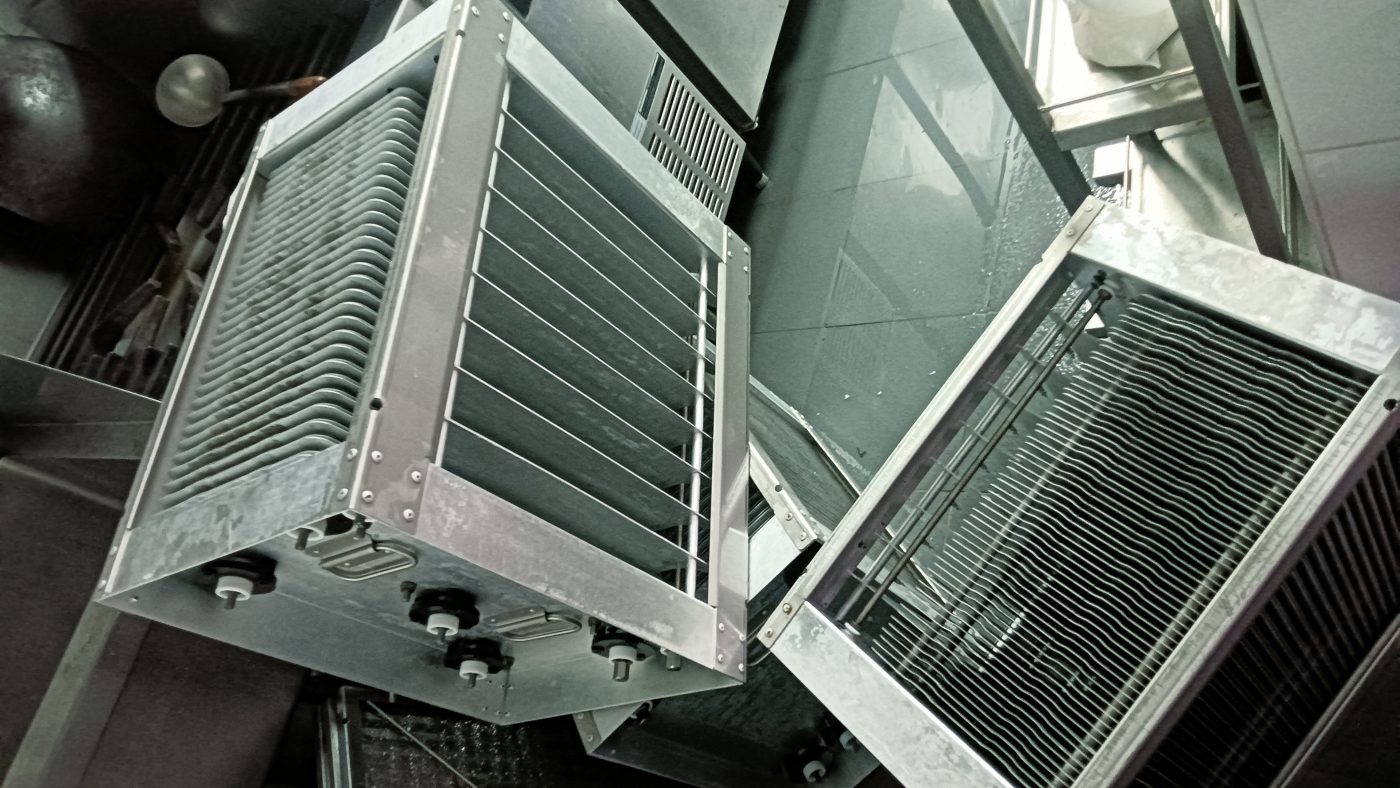
The picture is two electrostatic air-cleaner cells lifted out of their housing on one of our projects. Cells like these stand between a kitchen and a grease haze, in a ducted system or a recirculating one, and they work only if somebody takes them out and cleans them on schedule, whatever fuel the kitchen cooks with.
What to settle before the equipment is ordered
The cheapest time to get an electric kitchen's ventilation right is before anything is bought. The questions are short:
- The appliance schedule, with the cooking method against each item. Not just "induction hob x 4" but what is cooked on it. Frying, grilling and wok cooking are what load the duct.
- Is anything holding oil? Electric fryers, bratt pans and deep woks should be treated like their gas equivalents for grease and for fire.
- Has the hood been sized for the appliances and their positions, rather than cut down because the line is electric?
- Has the suppression question been asked, and if a system is fitted, how will the electrical isolation to the cooking line be interlocked?
- Is there a duct route and a discharge point that the landlord accepts? If not, what exactly is being proposed instead, and who will maintain it?
- Where does the make-up air come from?
- What is the cleaning interval, set against the menu rather than the fuel, and is the whole system in it, including hood, duct and fan?
- Can the unit's electrical supply carry the cooking line, the exhaust fan and any air treatment together? This is a fit-out question, but it is cheaper to ask now than after the switchboard is built.
Getting it designed properly
We design, fabricate, install, clean, repair and maintain commercial kitchen exhaust systems in-house: hood, ductwork, fan, make-up air, controls and air treatment. Our products include electrostatic air cleaners, ESP hoods, ducted UV-C and carbon banks, and we cover the hood fire suppression side too. The work is carried out to comply with NEA, SCDF and BCA requirements and bizSAFE standards, with 24/7 standby. We quote after seeing the layout and the cooking line, because an electric kitchen's system is sized to its menu like any other. The full picture of how the parts fit together is on our commercial kitchen ventilation systems page.
If you are planning an induction or all-electric kitchen, WhatsApp BC Air on 8989 2833 with your location, what you cook and whether it is a new fit-out, and send the appliance list if you have one.
The short version
- Grease comes from the food, not the flame. An electric kitchen that fries, grills or stir-fries still needs a proper hood, baffle filters, a grease duct and a cleaning interval set by the menu.
- Going electric genuinely lowers heat in the kitchen and removes combustion gases and the gas valve. Lower heat may allow a lower extract rate, but confirm it from the appliance schedule and by measurement, not by picking a smaller hood.
- Suppression follows the cooking: an electric fryer is still hot oil. Ask the question before the budget is set.
- A recirculating hood keeps the heat and steam in the room and depends entirely on its filters being serviced. It is not a substitute for a grease duct over a heavy line.
Questions
Common questions
If we switch to induction, do we still need a kitchen exhaust hood and duct?
If you fry, grill or stir-fry, yes. The grease in a kitchen exhaust comes from the food, not the flame, so an induction wok or an electric fryer still puts grease into the air. The hood, baffle filters, grease duct and fan stay, and so does a cleaning interval set by what you cook.
Does an all-electric kitchen need a smaller exhaust system?
It can need a lower extract rate, because induction puts far less heat into the room than a gas burner. But capture still depends on the appliances, their positions and the hood overhang, so the hood is sized to the appliance schedule and the airflow is confirmed by measurement at commissioning, not reduced on assumption.
Do electric kitchens still need a fire suppression system?
Do not assume going electric removes the question. Suppression follows the cooking, not the fuel, and an electric fryer is full of the same hot oil as a gas one. Whether a kitchen needs hood suppression is assessed by SCDF based on the premises, cooking type and layout. On an all-electric line the shut-off on discharge is the electrical supply to the appliances rather than a gas valve.
Can we use a recirculating (ductless) hood instead of ducting to the outside?
A recirculating hood filters the air and returns it to the same room, so heat and steam stay in the kitchen, and it only works as well as its last filter or cell clean. For light cooking where there is no duct route it may be worth discussing; check with your landlord and the relevant authorities whether one is accepted before designing around it. Over a line of fryers or woks it is usually a false saving.
How often does an electric kitchen exhaust need cleaning?
The same as any other kitchen doing the same cooking. Most commercial kitchens need cleaning every one to three months; heavy wok, grill and deep-frying kitchens often monthly, lighter kitchens quarterly. The interval is set after inspecting the system against the menu and cooking volume, not the fuel.