
13 Nov 2026 · Maintenance
A bird nest in a kitchen exhaust outlet or fan restricts the airflow and sits in a greasy airstream, so it is a kitchen problem, not only a bird problem. Do not block the opening, do not send staff onto the roof, and ask first about eggs or chicks. A sensible fix is to inspect, isolate the fan, clear the nest, clean the outlet, fan blades and housing, check the fan runs freely, then fix the gap that let the birds in, and keep dated photographs of the work.
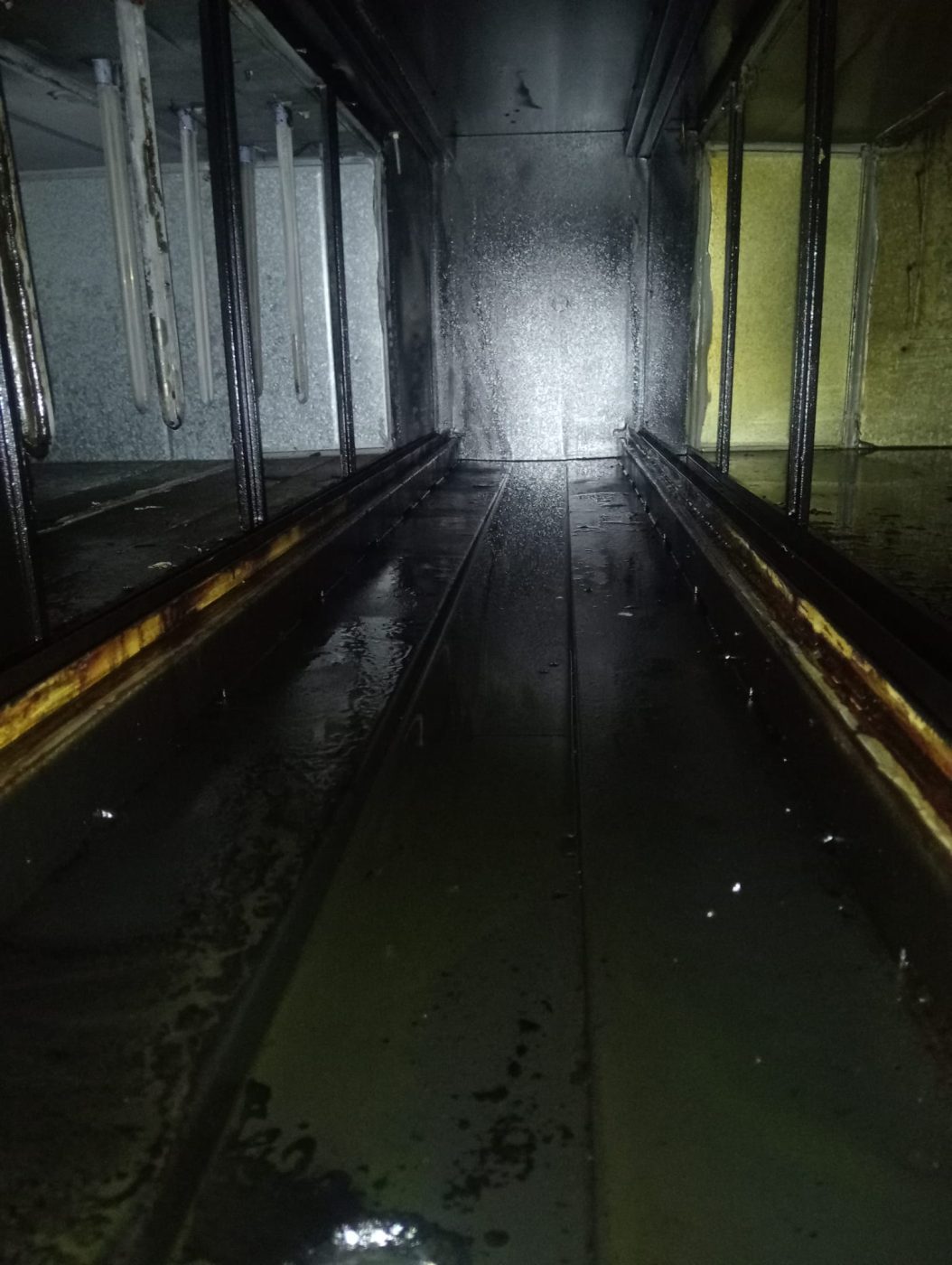
Pictured above: the inside of a kitchen exhaust duct section at one of BC Air’s cleaning and maintenance projects in Yishun, lit from one end, with grease along the edges and liquid grease on the floor. It is reused here because it shows the kind of enclosed, warm, greasy space that sits behind every exhaust outlet, and the part of the system nobody in the kitchen ever looks at.
Someone on the roof, or the building manager, or a neighbour in the next block, tells you that birds are going in and out of your kitchen exhaust outlet. Or the fan is noisy in a way it was not last month. Or the hood suddenly clears smoke badly and nothing in the kitchen has changed. A nest, or the material for one, is one of the less obvious causes, and it is the kind of problem that gets ignored because it looks like a bird problem rather than a kitchen problem.
It is a kitchen problem. This post is about why, what to do first, what not to do, and what a sensible fix looks like. It gives no prices: what it costs depends on the fan, the access and what is found, and we quote after an inspection.
Three things make it more than a nuisance.
It restricts the air. The fan was chosen to move a certain volume of air through the hood and duct. Anything packed into the discharge, the cowl, the mesh or around the fan housing adds resistance, and a fan that meets more resistance moves less air. The kitchen does not announce this. It shows up as smoke drifting out at the edges of the hood, heat building up on the cooking line, or a smell in the dining area. Our note on a kitchen exhaust that is running but still smoky lists the usual suspects, and a blocked discharge belongs on that list.
It is dry, loose, combustible material in a grease-laden airstream. Twigs, paper, plastic and feathers are not what a duct is designed to carry. Grease in the air condenses on whatever it meets near the outlet, and a nest becomes a sponge for it. We have written about how grease ends up on the roof around the fan; a nest at that point is fuel sitting in the same place. We are not saying a nest will start a fire by itself. We are saying it is something you would not choose to have at the one place where hot, greasy air leaves the building.
It can interfere with the fan itself. If material gets into the fan housing, it can foul the blades or the guard. A fan blade that is out of balance, or catching on something, is noisy and wears its bearings. That brings it into the same territory as noise and vibration complaints from neighbours, and it can end with a fan that trips or stops. If it has stopped, start with what to do when the kitchen exhaust fan stops working.
Most operators never see their own discharge. These are things you can check safely from the kitchen and the ground:
Send a photograph if you can get one from a safe position. A phone photo of the outlet tells us more than a description.
1. Inspect, then decide. The first job is to find out what is there and how far it goes: only the outlet, or inside the fan housing, or further down the duct. The answer sets the scope, which is why we quote after an inspection rather than over the phone.
2. Clear it, with the fan off and isolated. Anything near a fan that can start is dangerous. The fan is switched off and isolated before anyone works near it, and it stays that way until the work is done.
3. Clean what the nest was sitting in. A nest is usually soaked in grease by the time anyone sees it. Clearing the nest without cleaning the outlet, the fan blades and the housing leaves the grease behind. Our kitchen exhaust cleaning covers the hood, the filters, the accessible duct, the fan blades and housing and the make-up air grilles, documented with before-and-after photographs, and that is the right scope here too.
4. Check the fan after it is cleared. If something had been caught in the blades, check that it turns freely, that the sound is normal and that the airflow at the hood has come back. If a blade, guard or bearing is damaged, that is a repair, and our kitchen exhaust repair covers it. We repair equipment whoever installed it.
5. Stop it coming back. This is the part people skip. If birds got in once, they will try again, so look at why they could: a missing or damaged cowl or guard, a gap at the edge of the outlet, or a fan that sits idle each night and leaves a quiet, sheltered cavity. A guard that fits properly and is kept free of grease is the aim. We fabricate ductwork in-house, so a replacement guard or cowl can be made to fit, and the design should be agreed first so that it does not add resistance of its own. A mesh that is too fine will clog with grease quickly, which is why it should be checked at every clean.
We cannot give you a figure for how common this is, and we will not invent one. What we can say is how the situation tends to be set up. A fan that runs only during the day and sits idle overnight is a sheltered cavity for hours at a time. An outlet with an opening big enough to enter and no working guard is an invitation. A building where food waste is left out in the open attracts birds in the first place, and that is a conversation with building management rather than with your exhaust contractor.
If your outlet closes in the evening, keep the nest question in the same mind as the pest question. Our piece on kitchen exhaust pest harbourage covers what an inspector looks for.
Whatever is found, make sure it is written down: a dated photograph of the outlet before and after, a line saying what was removed and what was cleaned, and a note of anything repaired or replaced. That record is for you, your landlord and anyone who audits the premises, and it puts a date on when the problem was cleared. Keep it with the rest of your cleaning records; the exhaust logbook note says what is worth keeping.
WhatsApp BC Air on 8989 2833 with the location, what you can see or hear, who controls the roof access, and a photograph of the outlet if you can get one safely. We are on 24/7 standby, and scope and pricing follow an inspection.
Related reading: grease on the roof around the exhaust fan · where the duct terminates · pest harbourage in kitchen exhaust
We design, clean, repair and maintain commercial kitchen exhaust systems across Singapore — on 24/7 standby.